Thank you for visiting SNEWPapers!
Sign up free
Editorial
November 19, 1854
The Daily Union
Washington, District Of Columbia
What is this article about?
A Democratic editorial mocks the Boston Atlas and Whigs for supporting fusion tickets with Know-nothings and abolitionists, which backfired in the 1854 Massachusetts election defeat. It portrays Democrats as the republic's safeguard against anarchical factions.
Clipping
OCR Quality
98%
Excellent
Full Text
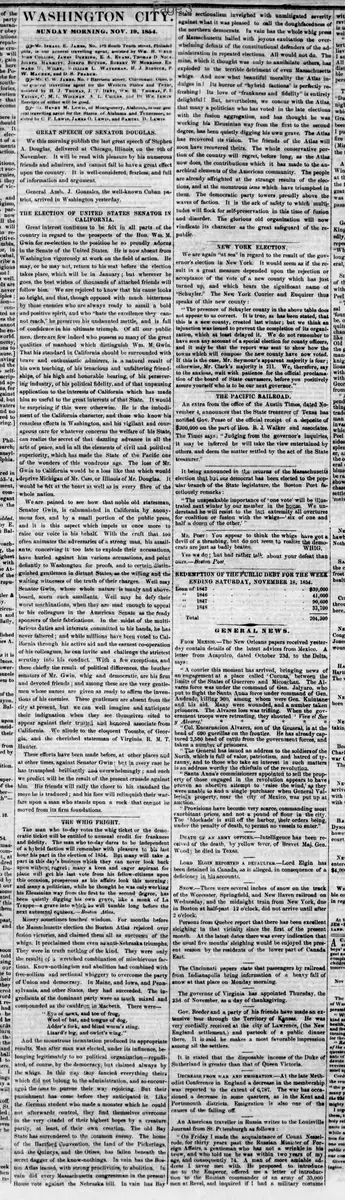
THE WHIG FRIGHT.
The man who to-day votes the whig ticket or the democratic ticket will be entitled to unusual credit for frankness and fidelity. The man who to-day dares to be independent of a hybrid faction will remember with pleasure to his last hour his part in the election of 1854. But many will take a part in this day's business which they can never look back upon without regret; many a keen and eager aspirant for place will get his last vote from his fellow-citizens upon this occasion, prosperous as his affairs look this morning; and many a politician, while he thought he was only working his Eleusinian way from the first to the second degree, has been quietly digging his own grave, like a monk of La Trappe—a grave into which he will tumble long before the next autumnal equinox.—Boston Atlas.
Misery sometimes teaches wisdom. For months before the Massachusetts election the Boston Atlas rejoiced over fusion victories, and claimed them all as successes of the whigs. It proclaimed them even as anti-Nebraska triumphs. They were in truth nothing of the kind. They were only the results of a wretched combination of mischievous factions. Know-nothingism and abolition had combined with free-soilism and sectional whiggery to overcome the party of Union and democracy. In Maine, and Iowa, and Pennsylvania, and other States, they had succeeded. The ingredients of the dominant party were as much mixed and compounded as the cauldron in Macbeth. There were— "Eye of newt, and toe of frog, Wool of bat, and tongue of dog, Adder's fork, and blind worm's sting. Lizard's leg, and owlet's wing." And the monstrous incantation produced its appropriate results. Man after man was elected, under its influence, belonging legitimately to no political organization—repudiated, of course, by the democracy, but claimed always by the whigs. In this way they fancied everything theirs which did not belong to the administration, and so encouraged the isms to pursue their way rejoicing. But their punishment has come before they anticipated it. Like the German student who made a monster which he could not afterwards control, they find themselves overcome in the very citadel of their highest hopes by a creature partly, at least, of their own creation. The old Bay State has surrendered to the common enemy. The home of the Hartford Convention, the land of the Pickerings, and the Quincys, and the Otises, has fallen beneath the secret dagger of the know-nothings. In vain has the Boston Atlas leaned, with strong proclivities, to abolition. In vain did every Massachusetts congressman in the present House vote against the Nebraska bill. In vain has Bay State sectionalism inveighed with unmitigated severity against what it was pleased to call the doughfacedness of the northern democrats. In vain has the whole whig press of Massachusetts hailed with joyous exultation the overwhelming defeats of the constitutional defenders of the administration in repeated elections. All would not do. The mine, which it thought was only to annihilate others, has exploded to the terrible detriment of even Massachusetts whigs. And now what beautiful morality the Atlas indulges in! Its horror of "hybrid factions" is perfectly refreshing! Its love of "frankness and fidelity" is entirely delightful! But, nevertheless, we concur with the Atlas, that many a politician who has voted in the late elections with the fusion aggregation, and has thought he was working his Eleusinian way from the first to the second degree, has been quietly digging his own grave. The Atlas has recovered its vision. The friends of the Atlas will soon have recovered theirs. The whole conservative portion of the country will regret, before long, as the Atlas now does, the contributions which it has made to the anarchical elements of the American community. The people are already affrighted at the strange results of the elections, and at the monstrous isms which have triumphed in them. The democratic party towers proudly above the waves of faction. It is the ark of safety to which multitudes will flock for self-preservation in this time of fusion and disorder. The glorious old organization will now vindicate its character as the great safeguard of the republic.
The man who to-day votes the whig ticket or the democratic ticket will be entitled to unusual credit for frankness and fidelity. The man who to-day dares to be independent of a hybrid faction will remember with pleasure to his last hour his part in the election of 1854. But many will take a part in this day's business which they can never look back upon without regret; many a keen and eager aspirant for place will get his last vote from his fellow-citizens upon this occasion, prosperous as his affairs look this morning; and many a politician, while he thought he was only working his Eleusinian way from the first to the second degree, has been quietly digging his own grave, like a monk of La Trappe—a grave into which he will tumble long before the next autumnal equinox.—Boston Atlas.
Misery sometimes teaches wisdom. For months before the Massachusetts election the Boston Atlas rejoiced over fusion victories, and claimed them all as successes of the whigs. It proclaimed them even as anti-Nebraska triumphs. They were in truth nothing of the kind. They were only the results of a wretched combination of mischievous factions. Know-nothingism and abolition had combined with free-soilism and sectional whiggery to overcome the party of Union and democracy. In Maine, and Iowa, and Pennsylvania, and other States, they had succeeded. The ingredients of the dominant party were as much mixed and compounded as the cauldron in Macbeth. There were— "Eye of newt, and toe of frog, Wool of bat, and tongue of dog, Adder's fork, and blind worm's sting. Lizard's leg, and owlet's wing." And the monstrous incantation produced its appropriate results. Man after man was elected, under its influence, belonging legitimately to no political organization—repudiated, of course, by the democracy, but claimed always by the whigs. In this way they fancied everything theirs which did not belong to the administration, and so encouraged the isms to pursue their way rejoicing. But their punishment has come before they anticipated it. Like the German student who made a monster which he could not afterwards control, they find themselves overcome in the very citadel of their highest hopes by a creature partly, at least, of their own creation. The old Bay State has surrendered to the common enemy. The home of the Hartford Convention, the land of the Pickerings, and the Quincys, and the Otises, has fallen beneath the secret dagger of the know-nothings. In vain has the Boston Atlas leaned, with strong proclivities, to abolition. In vain did every Massachusetts congressman in the present House vote against the Nebraska bill. In vain has Bay State sectionalism inveighed with unmitigated severity against what it was pleased to call the doughfacedness of the northern democrats. In vain has the whole whig press of Massachusetts hailed with joyous exultation the overwhelming defeats of the constitutional defenders of the administration in repeated elections. All would not do. The mine, which it thought was only to annihilate others, has exploded to the terrible detriment of even Massachusetts whigs. And now what beautiful morality the Atlas indulges in! Its horror of "hybrid factions" is perfectly refreshing! Its love of "frankness and fidelity" is entirely delightful! But, nevertheless, we concur with the Atlas, that many a politician who has voted in the late elections with the fusion aggregation, and has thought he was working his Eleusinian way from the first to the second degree, has been quietly digging his own grave. The Atlas has recovered its vision. The friends of the Atlas will soon have recovered theirs. The whole conservative portion of the country will regret, before long, as the Atlas now does, the contributions which it has made to the anarchical elements of the American community. The people are already affrighted at the strange results of the elections, and at the monstrous isms which have triumphed in them. The democratic party towers proudly above the waves of faction. It is the ark of safety to which multitudes will flock for self-preservation in this time of fusion and disorder. The glorious old organization will now vindicate its character as the great safeguard of the republic.
What sub-type of article is it?
Partisan Politics
Slavery Abolition
What keywords are associated?
Whig Fright
Fusion Tickets
Know Nothings
1854 Election
Massachusetts Politics
Nebraska Bill
Democratic Safeguard
What entities or persons were involved?
Boston Atlas
Whig Party
Democratic Party
Know Nothings
Abolitionists
Free Soilers
Massachusetts Congressmen
Hartford Convention
Pickerings
Quincys
Otis
Editorial Details
Primary Topic
Critique Of Whig Support For Fusion Movements In 1854 Elections
Stance / Tone
Pro Democratic, Anti Whig And Anti Fusion
Key Figures
Boston Atlas
Whig Party
Democratic Party
Know Nothings
Abolitionists
Free Soilers
Massachusetts Congressmen
Hartford Convention
Pickerings
Quincys
Otis
Key Arguments
Fusion Victories Were Not True Whig Successes But Results Of Mischievous Factions
Whigs Claimed Anti Nebraska Triumphs That Were Actually Combinations Of Know Nothingism, Abolition, And Free Soilism
Whig Encouragement Of Isms Led To Their Defeat In Massachusetts
Massachusetts Has Fallen To Know Nothings Despite Whig Leanings Toward Abolition And Opposition To Nebraska Bill
Democratic Party Is The Ark Of Safety Amid Fusion And Disorder