Thank you for visiting SNEWPapers!
Sign up free
Story
January 18, 1913
The Times Herald
Burns, Harney County, Oregon
What is this article about?
J.W. Babcock lectures that Christopher Columbus was not the first to discover America, citing pre-1492 maps showing Florida and Cuba, and Atlantic currents enabling earlier voyages by Portuguese, Italians, and Spaniards.
Clipping
OCR Quality
98%
Excellent
Full Text
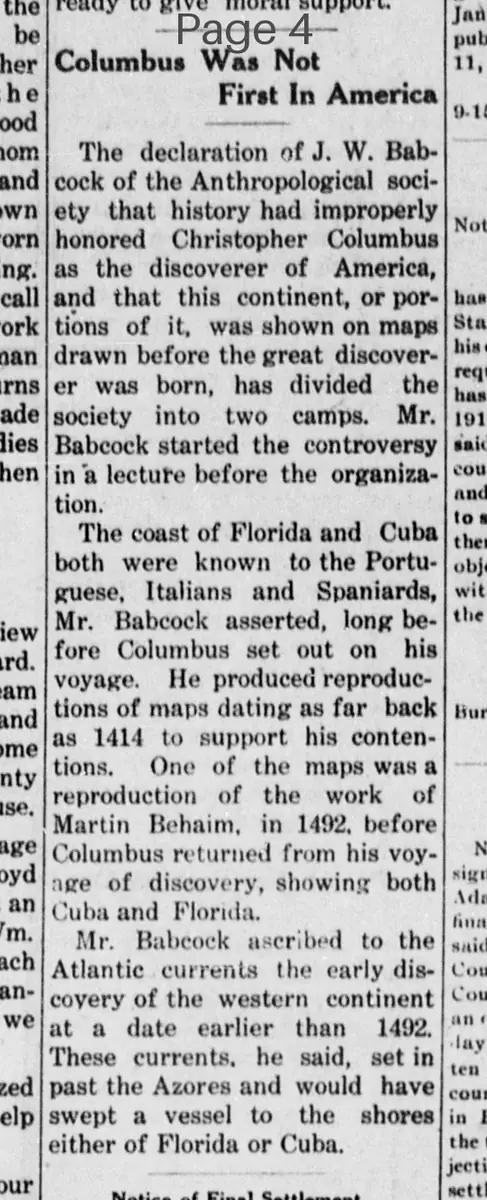
Columbus Was Not First In America
The declaration of J. W. Babcock of the Anthropological society that history had improperly honored Christopher Columbus as the discoverer of America, and that this continent, or portions of it, was shown on maps drawn before the great discoverer was born, has divided the society into two camps.
Mr. Babcock started the controversy in a lecture before the organization.
The coast of Florida and Cuba both were known to the Portuguese, Italians and Spaniards, Mr. Babcock asserted, long before Columbus set out on his voyage. He produced reproductions of maps dating as far back as 1414 to support his contentions. One of the maps was a reproduction of the work of Martin Behaim, in 1492, before Columbus returned from his voyage of discovery, showing both Cuba and Florida.
Mr. Babcock ascribed to the Atlantic currents the early discovery of the western continent at a date earlier than 1492. These currents, he said, set in past the Azores and would have swept a vessel to the shores either of Florida or Cuba.
The declaration of J. W. Babcock of the Anthropological society that history had improperly honored Christopher Columbus as the discoverer of America, and that this continent, or portions of it, was shown on maps drawn before the great discoverer was born, has divided the society into two camps.
Mr. Babcock started the controversy in a lecture before the organization.
The coast of Florida and Cuba both were known to the Portuguese, Italians and Spaniards, Mr. Babcock asserted, long before Columbus set out on his voyage. He produced reproductions of maps dating as far back as 1414 to support his contentions. One of the maps was a reproduction of the work of Martin Behaim, in 1492, before Columbus returned from his voyage of discovery, showing both Cuba and Florida.
Mr. Babcock ascribed to the Atlantic currents the early discovery of the western continent at a date earlier than 1492. These currents, he said, set in past the Azores and would have swept a vessel to the shores either of Florida or Cuba.
What sub-type of article is it?
Historical Event
Curiosity
What themes does it cover?
Exploration
What keywords are associated?
Columbus Discovery
Pre Columbian Maps
Atlantic Currents
Anthropological Society
Historical Controversy
What entities or persons were involved?
J. W. Babcock
Christopher Columbus
Martin Behaim
Where did it happen?
America, Florida, Cuba, Azores
Story Details
Key Persons
J. W. Babcock
Christopher Columbus
Martin Behaim
Location
America, Florida, Cuba, Azores
Event Date
Before 1492, 1414, 1492
Story Details
J.W. Babcock claims pre-Columbian knowledge of America via maps from 1414 and Martin Behaim's 1492 map showing Florida and Cuba, attributing early discovery to Atlantic currents sweeping vessels from the Azores.