Thank you for visiting SNEWPapers!
Sign up free
Story
January 29, 1831
Republican Herald
Providence, Providence County, Rhode Island
What is this article about?
Observations of storks and turtle-doves in Turkey, particularly Pergamus, highlighting their familiarity with Turks due to cultural reverence, nesting habits on Turkish structures, and avoidance of Christian areas, amid scenic ruins.
Clipping
OCR Quality
98%
Excellent
Full Text
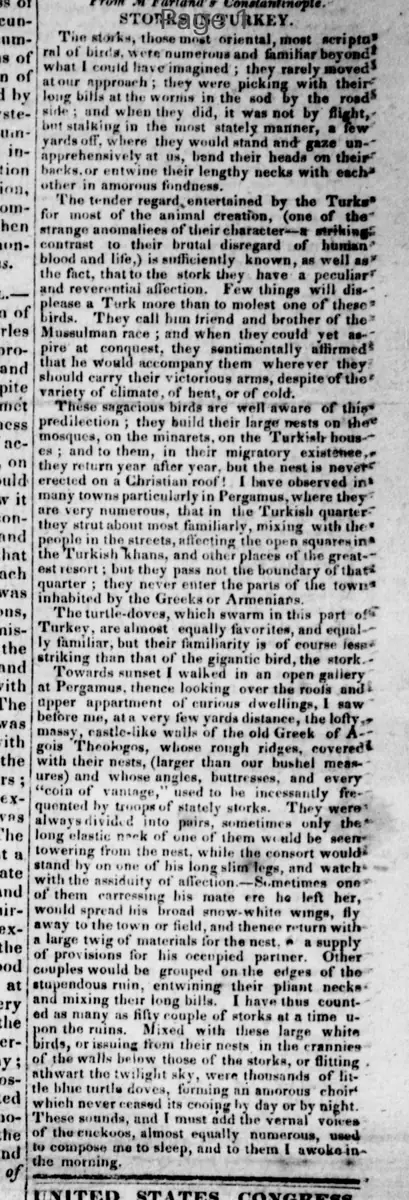
The storks, those most oriental, most scriptural of birds, were numerous and familiar beyond what I could have imagined; they rarely moved at our approach; they were picking with their long bills at the worms in the sod by the road side; and when they did, it was not by flight,— but stalking in the most stately manner, a few yards off, where they would stand and gaze unapprehensively at us, bend their heads on their backs, or entwine their lengthy necks with each other in amorous fondness.
The tender regard, entertained by the Turks for most of the animal creation, (one of the strange anomalies of their character striking contrast to their brutal disregard of human blood and life,) is sufficiently known, as well as the fact, that to the stork they have a peculiar and reverential affection. Few things will displease a Turk more than to molest one of these birds. They call him friend and brother of the Mussulman race; and when they could yet aspire at conquest, they sentimentally affirmed that he would accompany them wherever they should carry their victorious arms, despite of the variety of climate, of heat, or of cold.
These sagacious birds are well aware of this predilection; they build their large nests on the mosques, on the minarets, on the Turkish houses; and to them, in their migratory existence,— they return year after year, but the nest is never erected on a Christian roof! I have observed in many towns particularly in Pergamus, where they are very numerous, that in the Turkish quarter— they strut about most familiarly, mixing with the people in the streets, affecting the open squares in the Turkish khans, and other places of the greatest resort; but they pass not the boundary of that quarter; they never enter the parts of the towns inhabited by the Greeks or Armenians.
The turtle-doves, which swarm in this part of Turkey, are almost equally favorites, and equally familiar, but their familiarity is of course less striking than that of the gigantic bird, the stork.—
Towards sunset I walked in an open gallery at Pergamus, thence looking over the roofs and upper apartments of curious dwellings, I saw before me, at a very few yards distance, the lofty, massy, castle-like walls of the old Greek of Agios Theologos, whose rough ridges, covered with their nests, (larger than our bushel measures) and whose angles, buttresses, and every "coin of vantage," used to be incessantly frequented by troops of stately storks. They were always divided into pairs, sometimes only the long elastic neck of one of them would be seen towering from the nest, while the consort would stand by on one of his long slim legs, and watch with the assiduity of affection.—Sometimes one of them caressing his mate ere he left her, would spread his broad snow-white wings, fly away to the town or field, and thence return with a large twig of materials for the nest, or a supply of provisions for his occupied partner. Other couples would be grouped on the edges of the stupendous ruin, entwining their pliant necks and mixing their long bills. I have thus counted as many as fifty couple of storks at a time upon the ruins. Mixed with these large white birds, or issuing from their nests in the crannies of the walls below those of the storks, or flitting athwart the twilight sky, were thousands of little blue turtle doves, forming an amorous choir which never ceased its cooing by day or by night.
These sounds, and I must add the vernal voices of the cuckoos, almost equally numerous, used to compose me to sleep, and to them I awoke in the morning.
The tender regard, entertained by the Turks for most of the animal creation, (one of the strange anomalies of their character striking contrast to their brutal disregard of human blood and life,) is sufficiently known, as well as the fact, that to the stork they have a peculiar and reverential affection. Few things will displease a Turk more than to molest one of these birds. They call him friend and brother of the Mussulman race; and when they could yet aspire at conquest, they sentimentally affirmed that he would accompany them wherever they should carry their victorious arms, despite of the variety of climate, of heat, or of cold.
These sagacious birds are well aware of this predilection; they build their large nests on the mosques, on the minarets, on the Turkish houses; and to them, in their migratory existence,— they return year after year, but the nest is never erected on a Christian roof! I have observed in many towns particularly in Pergamus, where they are very numerous, that in the Turkish quarter— they strut about most familiarly, mixing with the people in the streets, affecting the open squares in the Turkish khans, and other places of the greatest resort; but they pass not the boundary of that quarter; they never enter the parts of the towns inhabited by the Greeks or Armenians.
The turtle-doves, which swarm in this part of Turkey, are almost equally favorites, and equally familiar, but their familiarity is of course less striking than that of the gigantic bird, the stork.—
Towards sunset I walked in an open gallery at Pergamus, thence looking over the roofs and upper apartments of curious dwellings, I saw before me, at a very few yards distance, the lofty, massy, castle-like walls of the old Greek of Agios Theologos, whose rough ridges, covered with their nests, (larger than our bushel measures) and whose angles, buttresses, and every "coin of vantage," used to be incessantly frequented by troops of stately storks. They were always divided into pairs, sometimes only the long elastic neck of one of them would be seen towering from the nest, while the consort would stand by on one of his long slim legs, and watch with the assiduity of affection.—Sometimes one of them caressing his mate ere he left her, would spread his broad snow-white wings, fly away to the town or field, and thence return with a large twig of materials for the nest, or a supply of provisions for his occupied partner. Other couples would be grouped on the edges of the stupendous ruin, entwining their pliant necks and mixing their long bills. I have thus counted as many as fifty couple of storks at a time upon the ruins. Mixed with these large white birds, or issuing from their nests in the crannies of the walls below those of the storks, or flitting athwart the twilight sky, were thousands of little blue turtle doves, forming an amorous choir which never ceased its cooing by day or by night.
These sounds, and I must add the vernal voices of the cuckoos, almost equally numerous, used to compose me to sleep, and to them I awoke in the morning.
What sub-type of article is it?
Curiosity
Animal Story
Journey
What themes does it cover?
Nature
Social Manners
What keywords are associated?
Storks
Turkey Birds
Turkish Culture
Pergamus Ruins
Turtle Doves
Animal Reverence
Migratory Birds
Where did it happen?
Pergamus, Turkey
Story Details
Location
Pergamus, Turkey
Story Details
The narrator describes the abundance and familiarity of storks in Turkish areas, their cultural significance to Turks, nesting preferences on Muslim structures, avoidance of Christian quarters, and interactions with mates on ancient ruins, alongside turtle-doves and cuckoos.