Thank you for visiting SNEWPapers!
Sign up free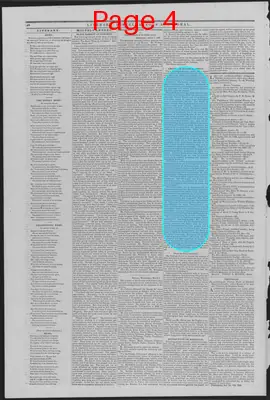
Editorial
March 19, 1836
The Liberator
Boston, Suffolk County, Massachusetts
What is this article about?
This editorial from the Great Falls Journal argues that Northerners have the right to advocate for abolishing slavery in the District of Columbia, criticizes Southern use of secession threats to intimidate the North, and asserts economic independence, urging resistance to such pressures while valuing the Union.
Clipping
OCR Quality
88%
Good
Full Text
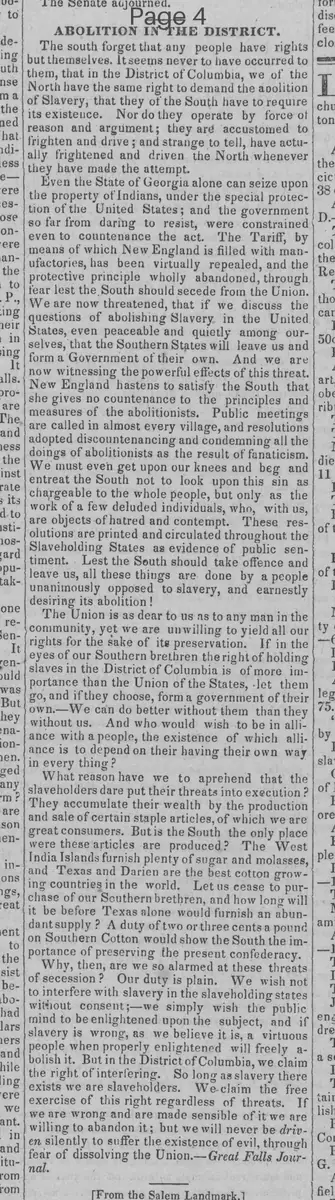
ABOLITION IN THE DISTRICT.
The south forget that any people have rights but themselves. It seems never to have occurred to them, that in the District of Columbia. we of the North have the same right to demand the abolition of Slavery, that they of the South have to require its existence. Nor do they operate by force of reason and argument; they are accustomed to frighten and drive; and strange to tell, have actually frightened and driven the North whenever they have made the attempt.
Even the State of Georgia alone can seize upon the property of Indians, under the special protection of the United States; and the government so far from daring to resist, were constrained even to countenance the act. The Tariff, by means of which New England is filled with manufactories, has been virtually repealed, and the protective principle wholly abandoned, through fear lest the South should secede from the Union.
We are now threatened, that if we discuss the questions of abolishing Slavery in the United States, even peaceable and quietly among ourselves, that the Southern States will leave us and form a Government of their own. And we are now witnessing the powerful effects of this threat. New England hastens to satisfy the South that she gives no countenance to the principles and measures of the abolitionists. Public meetings are called in almost every village, and resolutions adopted discountenancing and condemning all the doings of abolitionists as the result of fanaticism.
We must even get upon our knees and beg and entreat the South not to look upon this sin as chargeable to the whole people, but only as the work of a few deluded individuals, who, with us, are objects of hatred and contempt. These resolutions are printed and circulated throughout the Slaveholding States as evidence of public sentiment. Lest the South should take offence and leave us, all these things are done by a people unanimously opposed to slavery, and earnestly desiring its abolition!
The Union is as dear to us as to any man in the community, yet we are unwilling to yield all our rights for the sake of its preservation. If in the eyes of our Southern brethren the right of holding slaves in the District of Columbia is of more importance than the Union of the States, let them go, and if they choose, form a government of their own.—We can do better without them than they without us. And who would wish to be in alliance with a people, the existence of which alliance is to depend on their having their own way in every thing?
What reason have we to apprehend that the slaveholders dare put their threats into execution? They accumulate their wealth by the production and sale of certain staple articles, of which we are great consumers. But is the South the only place where these articles are produced? The West India Islands furnish plenty of sugar and molasses. and Texas and Darien are the best cotton growing countries in the world. Let us cease to purchase of our Southern brethren, and how long will it be before Texas alone would furnish an abundant supply ? A duty of two or three cents a pound on Southern Cotton would show the South the importance of preserving the present confederacy.
Why. then, are we so alarmed at these threats of secession? Our duty is plain. We wish not to interfere with slavery in the slaveholding states without consent;—we simply wish the public mind to be enlightened upon the subject, and if slavery is wrong, as we believe it is, a virtuous people when properly enlightened will freely abolish it. But in the District of Columbia, we claim the right of interfering. So long as slavery there exists we are slaveholders. We claim the free exercise of this right regardless of threats. If we are wrong and are made sensible of it we are willing to abandon it; but we will never be driven silently to suffer the existence of evil, through fear of dissolving the Union.—Great Falls Journal.
The south forget that any people have rights but themselves. It seems never to have occurred to them, that in the District of Columbia. we of the North have the same right to demand the abolition of Slavery, that they of the South have to require its existence. Nor do they operate by force of reason and argument; they are accustomed to frighten and drive; and strange to tell, have actually frightened and driven the North whenever they have made the attempt.
Even the State of Georgia alone can seize upon the property of Indians, under the special protection of the United States; and the government so far from daring to resist, were constrained even to countenance the act. The Tariff, by means of which New England is filled with manufactories, has been virtually repealed, and the protective principle wholly abandoned, through fear lest the South should secede from the Union.
We are now threatened, that if we discuss the questions of abolishing Slavery in the United States, even peaceable and quietly among ourselves, that the Southern States will leave us and form a Government of their own. And we are now witnessing the powerful effects of this threat. New England hastens to satisfy the South that she gives no countenance to the principles and measures of the abolitionists. Public meetings are called in almost every village, and resolutions adopted discountenancing and condemning all the doings of abolitionists as the result of fanaticism.
We must even get upon our knees and beg and entreat the South not to look upon this sin as chargeable to the whole people, but only as the work of a few deluded individuals, who, with us, are objects of hatred and contempt. These resolutions are printed and circulated throughout the Slaveholding States as evidence of public sentiment. Lest the South should take offence and leave us, all these things are done by a people unanimously opposed to slavery, and earnestly desiring its abolition!
The Union is as dear to us as to any man in the community, yet we are unwilling to yield all our rights for the sake of its preservation. If in the eyes of our Southern brethren the right of holding slaves in the District of Columbia is of more importance than the Union of the States, let them go, and if they choose, form a government of their own.—We can do better without them than they without us. And who would wish to be in alliance with a people, the existence of which alliance is to depend on their having their own way in every thing?
What reason have we to apprehend that the slaveholders dare put their threats into execution? They accumulate their wealth by the production and sale of certain staple articles, of which we are great consumers. But is the South the only place where these articles are produced? The West India Islands furnish plenty of sugar and molasses. and Texas and Darien are the best cotton growing countries in the world. Let us cease to purchase of our Southern brethren, and how long will it be before Texas alone would furnish an abundant supply ? A duty of two or three cents a pound on Southern Cotton would show the South the importance of preserving the present confederacy.
Why. then, are we so alarmed at these threats of secession? Our duty is plain. We wish not to interfere with slavery in the slaveholding states without consent;—we simply wish the public mind to be enlightened upon the subject, and if slavery is wrong, as we believe it is, a virtuous people when properly enlightened will freely abolish it. But in the District of Columbia, we claim the right of interfering. So long as slavery there exists we are slaveholders. We claim the free exercise of this right regardless of threats. If we are wrong and are made sensible of it we are willing to abandon it; but we will never be driven silently to suffer the existence of evil, through fear of dissolving the Union.—Great Falls Journal.
What sub-type of article is it?
Slavery Abolition
Constitutional
Partisan Politics
What keywords are associated?
Slavery Abolition
District Of Columbia
Southern Threats
Secession
Northern Rights
Economic Dependence
Public Enlightenment
Union Preservation
What entities or persons were involved?
Southern States
Northern People
District Of Columbia
Abolitionists
Georgia
New England
United States
West India Islands
Texas
Darien
Editorial Details
Primary Topic
Advocacy For Abolishing Slavery In The District Of Columbia Despite Southern Threats
Stance / Tone
Defiant Pro Abolition And Anti Secession Intimidation
Key Figures
Southern States
Northern People
District Of Columbia
Abolitionists
Georgia
New England
United States
West India Islands
Texas
Darien
Key Arguments
Northerners Have Equal Right To Demand Abolition Of Slavery In The District Of Columbia
Southerners Use Threats And Intimidation To Suppress Northern Opposition To Slavery
Examples Include Georgia Seizing Indian Property And Repeal Of Protective Tariff Due To Secession Fears
Southern Threats Of Secession Silence Abolition Discussions In The North
Public Meetings In New England Condemn Abolitionists To Appease The South
Union Preservation Should Not Require Yielding Northern Rights
Southern Economy Depends On Northern Consumption; Alternatives Exist For Cotton And Sugar
Northerners Should Enlighten Public On Slavery's Wrongs And Claim Right To Interfere In Dc
Willing To Abandon Position If Proven Wrong But Not Through Fear Of Disunion