Thank you for visiting SNEWPapers!
Sign up free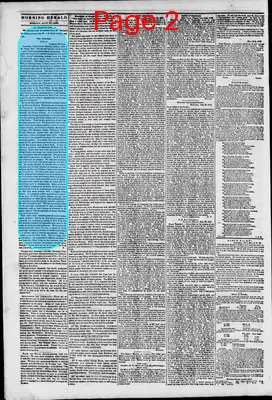
Literary
July 23, 1838
Morning Herald
New York, New York County, New York
What is this article about?
Mr. Bennett's journal entry from London on June 9th describes a delightful walk in St. James' Park, its natural beauty amid urban noise, and repeated visits to the free National Gallery, awakening his passion for old masters' paintings. He questions art's moral impact and contrasts London's fragmentation with New York's unified spirit.
Clipping
OCR Quality
98%
Excellent
Full Text
Mr. Bennett's Letters.
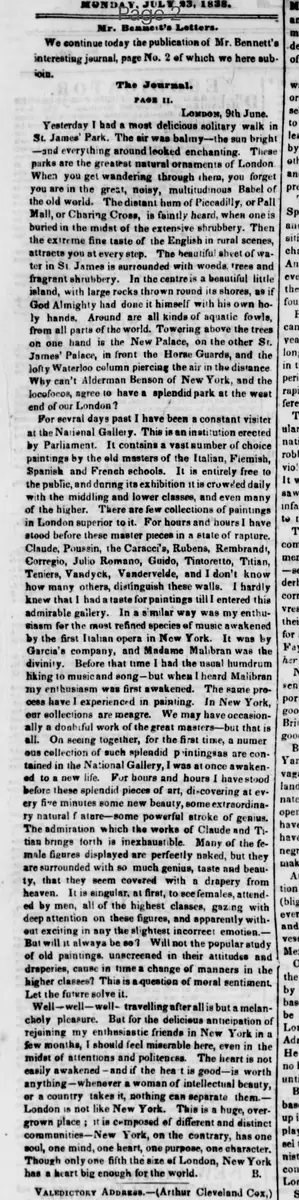
We continue today the publication of Mr. Bennett's interesting journal, page No. 2 of which we here subjoin.
The Journal.
PAGE II.
London, 9th June.
Yesterday I had a most delicious solitary walk in St. James' Park. The air was balmy—the sun bright—and everything around looked enchanting. These parks are the greatest natural ornaments of London. When you get wandering through them, you forget you are in the great, noisy, multitudinous Babel of the old world. The distant hum of Piccadilly, or Pall Mall, or Charing Cross, is faintly heard, when one is buried in the midst of the extensive shrubbery. Then the extreme fine taste of the English in rural scenes, attracts you at every step. The beautiful sheet of water in St. James is surrounded with woods, trees and fragrant shrubbery. In the centre is a beautiful little island, with large rocks thrown round its shores, as if God Almighty had done it himself with his own holy hands. Around are all kinds of aquatic fowls, from all parts of the world. Towering above the trees on one hand is the New Palace, on the other St. James' Palace, in front the Horse Guards, and the lofty Waterloo column piercing the air in the distance. Why can't Alderman Benson of New York, and the Locofocos, agree to have a splendid park at the west end of our London?
For several days past I have been a constant visitor at the National Gallery. This is an institution erected by Parliament. It contains a vast number of choice paintings by the old masters of the Italian, Flemish, Spanish and French schools. It is entirely free to the public, and during its exhibition it is crowded daily with the middling and lower classes, and even many of the higher. There are few collections of paintings in London superior to it. For hours and hours I have stood before these master pieces in a state of rapture. Claude, Poussin, the Caracci's, Rubens, Rembrandt, Correggio, Julio Romano, Guido, Tintoretto, Titian, Teniers, Vandyck, Vandervelde, and I don't know how many others, distinguish these walls. I hardly knew that I had a taste for paintings till I entered this admirable gallery. In a similar way was my enthusiasm for the most refined species of music awakened by the first Italian opera in New York. It was by Garcia's company, and Madame Malibran was the divinity. Before that time I had the usual humdrum liking to music and song—but when I heard Malibran my enthusiasm was first awakened. The same process have I experienced in painting. In New York, our collections are meagre. We may have occasionally a doubtful work of the great masters—but that is all. On seeing together, for the first time, a numerous collection of such splendid paintings as are contained in the National Gallery, I was at once awakened to a new life. For hours and hours I have stood before these splendid pieces of art, discovering at every five minutes some new beauty, some extraordinary natural feature—some powerful stroke of genius. The admiration which the works of Claude and Titian brings forth is inexhaustible. Many of the female figures displayed are perfectly naked, but they are surrounded with so much genius, taste and beauty, that they seem covered with a drapery from heaven. It is singular, at first, to see females, attended by men, all of the highest classes, gazing with deep attention on these figures, and apparently without exciting in any the slightest incorrect emotion. But will it always be so? Will not the popular study of old paintings, unscrcened in their attitudes and draperies, cause in time a change of manners in the higher classes? This is a question of moral sentiment. Let the future solve it.
Well—well—well—travelling after all is but a melancholy pleasure. But for the delicious anticipation of rejoining my enthusiastic friends in New York in a few months, I should feel miserable here, even in the midst of attentions and politeness. The heart is not easily awakened—and if the heart is good—is worth anything—whenever a woman of intellectual beauty, or a country takes it, nothing can separate them. London is not like New York. This is a huge, overgrown place; it is composed of different and distinct communities—New York, on the contrary, has one soul, one mind, one heart, one purpose, one character. Though only one fifth the size of London, New York has a heart big enough for the world.
B.
We continue today the publication of Mr. Bennett's interesting journal, page No. 2 of which we here subjoin.
The Journal.
PAGE II.
London, 9th June.
Yesterday I had a most delicious solitary walk in St. James' Park. The air was balmy—the sun bright—and everything around looked enchanting. These parks are the greatest natural ornaments of London. When you get wandering through them, you forget you are in the great, noisy, multitudinous Babel of the old world. The distant hum of Piccadilly, or Pall Mall, or Charing Cross, is faintly heard, when one is buried in the midst of the extensive shrubbery. Then the extreme fine taste of the English in rural scenes, attracts you at every step. The beautiful sheet of water in St. James is surrounded with woods, trees and fragrant shrubbery. In the centre is a beautiful little island, with large rocks thrown round its shores, as if God Almighty had done it himself with his own holy hands. Around are all kinds of aquatic fowls, from all parts of the world. Towering above the trees on one hand is the New Palace, on the other St. James' Palace, in front the Horse Guards, and the lofty Waterloo column piercing the air in the distance. Why can't Alderman Benson of New York, and the Locofocos, agree to have a splendid park at the west end of our London?
For several days past I have been a constant visitor at the National Gallery. This is an institution erected by Parliament. It contains a vast number of choice paintings by the old masters of the Italian, Flemish, Spanish and French schools. It is entirely free to the public, and during its exhibition it is crowded daily with the middling and lower classes, and even many of the higher. There are few collections of paintings in London superior to it. For hours and hours I have stood before these master pieces in a state of rapture. Claude, Poussin, the Caracci's, Rubens, Rembrandt, Correggio, Julio Romano, Guido, Tintoretto, Titian, Teniers, Vandyck, Vandervelde, and I don't know how many others, distinguish these walls. I hardly knew that I had a taste for paintings till I entered this admirable gallery. In a similar way was my enthusiasm for the most refined species of music awakened by the first Italian opera in New York. It was by Garcia's company, and Madame Malibran was the divinity. Before that time I had the usual humdrum liking to music and song—but when I heard Malibran my enthusiasm was first awakened. The same process have I experienced in painting. In New York, our collections are meagre. We may have occasionally a doubtful work of the great masters—but that is all. On seeing together, for the first time, a numerous collection of such splendid paintings as are contained in the National Gallery, I was at once awakened to a new life. For hours and hours I have stood before these splendid pieces of art, discovering at every five minutes some new beauty, some extraordinary natural feature—some powerful stroke of genius. The admiration which the works of Claude and Titian brings forth is inexhaustible. Many of the female figures displayed are perfectly naked, but they are surrounded with so much genius, taste and beauty, that they seem covered with a drapery from heaven. It is singular, at first, to see females, attended by men, all of the highest classes, gazing with deep attention on these figures, and apparently without exciting in any the slightest incorrect emotion. But will it always be so? Will not the popular study of old paintings, unscrcened in their attitudes and draperies, cause in time a change of manners in the higher classes? This is a question of moral sentiment. Let the future solve it.
Well—well—well—travelling after all is but a melancholy pleasure. But for the delicious anticipation of rejoining my enthusiastic friends in New York in a few months, I should feel miserable here, even in the midst of attentions and politeness. The heart is not easily awakened—and if the heart is good—is worth anything—whenever a woman of intellectual beauty, or a country takes it, nothing can separate them. London is not like New York. This is a huge, overgrown place; it is composed of different and distinct communities—New York, on the contrary, has one soul, one mind, one heart, one purpose, one character. Though only one fifth the size of London, New York has a heart big enough for the world.
B.
What sub-type of article is it?
Essay
Journey Narrative
What themes does it cover?
Nature
Patriotism
Social Manners
What keywords are associated?
St James Park
National Gallery
London Observations
Art Appreciation
New York Praise
What entities or persons were involved?
B.
Literary Details
Title
Page Ii.
Author
B.
Subject
Journal Entry From London On Parks And Art
Key Lines
These Parks Are The Greatest Natural Ornaments Of London. When You Get Wandering Through Them, You Forget You Are In The Great, Noisy, Multitudinous Babel Of The Old World.
For Hours And Hours I Have Stood Before These Master Pieces In A State Of Rapture.
New York, On The Contrary, Has One Soul, One Mind, One Heart, One Purpose, One Character. Though Only One Fifth The Size Of London, New York Has A Heart Big Enough For The World.