Thank you for visiting SNEWPapers!
Sign up free
Editorial
August 4, 1802
Alexandria Advertiser And Commercial Intelligencer
Alexandria, Virginia
What is this article about?
The New York Evening Post continues its review of a pamphlet by the author of the 'Narrative' criticizing Aaron Burr's conduct in the 1800 presidential election tie with Jefferson. It details accusations of deceitful letters, negotiations with Federalists to secure the presidency, and personal attacks, while noting copyright concerns from publishers.
Clipping
OCR Quality
95%
Excellent
Full Text
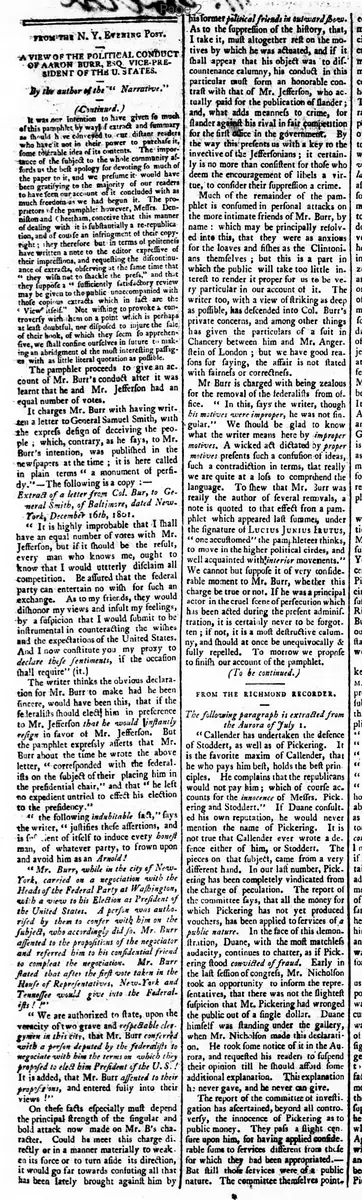
From the N. Y. Evening Post.
A VIEW OF THE POLITICAL CONDUCT
OF AARON BURR, ESQ. VICE-PRESIDENT
OF THE U. STATES.
By the author of the "Narrative."
(Continued.)
It was our intention to have given so much of this pamphlet by way of extract and summary as should have conveyed to our distant readers some tolerable idea of its contents. The importance of the subject to the whole community affords us the best apology for devoting so much of the paper to it, and we presume it would have been gratifying to the majority of our readers to have seen our account of it concluded with as much freedom as we had begun it. The proprietors of the pamphlet however, Messrs. Denniston and Cheetham, conceive that this manner of dealing with it is substantially a re-publication, and of course an infringement of their copyright; they therefore but in terms of politeness have written a note to the editor expressive of their impressions, and requesting the discontinuance of extracts, observing at the same time that they suppose a "sufficiently satisfactory review may be given to the public unaccompanied with those copious extracts which in fact are the very pith and marrow of the work itself." Not wishing to provoke a controversy at least doubtful, nor disposed to injure the sale of their book, of which they seem so apprehensive, we shall confine ourselves in future to making an abridgment of the most interesting passages with as little literal quotation as possible.
The pamphlet proceeds to give an account of Mr. Burr's conduct after it was learnt that he and Mr. Jefferson had an equal number of votes.
It charges Mr. Burr with having written a letter to General Samuel Smith, with the express design of deceiving the people; which, contrary, as he says, to Mr. Burr's intention, was published in the newspapers at the time: it is here called in plain terms "a monument of perfidy."-The following is a copy:-
Extract of a letter from Col. Burr, to Gen. Samuel Smith, of Baltimore, dated New-York, December 16th, 1801.
"It is highly improbable that I shall have an equal number of votes with Mr. Jefferson, but if it should be the result, every man who knows me, ought to know that I would utterly disclaim all competition. Be assured that the federal party can entertain no wish for such an exchange. As to my friends, they would dishonor my views and insult my feelings, by a suspicion that I would submit to be instrumental in counteracting the wishes and the expectations of the United States. And I now constitute you my proxy to declare these sentiments, if the occasion shall require." (it.)
The writer thinks the obvious declaration for Mr. Burr to make had he been sincere, would have been this, that if the federalists should elect him in preference to Mr. Jefferson that he would instantly resign in favor of Mr. Jefferson. But the pamphlet expressly asserts that Mr. Burr about the time he wrote the above letter, "corresponded with the federalists on the subject of their placing him in the presidential chair," and that "he left no expedient untried to effect his election to the presidency."
"As the following indubitable fact," says the writer, "justifies these assertions, and is of itself sufficient to induce every honest man, of whatever party, to frown upon and avoid him as an Arnold!"
"Mr. Burr, while in the city of New-York, carried on a negotiation with the Heads of the Federal Party at Washington, with a view to his Election as President of the United States. A person was authorized by them to confer with him on the subject, who accordingly did so. Mr. Burr assented to the propositions of the negotiator and referred him to his confidential friend to complete the negotiation. Mr. Burr stated that after the first vote taken in the House of Representatives, New-York and Tennessee would give into the Federalists!!"
"We are authorized to state, upon the veracity of two grave and respectable clergymen in this city, that Mr. Burr conferred with a person deputed by the federalists to negotiate with him the terms on which they proposed to elect him President of the U.S.! It is added, that Mr. Burr assented to their propositions, and entered fully into their views!"
On these facts especially must depend the principal strength of the singular and bold attack now made on Mr. B's character. Could he meet this charge directly or in a manner materially to weaken its force or to turn aside its direction, it would go far towards confuting all that has been lately brought against him by his former political friends in outward bearing.
As to the suppression of the history, that, I take it, must altogether rest on the motives by which he was actuated, and if it shall appear that his object was to discountenance calumny, his conduct in this particular put form an honorable contrast with that of Mr. Jefferson, who actually paid for the publication of slander; and, what adds meanness to crime, for slander against his rival in fair competition for the first office in the government. By the way this presents us with a key to the invective of the Jeffersonians; it certainly is no more than consistent for those who deem the encouragement of libels a virtue, to consider their suppression a crime.
Much of the remainder of the pamphlet is consumed in personal attacks on the more intimate friends of Mr. Burr, by name: which may be principally resolved into this, that they were as anxious for the loaves and fishes as the Clintonians themselves: but this is a part in which the public will take too little interest to render it proper for us to be very particular in our account of it. The writer too, with a view of striking as deep as possible, has descended into Col. Burr's private concerns, and among other things has given the particulars of a suit in Chancery between him and Mr. Angerstein of London; but we have good reasons for saying, the affair is not stated with fairness or correctness.
Mr. Burr is charged with being zealous for the removal of the federalists from office. "In this," says the writer, though his motives were improper, he was not singular." We should be glad to know what the writer means here by improper motives. A wicked act dictated by proper motives presents such a confusion of ideas, such a contradiction in terms, that really we are quite at a loss to comprehend the language. To show that Mr. Burr was really the author of several removals, a note is quoted to that effect from a pamphlet which appeared last summer, under the signature of Lucius Junius Brutus, "one accustomed" the pamphleteer thinks, to move in the higher political circles, and well acquainted with interior movements."
We cannot but suppose it of very considerable moment to Mr. Burr, whether this charge be true or not. If he was a principal actor in the cruel scene of persecution which has been acted during the present administration, it is certainly never to be forgotten; if not, it is a most destructive calumny, and should at once be unequivocally and fully repelled. To morrow we propose to finish our account of the pamphlet.
(To be continued.)
A VIEW OF THE POLITICAL CONDUCT
OF AARON BURR, ESQ. VICE-PRESIDENT
OF THE U. STATES.
By the author of the "Narrative."
(Continued.)
It was our intention to have given so much of this pamphlet by way of extract and summary as should have conveyed to our distant readers some tolerable idea of its contents. The importance of the subject to the whole community affords us the best apology for devoting so much of the paper to it, and we presume it would have been gratifying to the majority of our readers to have seen our account of it concluded with as much freedom as we had begun it. The proprietors of the pamphlet however, Messrs. Denniston and Cheetham, conceive that this manner of dealing with it is substantially a re-publication, and of course an infringement of their copyright; they therefore but in terms of politeness have written a note to the editor expressive of their impressions, and requesting the discontinuance of extracts, observing at the same time that they suppose a "sufficiently satisfactory review may be given to the public unaccompanied with those copious extracts which in fact are the very pith and marrow of the work itself." Not wishing to provoke a controversy at least doubtful, nor disposed to injure the sale of their book, of which they seem so apprehensive, we shall confine ourselves in future to making an abridgment of the most interesting passages with as little literal quotation as possible.
The pamphlet proceeds to give an account of Mr. Burr's conduct after it was learnt that he and Mr. Jefferson had an equal number of votes.
It charges Mr. Burr with having written a letter to General Samuel Smith, with the express design of deceiving the people; which, contrary, as he says, to Mr. Burr's intention, was published in the newspapers at the time: it is here called in plain terms "a monument of perfidy."-The following is a copy:-
Extract of a letter from Col. Burr, to Gen. Samuel Smith, of Baltimore, dated New-York, December 16th, 1801.
"It is highly improbable that I shall have an equal number of votes with Mr. Jefferson, but if it should be the result, every man who knows me, ought to know that I would utterly disclaim all competition. Be assured that the federal party can entertain no wish for such an exchange. As to my friends, they would dishonor my views and insult my feelings, by a suspicion that I would submit to be instrumental in counteracting the wishes and the expectations of the United States. And I now constitute you my proxy to declare these sentiments, if the occasion shall require." (it.)
The writer thinks the obvious declaration for Mr. Burr to make had he been sincere, would have been this, that if the federalists should elect him in preference to Mr. Jefferson that he would instantly resign in favor of Mr. Jefferson. But the pamphlet expressly asserts that Mr. Burr about the time he wrote the above letter, "corresponded with the federalists on the subject of their placing him in the presidential chair," and that "he left no expedient untried to effect his election to the presidency."
"As the following indubitable fact," says the writer, "justifies these assertions, and is of itself sufficient to induce every honest man, of whatever party, to frown upon and avoid him as an Arnold!"
"Mr. Burr, while in the city of New-York, carried on a negotiation with the Heads of the Federal Party at Washington, with a view to his Election as President of the United States. A person was authorized by them to confer with him on the subject, who accordingly did so. Mr. Burr assented to the propositions of the negotiator and referred him to his confidential friend to complete the negotiation. Mr. Burr stated that after the first vote taken in the House of Representatives, New-York and Tennessee would give into the Federalists!!"
"We are authorized to state, upon the veracity of two grave and respectable clergymen in this city, that Mr. Burr conferred with a person deputed by the federalists to negotiate with him the terms on which they proposed to elect him President of the U.S.! It is added, that Mr. Burr assented to their propositions, and entered fully into their views!"
On these facts especially must depend the principal strength of the singular and bold attack now made on Mr. B's character. Could he meet this charge directly or in a manner materially to weaken its force or to turn aside its direction, it would go far towards confuting all that has been lately brought against him by his former political friends in outward bearing.
As to the suppression of the history, that, I take it, must altogether rest on the motives by which he was actuated, and if it shall appear that his object was to discountenance calumny, his conduct in this particular put form an honorable contrast with that of Mr. Jefferson, who actually paid for the publication of slander; and, what adds meanness to crime, for slander against his rival in fair competition for the first office in the government. By the way this presents us with a key to the invective of the Jeffersonians; it certainly is no more than consistent for those who deem the encouragement of libels a virtue, to consider their suppression a crime.
Much of the remainder of the pamphlet is consumed in personal attacks on the more intimate friends of Mr. Burr, by name: which may be principally resolved into this, that they were as anxious for the loaves and fishes as the Clintonians themselves: but this is a part in which the public will take too little interest to render it proper for us to be very particular in our account of it. The writer too, with a view of striking as deep as possible, has descended into Col. Burr's private concerns, and among other things has given the particulars of a suit in Chancery between him and Mr. Angerstein of London; but we have good reasons for saying, the affair is not stated with fairness or correctness.
Mr. Burr is charged with being zealous for the removal of the federalists from office. "In this," says the writer, though his motives were improper, he was not singular." We should be glad to know what the writer means here by improper motives. A wicked act dictated by proper motives presents such a confusion of ideas, such a contradiction in terms, that really we are quite at a loss to comprehend the language. To show that Mr. Burr was really the author of several removals, a note is quoted to that effect from a pamphlet which appeared last summer, under the signature of Lucius Junius Brutus, "one accustomed" the pamphleteer thinks, to move in the higher political circles, and well acquainted with interior movements."
We cannot but suppose it of very considerable moment to Mr. Burr, whether this charge be true or not. If he was a principal actor in the cruel scene of persecution which has been acted during the present administration, it is certainly never to be forgotten; if not, it is a most destructive calumny, and should at once be unequivocally and fully repelled. To morrow we propose to finish our account of the pamphlet.
(To be continued.)
What sub-type of article is it?
Partisan Politics
What keywords are associated?
Aaron Burr
Presidential Election 1800
Political Intrigue
Federalist Negotiations
Election Tie
Perfidy
What entities or persons were involved?
Aaron Burr
Thomas Jefferson
General Samuel Smith
Federalists
Messrs. Denniston And Cheetham
Editorial Details
Primary Topic
Critique Of Aaron Burr's Conduct In The 1800 Presidential Election
Stance / Tone
Critical Of Burr, Supportive Of Pamphlet's Accusations
Key Figures
Aaron Burr
Thomas Jefferson
General Samuel Smith
Federalists
Messrs. Denniston And Cheetham
Key Arguments
Burr Wrote A Deceptive Letter To Smith Disclaiming Competition With Jefferson
Burr Negotiated With Federalists To Become President
Burr Assented To Federalist Propositions And Predicted State Support
Burr Zealous For Removing Federalists From Office
Pamphlet Attacks Burr's Friends And Private Affairs