Thank you for visiting SNEWPapers!
Sign up free
New Hampshire Statesman And Concord Register
Concord, Merrimack County, New Hampshire
What is this article about?
In the Virginia Convention, debates centered on representation basis for the House of Delegates. Amendments by Mr. Green (persons/property) and Mr. Leigh (federal numbers) were rejected by narrow majorities favoring white population only. Mr. Randolph and Mr. Monroe advocated compromises amid rising tensions and calls for conciliation to preserve state unity.
Clipping
OCR Quality
Full Text
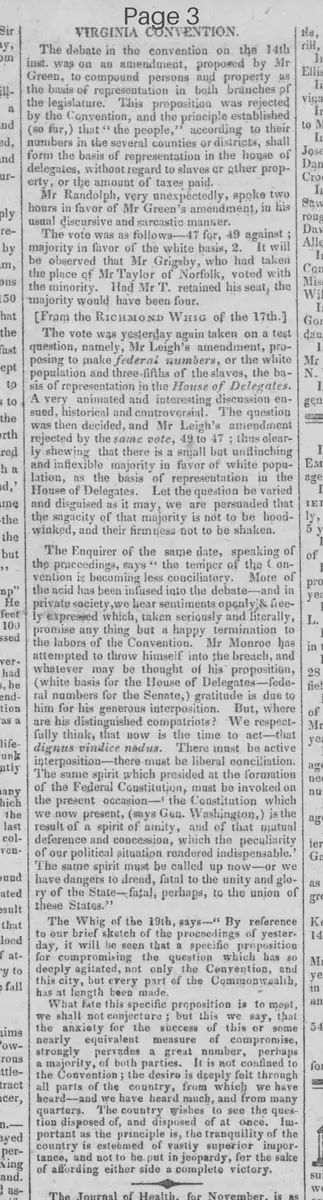
The debate in the convention on the 14th inst. was on an amendment, proposed by Mr Green, to compound persons and property as the basis of representation in both branches of the legislature. This proposition was rejected by the Convention, and the principle established (so far,) that 'the people,' according to their numbers in the several counties or districts, shall form the basis of representation in the house of delegates, without regard to slaves or other property, or the amount of taxes paid.
Mr Randolph, very unexpectedly, spoke two hours in favor of Mr Green's amendment, in his usual discursive and sarcastic manner.
The vote was as follows—47 for, 49 against; majority in favor of the white basis, 2. It will be observed that Mr Grigsby, who had taken the place of Mr Taylor of Norfolk, voted with the minority. Had Mr T. retained his seat, the majority would have been four.
[From the Richmond Whig of the 17th.]
The vote was yesterday again taken on a test question, namely, Mr Leigh's amendment, proposing to make federal numbers, or the white population and three-fifths of the slaves, the basis of representation in the House of Delegates. A very animated and interesting discussion ensued, historical and controversial. The question was then decided, and Mr Leigh's amendment rejected by the same vote, 49 to 47; thus clearly shewing that there is a small but unflinching and inflexible majority in favor of white population, as the basis of representation in the House of Delegates. Let the question be varied and disguised as it may, we are persuaded that the sagacity of that majority is not to be hoodwinked, and their firmness not to be shaken.
The Enquirer of the same date, speaking of the proceedings, says 'the temper of the Convention is becoming less conciliatory. More of the acid has been infused into the debate—and in private society we hear sentiments openly & freely expressed which, taken seriously and literally, promise any thing but a happy termination to the labors of the Convention. Mr Monroe has attempted to throw himself into the breach, and whatever may be thought of his proposition, (white basis for the House of Delegates—federal numbers for the Senate,) gratitude is due to him for his generous interposition. But, where are his distinguished compatriots? We respectfully think, that now is the time to act—that dignus vindice nodus. There must be active interposition—there must be liberal conciliation. The same spirit which presided at the formation of the Federal Constitution, must be invoked on the present occasion—'the Constitution which we now present, (says Gen. Washington,) is the result of a spirit of amity, and of that mutual deference and concession, which the peculiarity of our political situation rendered indispensable. The same spirit must be called up now—or we have dangers to dread, fatal to the unity and glory of the State—fatal, perhaps, to the union of these States.'
The Whig of the 19th, says—'By reference to our brief sketch of the proceedings of yesterday, it will be seen that a specific proposition for compromising the question which has so deeply agitated, not only the Convention, and this city, but every part of the Commonwealth, has at length been made.
What fate this specific proposition is to meet, we shall not conjecture; but this we say, that the anxiety for the success of this or some nearly equivalent measure of compromise, strongly pervades a great number, perhaps a majority, of both parties. It is not confined to the Convention; the desire is deeply felt through all parts of the country, from which we have heard—and we have heard much, and from many quarters. The country wishes to see the question disposed of, and disposed of at once. Important as the principle is, the tranquility of the country is esteemed of vastly superior importance, and not to be put in jeopardy, for the sake of affording either side a complete victory.'
What sub-type of article is it?
What keywords are associated?
What entities or persons were involved?
Where did it happen?
Domestic News Details
Primary Location
Virginia
Event Date
14th To 19th Inst.
Key Persons
Outcome
amendments rejected; 47-49 vote against mr green's amendment; 49-47 vote against mr leigh's amendment; majority in favor of white population basis for house of delegates representation.
Event Details
Debate in Virginia Convention on amendments to basis of representation: Mr Green's proposal for persons and property rejected; Mr Randolph spoke in favor; Mr Leigh's amendment for federal numbers rejected; discussions on compromise; anxiety for resolution to maintain tranquility.