Thank you for visiting SNEWPapers!
Sign up free
Richmond Enquirer
Richmond, Richmond County, Virginia
What is this article about?
In the House of Commons, Mr. Stanley proposed an amendment to the Irish Church Reform Bill's 147th clause, limiting funds from bishops' leases to extinguishing Vestry Cess to avoid defeat in the Lords. Despite criticism from Mr. O'Connell and others for abandoning the principle of secular appropriation, the amendment passed 280-148. Report also mentions King's remonstrance to bishops via Archbishop of Canterbury.
Clipping
OCR Quality
Full Text
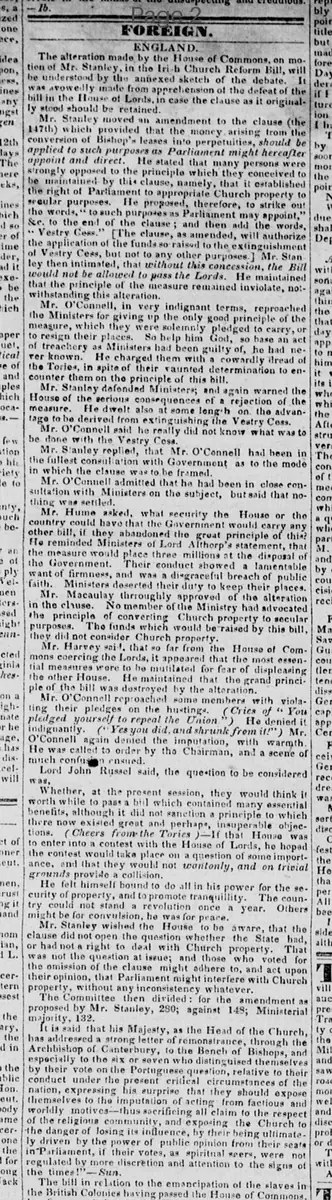
ENGLAND.
The alteration made by the House of Commons, on motion of Mr. Stanley, in the Irish Church Reform Bill, will be understood by the annexed sketch of the debate. It was avowedly made from apprehension of the defeat of the bill in the House of Lords, in case the clause as it originally stood should be retained.
Mr. Stanley moved an amendment to the clause (the 147th) which provided that the money arising from the conversion of Bishop's leases into perpetuities, should be applied to such purposes as Parliament might hereafter appoint and direct. He stated that many persons were strongly opposed to the principle which they conceived to be maintained by this clause, namely, that it established the right of Parliament to appropriate Church property to secular purposes. He proposed, therefore, to strike out the words, "to such purposes as Parliament may appoint," &c. to the end of the clause; and then add the words, "Vestry Cess." The clause, as amended, will authorize the application of the funds so raised to the extinguishment of Vestry Cess, but not to any other purposes. Mr. Stanley then intimated, that without this concession, the Bill would not be allowed to pass the Lords. He maintained that the principle of the measure remained inviolate, notwithstanding this alteration.
Mr. O'Connell, in very indignant terms, reproached the Ministers for giving up the only good principle of the measure, which they were solemnly pledged to carry, or to resign their places. So help him God, "so base an act of treachery as Ministers had been guilty of, he had never known." He charged them with a cowardly dread of the Tories, in spite of their vaunted determination to encounter them on the principle of this bill.
Mr. Stanley defended Ministers; and again warned the House of the serious consequences of a rejection of the measure. He dwelt also at some length on the advantage to be derived from extinguishing the Vestry Cess.
Mr. O'Connell said he really did not know what was to be done with the Vestry Cess.
Mr. Stanley replied, that Mr. O'Connell had been in the fullest consultation with Government as to the mode in which the clause was to be framed.
Mr. O'Connell admitted that he had been in close consultation with Ministers on the subject, but said that nothing was settled.
Mr. Hume asked, what security the House or the country could have that the Government would carry any other bill, if they abandoned the great principle of this? He reminded Ministers of Lord Althorp's statement, that the measure would place three millions at the disposal of the Government. Their conduct showed a lamentable want of firmness, and was a disgraceful breach of public faith. Ministers deserted their duty to keep their places.
Mr. Macaulay thoroughly approved of the alteration in the clause. No member of the Ministry had advocated the principle of converting Church property to secular purposes. The funds which would be raised by this bill, they did not consider Church property.
Mr. Harvey said. that so far from the House of Commons coercing the Lords, it appeared that the most essential measures were to be mutilated for fear of displeasing the other House. He maintained that the grand principle of the bill was destroyed by the alteration.
Mr. O'Connell reproached some members with violating their pledges on the hustings. (Cries of "You pledged yourself to repeal the Union") He denied it indignantly. ("Yes you did, and shrunk from it!") Mr. O'Connell again denied the imputation, with warmth. He was called to order by the Chairman, and a scene of much confusion ensued.
Lord John Russell said, the question to be considered was Whether, at the present session, they would think it worth while to pass a bill which contained many essential benefits, although it did not sanction a principle to which there now existed great and perhaps, insuperable objections. (Cheers from the Tories)—If that House was to enter into a contest with the House of Lords, he hoped the contest would take place on a question of some importance, and that they would not wantonly, and on trivial grounds provide a collision.
He felt himself bound to do all in his power for the security of property, and to promote tranquillity. The country could not stand a revolution once a year. Others might be for convulsion, he was for peace.
Mr. Stanley wished the House to be aware, that the clause did not open the question whether the State had, or had not a right to deal with Church property. That was not the question at issue; and those who voted for the omission of the clause might adhere to, and act upon their opinion, that Parliament might interfere with Church property, without any inconsistency whatever.
The Committee then divided: for the amendment as proposed by Mr. Stanley, 280; against 148; Ministerial majority, 132.
It is said that his Majesty, as the Head of the Church, has addressed a strong letter of remonstrance, through the Archbishop of Canterbury, to the Bench of Bishops, and especially to the six or seven who distinguished themselves by their vote on the Portuguese question, relative to their conduct under the present critical circumstances of the nation, expressing his surprise that they should expose themselves to the imputation of acting from factious and worldly motives—thus sacrificing all claim to the respect of the religious community, and exposing the Church to the danger of losing its influence, by their being ultimately driven by the power of public opinion from their seats in-Parliament, if their votes, as spiritual seers, were not regulated by more discretion and attention to the signs of the times!"—Sun.
What sub-type of article is it?
What keywords are associated?
What entities or persons were involved?
Where did it happen?
Foreign News Details
Primary Location
England
Key Persons
Outcome
amendment passed: 280 for, 148 against; ministerial majority 132.
Event Details
Debate in House of Commons on amendment to 147th clause of Irish Church Reform Bill, changing application of funds from bishops' leases from general parliamentary purposes to extinguishing Vestry Cess, to ensure passage in Lords. Mr. O'Connell and others criticized ministers for abandoning principle of secular appropriation of church property. Mr. Stanley defended the change. Additional report of King's remonstrance to bishops via Archbishop on their conduct.