Thank you for visiting SNEWPapers!
Sign up free
Editorial
October 29, 1812
The Rhode Island Republican
Newport, Newport County, Rhode Island
What is this article about?
Concluding review defends war with Britain over maritime spoliations, impressment, and trade rights, contrasting minimal French violations. Argues British wrongs justify conflict despite republican preparation limits; highlights robust non-British exports. Criticizes minority address for favoring submission.
Merged-components note: The two tables provide export data directly referenced and integral to the editorial's argument on trade with Britain versus France.
Clipping
OCR Quality
75%
Good
Full Text
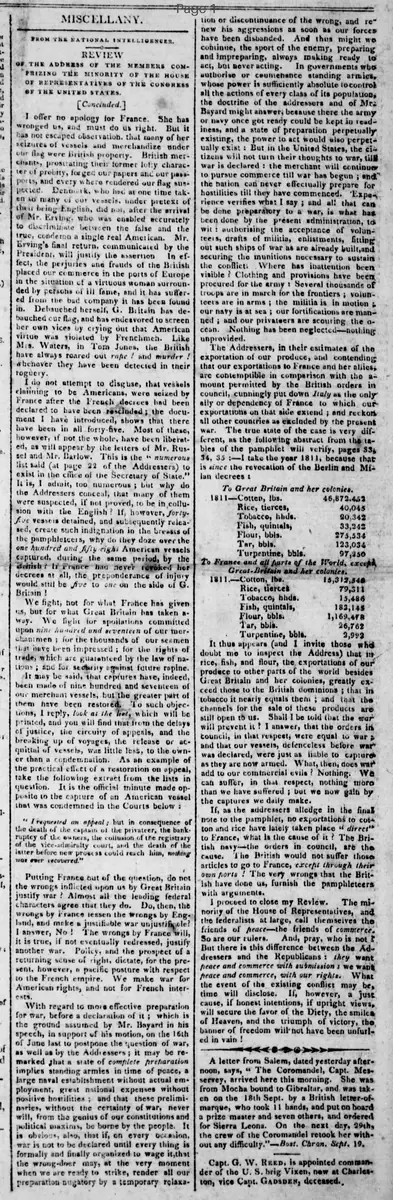
MISCELLANY.
FROM THE NATIONAL INTELLIGENCER.
-O
REVIEW
OF THE ADDRESS OF THE MEMBERS COM-
PRIZING THE MINORITY OF THE HOUSE
OF REPRESENTATIVES OF THE CONGRESS
OF THE UNITED STATES.
[Concluded.]
I offer no apology for France. She has
wronged us, and must do us right. But it
has not escaped observation, that many of her
seizures of vessels and merchandize under
our flag were British property. British mer-
chants, prostrating their former lofty charac-
ter of probity, forged our papers and our pass-
ports, and every where rendered our flag sus-
pected. Denmark, who had at one time tak-
en so many of our vessels, under pretext of
their being English, did not, after the arrival
of Mr. Erving. who was enabled accurately
to discriminate between the false and the
true, condemn a single real American. Mr.
Erving's final return, communicated by the
President, will justify the assertion In ef-
fect, the perjuries and frauds of the British
placed our commerce in the ports of Europe
in the situation of a virtuous woman surroun-
ded by persons of ill fame, and it has suffered
from the bad company it has been found
in. Debased herself, G. Britain has de-
bauched our flag, and has endeavored to screen
her own vices by crying out that American
virtue was violated by Frenchmen. Like
Mrs. Waters, in Tom Jones, the British
have always roared out rape! and murder!
whenever they have been detected in their
roguery.
I do not attempt to disguise, that vessels
claiming to be Americans, were seized by
France after the French decrees had been
rescinded; the document I have introduced, shows that there
have been in all forty-five. Most of these,
however, if not the whole, have been liberat-
ed, as will appear by the letters of Mr. Rus-
sell and Mr. Barlow. This is the "numerous
list said (at page 22 of the Addressers) to
exist in the office of the Secretary of State."
It is, I admit, too numerous ; but why do
the Addressers conceal, that many of them
were suspected, if not proved, to be in collu-
sion with the English? If, however, forty-
five vessels detained, and subsequently relea-
sed, create such indignation in the breasts of
the pamphleteers, why do they doze over the
one hundred and fifty-eight American vessels
captured, during the same period, by the
British? If France had never revoked her
decrees at all, the preponderance of injury
would still be five to one on the side of G.
Britain!
We fight, not for what France has given
us, but for what Great Britain has taken a-
way. We fight for spoliations committed
upon nine hundred and seventeen of our mer-
chantmen ; for the thousands of our seamen
that have been impressed; for the rights of
trade, which are guaranteed by the law of na-
tions ; and for security against future rapine.
It may be said, that captures have, indeed,
been made of nine hundred and seventeen of
our merchant vessels, but the greater part of
them have been restored. To such objec-
tions, I reply, look at the list, which will be
printed, and you will find that from the delays
of justice, the circuity of appeals, and the
breaking up of voyages, the release or ac-
quittal of vessels, was little less, to the own-
er than a condemnation. As an example of
the practical effect of a restoration on appeal,
take the following extract from the lists in
question. It is the official minute made op-
posite to the capture of an American vessel
that was condemned in the Courts below :
" I requested an appeal : but in consequence of
the death of the captain of the privateer, the bank-
ruptcy of the owners, the collusion of the registrary
of the vice-admiralty court, and the death of the
latter before new process could reach him, nothing
was ever recovered."
Putting France but of the question, do not
the wrongs inflicted upon us by Great Britain
justify war ? Almost all the leading federal
characters agree that they do. Do, then, the
wrongs by France lessen the wrongs by Eng-
land, and make a justifiable war unjustifiable?
I answer, No ! The wrongs by France will,
it is true, if not eventually redressed, justify
another war. Policy, and the prospect of a
returning sense of right, dictate, for the pre-
sent, however, a pacific posture with respect
to the French empire. We make war for
American rights, and not for French inter-
ests.
With regard to more effective preparation
for war, before a declaration of it ; which is
the ground assumed by Mr. Bayard in his
speech, in support of his motion, on the 16th
of June last to postpone the question of war,
as well as by the Addressers; it may be re-
marked that a state of complete preparation
implies standing armies in time of peace, a
large naval establishment without actual em-
ployment, great national expenses without
positive hostilities ; and that these prelimi-
naries, without the certainty of war, never
will, from the genius of our constitutions and
political maxims, be borne by the people. It
is obvious, also, that if, on every occasion,
war is not to be declared until every thing is
formally and finally organized to wage it, that
the wrong-doer may, at the very moment
when we are ready to strike, render all our
preparation nugatory by a temporary relaxa-
tion or discontinuance of the wrong, and re-
new his aggressions as soon as our forces
have been disbanded. And thus might we
continue, the sport of the enemy, preparing
and unpreparing, always making ready to
act, but never acting:
In governments whose
authorise or countenance standing armies,
whose power is sufficiently absolute to control
all the actions of every class of its population,
the doctrine of the addressers and of Mr.
Bayard might answer; because there the army
or navy once got ready could be kept in read-
iness, and a state of preparation perpetually
existing, the power to act would also perpetu-
ally exist : But in the United States, the citi-
zens will not turn their thoughts to war, till
war is declared : the merchant will continue
to pursue commerce till war has begun ; and
the nation can never effectually prepare for
hostilities till they have commenced. Expe-
rience verifies what I say ; and all that can
be done preparatory to a war, is what has
been done by the present administration, to
wit : authorising the acceptance of volun-
teers, drafts of militia, enlistments, fitting
out such ships of war as are already built, and
securing the munitions necessary to sustain
the conflicts , Where has inattention been
visible ? Clothing and provisions have been
procured for the army : Several thousands of
troops are in march for the frontiers ; volun-
teers are in arms ; the militia is in motion ;
our navy is at sea ; our fortifications are man-
ned ; and our privateers are scouring the o-
cean. Nothing has been neglected—nothing
unprovided.
The Addressers, in their estimates of the
exportation of our produce, and contending
that our exportations to France and her allies;
are contemptible in comparison with the a-
mount permitted by the British orders in
council, cunningly put down Italy as the only
ally or dependency of France to which our
exportations on that side extend ; and reckon
all other countries as excluded by the present
war. The true state of the case is very dif-
ferent, as the following abstract from the ta-
bles of the pamphlet will verify, pages 33
34, 35 :—I take the year 1811, because that
is since the revocation of the Berlin and Milan
decrees :
To Great Britain and her colonies,
1
To France and all parts of the world, such
Great Britain
It thus appears (and I invite those who
doubt me to inspect the Address) that in
rice, fish, and flour, the exportations of our
produce to other parts of the world besides
Great Britain and her colonies, greatly ex-
ceed those to the British dominions ; that in
tobacco it nearly equals them ; and that the
channels for the sale of these products are
still open to us. Shall I be told that the war
will prevent it ? I answer, that the orders in
council, in that respect; were equal to war
and that our vessels, defenceless before war
was declared, were just as liable to capture
as they are now armed. What, then, does war
add to our commercial evils ? Nothing. We
can suffer, in that respect, nothing more
than we have suffered ; but we now gain by
the captures we daily make.
If, as the addressers allege in the final
note to the pamphlet, no exportations to cot-
ton and rice have lately taken place " direct"
to France, what is the cause of it ? The Bri-
tish navy—the orders in council, are the
Cause.
The British would not suffer those
articles to go to France, except through their
own ports ! The very wrongs that the Brit-
"ish have done us, furnish the pamphleteers
with arguments.
I proceed to close my Review.
The mi-
nority of the House of Representatives," and
the federalists at large, call themselves the
friends of peace—the friends of commerce.
So are our rulers. And, pray, who is not ?
But there is this difference between the Ad-
dressers and the Republicans : they want
peace and commerce with submission : we want
peace and commerce, with our rights. What
the event of the, existing conflict may be,
time will disclose. If, however, a just
cause, if honest intentions, if upright views,
will secure the favor of the Deity, the smiles
of Heaven, and the triumph of victory, the
banner of freedom will not have been unfurled
in vain !
FROM THE NATIONAL INTELLIGENCER.
-O
REVIEW
OF THE ADDRESS OF THE MEMBERS COM-
PRIZING THE MINORITY OF THE HOUSE
OF REPRESENTATIVES OF THE CONGRESS
OF THE UNITED STATES.
[Concluded.]
I offer no apology for France. She has
wronged us, and must do us right. But it
has not escaped observation, that many of her
seizures of vessels and merchandize under
our flag were British property. British mer-
chants, prostrating their former lofty charac-
ter of probity, forged our papers and our pass-
ports, and every where rendered our flag sus-
pected. Denmark, who had at one time tak-
en so many of our vessels, under pretext of
their being English, did not, after the arrival
of Mr. Erving. who was enabled accurately
to discriminate between the false and the
true, condemn a single real American. Mr.
Erving's final return, communicated by the
President, will justify the assertion In ef-
fect, the perjuries and frauds of the British
placed our commerce in the ports of Europe
in the situation of a virtuous woman surroun-
ded by persons of ill fame, and it has suffered
from the bad company it has been found
in. Debased herself, G. Britain has de-
bauched our flag, and has endeavored to screen
her own vices by crying out that American
virtue was violated by Frenchmen. Like
Mrs. Waters, in Tom Jones, the British
have always roared out rape! and murder!
whenever they have been detected in their
roguery.
I do not attempt to disguise, that vessels
claiming to be Americans, were seized by
France after the French decrees had been
rescinded; the document I have introduced, shows that there
have been in all forty-five. Most of these,
however, if not the whole, have been liberat-
ed, as will appear by the letters of Mr. Rus-
sell and Mr. Barlow. This is the "numerous
list said (at page 22 of the Addressers) to
exist in the office of the Secretary of State."
It is, I admit, too numerous ; but why do
the Addressers conceal, that many of them
were suspected, if not proved, to be in collu-
sion with the English? If, however, forty-
five vessels detained, and subsequently relea-
sed, create such indignation in the breasts of
the pamphleteers, why do they doze over the
one hundred and fifty-eight American vessels
captured, during the same period, by the
British? If France had never revoked her
decrees at all, the preponderance of injury
would still be five to one on the side of G.
Britain!
We fight, not for what France has given
us, but for what Great Britain has taken a-
way. We fight for spoliations committed
upon nine hundred and seventeen of our mer-
chantmen ; for the thousands of our seamen
that have been impressed; for the rights of
trade, which are guaranteed by the law of na-
tions ; and for security against future rapine.
It may be said, that captures have, indeed,
been made of nine hundred and seventeen of
our merchant vessels, but the greater part of
them have been restored. To such objec-
tions, I reply, look at the list, which will be
printed, and you will find that from the delays
of justice, the circuity of appeals, and the
breaking up of voyages, the release or ac-
quittal of vessels, was little less, to the own-
er than a condemnation. As an example of
the practical effect of a restoration on appeal,
take the following extract from the lists in
question. It is the official minute made op-
posite to the capture of an American vessel
that was condemned in the Courts below :
" I requested an appeal : but in consequence of
the death of the captain of the privateer, the bank-
ruptcy of the owners, the collusion of the registrary
of the vice-admiralty court, and the death of the
latter before new process could reach him, nothing
was ever recovered."
Putting France but of the question, do not
the wrongs inflicted upon us by Great Britain
justify war ? Almost all the leading federal
characters agree that they do. Do, then, the
wrongs by France lessen the wrongs by Eng-
land, and make a justifiable war unjustifiable?
I answer, No ! The wrongs by France will,
it is true, if not eventually redressed, justify
another war. Policy, and the prospect of a
returning sense of right, dictate, for the pre-
sent, however, a pacific posture with respect
to the French empire. We make war for
American rights, and not for French inter-
ests.
With regard to more effective preparation
for war, before a declaration of it ; which is
the ground assumed by Mr. Bayard in his
speech, in support of his motion, on the 16th
of June last to postpone the question of war,
as well as by the Addressers; it may be re-
marked that a state of complete preparation
implies standing armies in time of peace, a
large naval establishment without actual em-
ployment, great national expenses without
positive hostilities ; and that these prelimi-
naries, without the certainty of war, never
will, from the genius of our constitutions and
political maxims, be borne by the people. It
is obvious, also, that if, on every occasion,
war is not to be declared until every thing is
formally and finally organized to wage it, that
the wrong-doer may, at the very moment
when we are ready to strike, render all our
preparation nugatory by a temporary relaxa-
tion or discontinuance of the wrong, and re-
new his aggressions as soon as our forces
have been disbanded. And thus might we
continue, the sport of the enemy, preparing
and unpreparing, always making ready to
act, but never acting:
In governments whose
authorise or countenance standing armies,
whose power is sufficiently absolute to control
all the actions of every class of its population,
the doctrine of the addressers and of Mr.
Bayard might answer; because there the army
or navy once got ready could be kept in read-
iness, and a state of preparation perpetually
existing, the power to act would also perpetu-
ally exist : But in the United States, the citi-
zens will not turn their thoughts to war, till
war is declared : the merchant will continue
to pursue commerce till war has begun ; and
the nation can never effectually prepare for
hostilities till they have commenced. Expe-
rience verifies what I say ; and all that can
be done preparatory to a war, is what has
been done by the present administration, to
wit : authorising the acceptance of volun-
teers, drafts of militia, enlistments, fitting
out such ships of war as are already built, and
securing the munitions necessary to sustain
the conflicts , Where has inattention been
visible ? Clothing and provisions have been
procured for the army : Several thousands of
troops are in march for the frontiers ; volun-
teers are in arms ; the militia is in motion ;
our navy is at sea ; our fortifications are man-
ned ; and our privateers are scouring the o-
cean. Nothing has been neglected—nothing
unprovided.
The Addressers, in their estimates of the
exportation of our produce, and contending
that our exportations to France and her allies;
are contemptible in comparison with the a-
mount permitted by the British orders in
council, cunningly put down Italy as the only
ally or dependency of France to which our
exportations on that side extend ; and reckon
all other countries as excluded by the present
war. The true state of the case is very dif-
ferent, as the following abstract from the ta-
bles of the pamphlet will verify, pages 33
34, 35 :—I take the year 1811, because that
is since the revocation of the Berlin and Milan
decrees :
To Great Britain and her colonies,
1
To France and all parts of the world, such
Great Britain
It thus appears (and I invite those who
doubt me to inspect the Address) that in
rice, fish, and flour, the exportations of our
produce to other parts of the world besides
Great Britain and her colonies, greatly ex-
ceed those to the British dominions ; that in
tobacco it nearly equals them ; and that the
channels for the sale of these products are
still open to us. Shall I be told that the war
will prevent it ? I answer, that the orders in
council, in that respect; were equal to war
and that our vessels, defenceless before war
was declared, were just as liable to capture
as they are now armed. What, then, does war
add to our commercial evils ? Nothing. We
can suffer, in that respect, nothing more
than we have suffered ; but we now gain by
the captures we daily make.
If, as the addressers allege in the final
note to the pamphlet, no exportations to cot-
ton and rice have lately taken place " direct"
to France, what is the cause of it ? The Bri-
tish navy—the orders in council, are the
Cause.
The British would not suffer those
articles to go to France, except through their
own ports ! The very wrongs that the Brit-
"ish have done us, furnish the pamphleteers
with arguments.
I proceed to close my Review.
The mi-
nority of the House of Representatives," and
the federalists at large, call themselves the
friends of peace—the friends of commerce.
So are our rulers. And, pray, who is not ?
But there is this difference between the Ad-
dressers and the Republicans : they want
peace and commerce with submission : we want
peace and commerce, with our rights. What
the event of the, existing conflict may be,
time will disclose. If, however, a just
cause, if honest intentions, if upright views,
will secure the favor of the Deity, the smiles
of Heaven, and the triumph of victory, the
banner of freedom will not have been unfurled
in vain !
| 1811—Cotten, lbs. | 46,872,452 |
| Rice, tierces, | 40,045 |
| Tobacco, hds. | 20,342 |
| Fish, quintals, | 33,242 |
| Flour, bbls. | 275,534 |
| Tar, bbls. | 123,034 |
| Turpentine, bbls. | 97,250 |
| 1811.—Cotton, lbs. | 15,312,548 |
| Rice, tierces | 79,311 |
| Tobacco, hrds. | 15,486 |
| Fish, quintals, | 183,145 |
| Flour, bbls. | 1,169,478 |
| Tar, bbls. | 26,762 |
| Turpentine, bbls. | 2,992 |
What sub-type of article is it?
War Or Peace
Foreign Affairs
Trade Or Commerce
What keywords are associated?
War With Britain
Vessel Captures
Impressment
Maritime Rights
French Decrees
British Orders
American Commerce
Export Statistics
What entities or persons were involved?
House Of Representatives Minority
Mr. Bayard
Mr. Erving
Mr. Russell
Mr. Barlow
Great Britain
France
President
Editorial Details
Primary Topic
Review Of Minority Address Justifying War With Britain
Stance / Tone
Strongly Pro War With Britain, Defending Administration
Key Figures
House Of Representatives Minority
Mr. Bayard
Mr. Erving
Mr. Russell
Mr. Barlow
Great Britain
France
President
Key Arguments
British Frauds Debauched American Flag, Leading To French Seizures
Only 45 American Vessels Seized By France Post Decrees, Most Released
158 Vessels Captured By Britain During Same Period
917 Merchantmen Spoliated And Thousands Of Seamen Impressed By Britain
Restorations Ineffective Due To Delays And Costs
French Wrongs Do Not Negate British Justifications For War
Preparation For War Limited By Republican Institutions
Administration Has Adequately Prepared With Volunteers, Militia, Navy
Exports To Non British Markets Substantial, War Adds No New Commercial Evils
Minority Seeks Peace With Submission, Republicans Seek Peace With Rights