Thank you for visiting SNEWPapers!
Sign up free
Story
April 25, 1884
Springfield Weekly Republican
Springfield, Hampden County, Massachusetts
What is this article about?
Governor Robinson speaks at Lexington on the 109th anniversary of the Battle of Lexington, recounting the minutemen's brave stand against British troops for liberty and equal rights, and praising their loyalty to justice over government.
Clipping
OCR Quality
96%
Excellent
Full Text
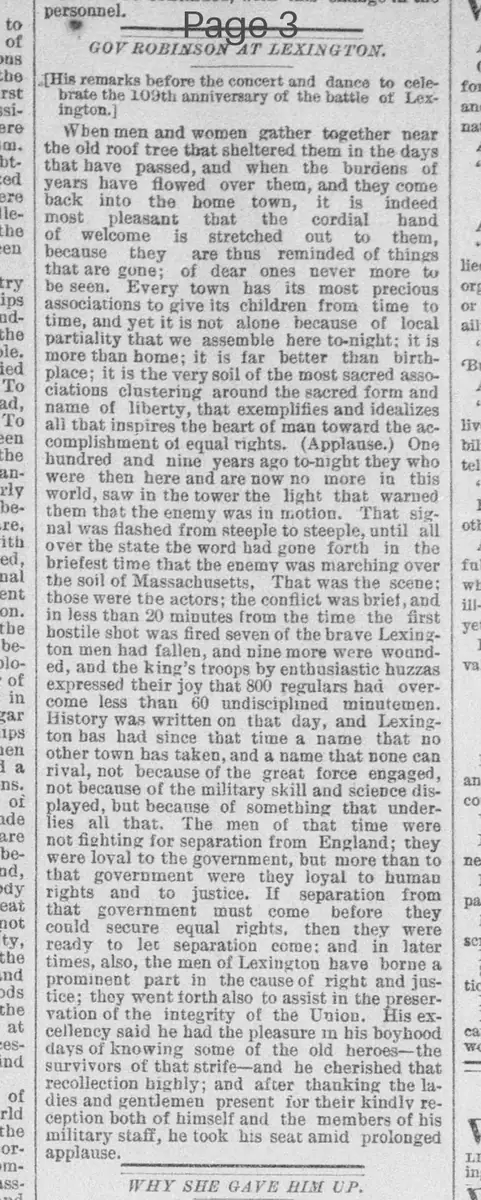
GOV. ROBINSON AT LEXINGTON.
[His remarks before the concert and dance to celebrate the 109th anniversary of the battle of Lexington.]
When men and women gather together near the old roof tree that sheltered them in the days that have passed, and when the burdens of years have flowed over them, and they come back into the home town, it is indeed most pleasant that the cordial hand of welcome is stretched out to them, because they are thus reminded of things that are gone; of dear ones never more to be seen. Every town has its most precious associations to give its children from time to time, and yet it is not alone because of local partiality that we assemble here to-night: it is more than home; it is far better than birthplace; it is the very soil of the most sacred associations clustering around the sacred form and name of liberty, that exemplifies and idealizes all that inspires the heart of man toward the accomplishment of equal rights. (Applause.) One hundred and nine years ago to-night they who were then here and are now no more in this world, saw in the tower the light that warned them that the enemy was in motion. That signal was flashed from steeple to steeple, until all over the state the word had gone forth in the briefest time that the enemy was marching over the soil of Massachusetts. That was the scene; those were the actors: the conflict was brief, and in less than 20 minutes from the time the first hostile shot was fired seven of the brave Lexington men had fallen, and nine more were wounded, and the king's troops by enthusiastic huzzas expressed their joy that 800 regulars had overcome less than 60 undisciplined minutemen.
History was written on that day, and Lexington has had since that time a name that no other town has taken, and a name that none can rival, not because of the great force engaged, not because of the military skill and science displayed, but because of something that underlies all that. The men of that time were not fighting for separation from England; they were loyal to the government, but more than to that government were they loyal to human rights and to justice. If separation from that government must come before they could secure equal rights, then they were ready to let separation come; and in later times, also, the men of Lexington have borne a prominent part in the cause of right and justice; they went forth also to assist in the preservation of the integrity of the Union. His excellency said he had the pleasure in his boyhood days of knowing some of the old heroes—the survivors of that strife—and he cherished that recollection highly; and after thanking the ladies and gentlemen present for their kindly reception both of himself and the members of his military staff, he took his seat amid prolonged applause.
[His remarks before the concert and dance to celebrate the 109th anniversary of the battle of Lexington.]
When men and women gather together near the old roof tree that sheltered them in the days that have passed, and when the burdens of years have flowed over them, and they come back into the home town, it is indeed most pleasant that the cordial hand of welcome is stretched out to them, because they are thus reminded of things that are gone; of dear ones never more to be seen. Every town has its most precious associations to give its children from time to time, and yet it is not alone because of local partiality that we assemble here to-night: it is more than home; it is far better than birthplace; it is the very soil of the most sacred associations clustering around the sacred form and name of liberty, that exemplifies and idealizes all that inspires the heart of man toward the accomplishment of equal rights. (Applause.) One hundred and nine years ago to-night they who were then here and are now no more in this world, saw in the tower the light that warned them that the enemy was in motion. That signal was flashed from steeple to steeple, until all over the state the word had gone forth in the briefest time that the enemy was marching over the soil of Massachusetts. That was the scene; those were the actors: the conflict was brief, and in less than 20 minutes from the time the first hostile shot was fired seven of the brave Lexington men had fallen, and nine more were wounded, and the king's troops by enthusiastic huzzas expressed their joy that 800 regulars had overcome less than 60 undisciplined minutemen.
History was written on that day, and Lexington has had since that time a name that no other town has taken, and a name that none can rival, not because of the great force engaged, not because of the military skill and science displayed, but because of something that underlies all that. The men of that time were not fighting for separation from England; they were loyal to the government, but more than to that government were they loyal to human rights and to justice. If separation from that government must come before they could secure equal rights, then they were ready to let separation come; and in later times, also, the men of Lexington have borne a prominent part in the cause of right and justice; they went forth also to assist in the preservation of the integrity of the Union. His excellency said he had the pleasure in his boyhood days of knowing some of the old heroes—the survivors of that strife—and he cherished that recollection highly; and after thanking the ladies and gentlemen present for their kindly reception both of himself and the members of his military staff, he took his seat amid prolonged applause.
What sub-type of article is it?
Historical Event
Heroic Act
What themes does it cover?
Bravery Heroism
Justice
What keywords are associated?
Battle Of Lexington
Anniversary Speech
Governor Robinson
Minutemen
Liberty
Equal Rights
What entities or persons were involved?
Gov. Robinson
Lexington Minutemen
Where did it happen?
Lexington
Story Details
Key Persons
Gov. Robinson
Lexington Minutemen
Location
Lexington
Event Date
109th Anniversary Of The Battle Of Lexington
Story Details
Gov. Robinson delivers a commemorative speech praising the minutemen's stand against British forces for liberty and equal rights, noting the brief battle where seven died and nine were wounded, and highlighting Lexington's enduring legacy of justice.