Thank you for visiting SNEWPapers!
Sign up free
The Kentucky Gazette
Lexington, Fayette County, Kentucky
What is this article about?
Extract of a letter describing a large New York town meeting on Saturday before July 20 where about 3-4000 people, mostly anti-treaty republicans, outnumbered pro-treaty federalists led by A. Hamilton and R. King. Attempts to move discussion to a church or avoid opinion failed; treaty burned at battery; Hamilton's resolution hissed, he pelted with stones; committee to draft resolutions.
Clipping
OCR Quality
Full Text
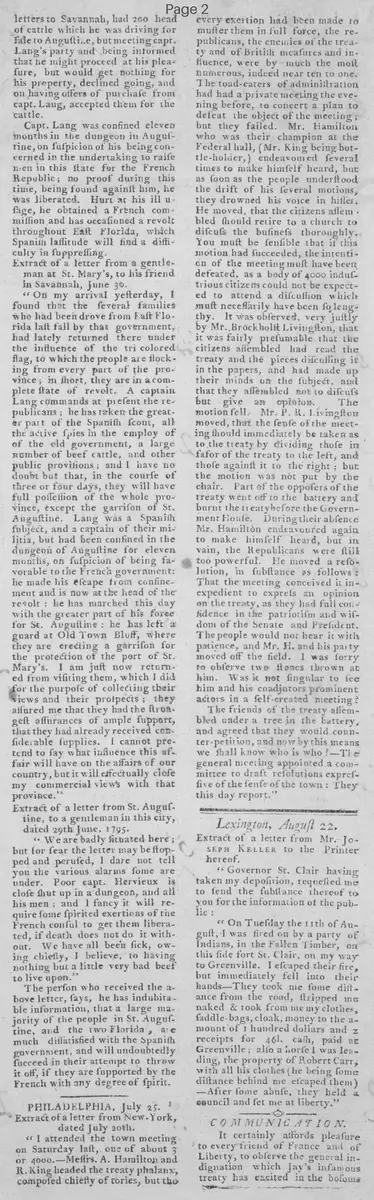
Extract of a letter from New-York, dated July 20th.
"I attended the town meeting on Saturday last, one of about 3 or 4000.—Messrs. A. Hamilton and R. King headed the treaty phalanx, composed chiefly of tories, but though every exertion had been made to muster them in full force, the republicans, the enemies of the treaty and of British measures and influence, were by much the most numerous, indeed near ten to one. The toad-eaters of administration had had a private meeting the evening before, to concert a plan to defeat the object of the meeting; but they failed. Mr. Hamilton who was their champion at the Federal hall, (Mr. King being bottle-holder,) endeavored several times to make himself heard, but as soon as the people understood the drift of his several motions, they drowned his voice in hisses. He moved, that the citizens assembled should retire to a church to discuss the business thoroughly. You must be sensible that if this motion had succeeded, the intention of the meeting must have been defeated, as a body of 4000 industrious citizens could not be expected to attend a discussion which must necessarily have been so lengthy. It was observed, very justly by Mr., Brockholst Livingston, that it was fairly presumable that the citizens assembled had read the treaty and the pieces discussing it in the papers, and had made up their minds on the subject, and that they assembled not to discuss but give an opinion.
The motion fell, Mr. P. R. Livingston moved, that the sense of the meeting should immediately be taken as to the treaty by dividing those in favor of the treaty to the left, and those against it to the right; but the motion was not put by the chair. Part of the opposers of the treaty went off to the battery and burnt the treaty before the Government House. During their absence Mr. Hamilton endeavored again to make himself heard, but in vain, the Republicans were still too powerful. He moved a resolution, in substance as follows:
That the meeting conceived it inexpedient to express an opinion on the treaty, as they had full confidence in the patriotism and wisdom of the Senate and President.
The people would not hear it with patience, and Mr. H. and his party moved off the field. I was sorry to observe two stones thrown at him. Was it not singular to see him and his coadjutors prominent actors in a self-created meeting? The friends of the treaty assembled under a tree in the battery, and agreed that they would counter-petition, and now by this means we shall know who is who?—The general meeting appointed a committee to draft resolutions expressive of the sense of the town: They this day report."
What sub-type of article is it?
What themes does it cover?
What keywords are associated?
What entities or persons were involved?
Where did it happen?
Story Details
Key Persons
Location
New York
Event Date
Saturday Last (Prior To July 20th)
Story Details
At a town meeting of about 3-4000 in New-York, anti-treaty republicans vastly outnumbered pro-treaty tories led by A. Hamilton and R. King. Efforts to relocate discussion or avoid expressing opinion failed; opposers burned the treaty at the battery; Hamilton's pro-confidence resolution was rejected amid hisses and stones thrown at him; pro-treaty group planned counter-petition; committee appointed for anti-treaty resolutions.