Thank you for visiting SNEWPapers!
Sign up free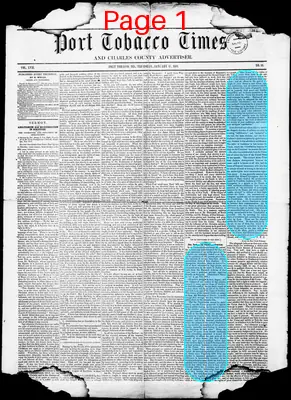
Editorial
January 17, 1861
Port Tobacco Times, And Charles County Advertiser
Port Tobacco, Charles County, Maryland
What is this article about?
Editorial quotes Andrew Jackson's Farewell Address to argue against using coercive force to preserve the Union, distinguishing nullification from secession, and critiques advocates of military coercion while affirming states' rights doctrines.
Clipping
OCR Quality
95%
Excellent
Full Text
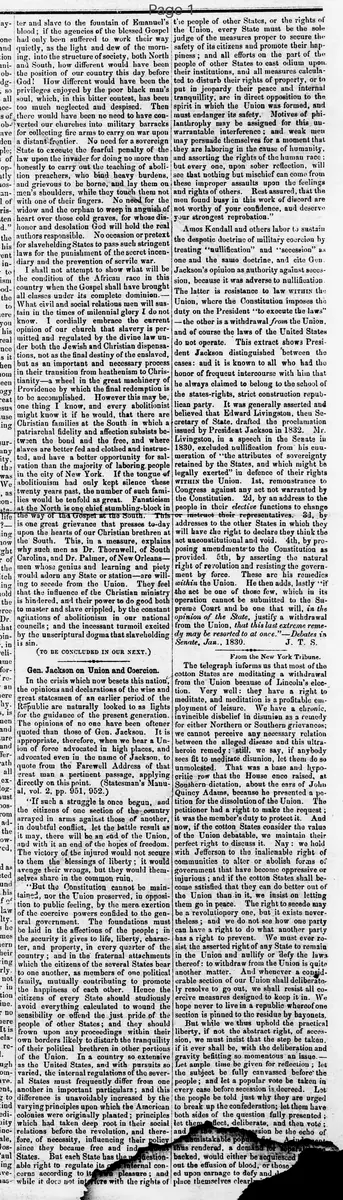
Gen. Jackson on Union and Coercion.
In the crisis which now besets this nation, the opinions and declarations of the wise and great statesmen of an earlier period of the Republic are naturally looked to as lights for the guidance of the present generation. The opinions of no one have been oftener quoted than those of Gen. Jackson. It is appropriate, therefore, when we hear a Union of force advocated in high places, and advocated even in the name of Jackson, to quote from the Farewell Address of that great man a pertinent passage, applying directly on this point. (Statesman's Manual, vol. 2, pp. 951, 952.)
"If such a struggle is once begun, and the citizens of one section of the country arrayed in arms against those of another, in doubtful conflict, let the battle result as it may, there will be an end of the Union, and with it an end of the hopes of freedom. The victory of the injured would not secure to them the blessings of liberty; it would avenge their wrongs, but they would themselves share in the common ruin.
"But the Constitution cannot be maintained, nor the Union preserved, in opposition to public feeling, by the mere exertion of the coercive powers confided to the general government. The foundations must be laid in the affections of the people; in the security it gives to life, liberty, character, and property, in every quarter of the country; and in the fraternal attachments which the citizens of the several States bear to one another, as members of one political family, mutually contributing to promote the happiness of each other. Hence the citizens of every State should studiously avoid everything calculated to wound the sensibility or offend the just pride of the people of other States; and they should frown upon any proceedings within their own borders likely to disturb the tranquility of their political brethren in other portions of the Union. In a country so extensive as the United States, and with pursuits so varied, the internal regulations of the several States must frequently differ from one another in important particulars; and this difference is unavoidably increased by the varying principles upon which the American colonies were originally planted; principles which had taken deep root in their social relations before the revolution, and therefore, of necessity, influencing their policy since they became free and independent States. But each State has the unquestionable right to regulate its own internal concerns according to its pleasure; and while it does not interfere with the rights of the people of other States, or the rights of the Union, every State must be the sole judge of the measures proper to secure the safety of its citizens and promote their happiness; and all efforts on the part of the people of other States to cast odium upon their institutions, and all measures calculated to disturb their rights of property, or to put in jeopardy their peace and internal tranquillity, are in direct opposition to the spirit in which the Union was formed, and must endanger its safety. Motives of philanthropy may be assigned for this unwarrantable interference; and weak men may persuade themselves for a moment that they are laboring in the cause of humanity, and asserting the rights of the human race: but every one, upon sober reflection, will see that nothing but mischief can come from these improper assaults upon the feelings and rights of others. Rest assured, that the men found busy in this work of discord are not worthy of your confidence, and deserve your strongest reprobation."
Amos Kendall and others labor to sustain the despotic doctrine of military coercion by treating "nullification" and "secession" as one and the same doctrine, and cite Gen. Jackson's opinion as authority against secession, because it was adverse to nullification. The latter is resistance to law within the Union, where the Constitution imposes the duty on the President "to execute the laws"—the other is a withdrawal from the Union and of course the laws of the United States do not operate. This extract shows President Jackson distinguished between the cases: and it is known to all who had the honor of frequent intercourse with him that he always claimed to belong to the school of the states-rights, strict construction republican party. It was generally asserted and believed that Edward Livingston, then Secretary of State, drafted the proclamation issued by President Jackson in 1832. Mr. Livingston, in a speech in the Senate in 1830, excluded nullification from his enumeration of the attributes of sovereignty retained by the States, and which might be legally exerted" in defence of their rights within the Union. 1st, remonstrance to Congress against any act not warranted by the Constitution. 2d, by an address to the people in their elective functions to change or instruct their representatives. 3d, by addresses to the other States in which they will have the right to declare they think the act unconstitutional and void. 4th, by proposing amendments to the Constitution as provided. 5th, by asserting the natural right of revolution and resisting the government by force. These are his remedies within the Union. He then adds, lastly 'if the act be one of those few, which in its operation cannot be submitted to the Supreme Court and be one that will, in the opinion of the State, justify a withdrawal from the Union, that this last extreme remedy may be resorted to at once.'—Debates in Senate, Jan., 1830.
J. T. S.
In the crisis which now besets this nation, the opinions and declarations of the wise and great statesmen of an earlier period of the Republic are naturally looked to as lights for the guidance of the present generation. The opinions of no one have been oftener quoted than those of Gen. Jackson. It is appropriate, therefore, when we hear a Union of force advocated in high places, and advocated even in the name of Jackson, to quote from the Farewell Address of that great man a pertinent passage, applying directly on this point. (Statesman's Manual, vol. 2, pp. 951, 952.)
"If such a struggle is once begun, and the citizens of one section of the country arrayed in arms against those of another, in doubtful conflict, let the battle result as it may, there will be an end of the Union, and with it an end of the hopes of freedom. The victory of the injured would not secure to them the blessings of liberty; it would avenge their wrongs, but they would themselves share in the common ruin.
"But the Constitution cannot be maintained, nor the Union preserved, in opposition to public feeling, by the mere exertion of the coercive powers confided to the general government. The foundations must be laid in the affections of the people; in the security it gives to life, liberty, character, and property, in every quarter of the country; and in the fraternal attachments which the citizens of the several States bear to one another, as members of one political family, mutually contributing to promote the happiness of each other. Hence the citizens of every State should studiously avoid everything calculated to wound the sensibility or offend the just pride of the people of other States; and they should frown upon any proceedings within their own borders likely to disturb the tranquility of their political brethren in other portions of the Union. In a country so extensive as the United States, and with pursuits so varied, the internal regulations of the several States must frequently differ from one another in important particulars; and this difference is unavoidably increased by the varying principles upon which the American colonies were originally planted; principles which had taken deep root in their social relations before the revolution, and therefore, of necessity, influencing their policy since they became free and independent States. But each State has the unquestionable right to regulate its own internal concerns according to its pleasure; and while it does not interfere with the rights of the people of other States, or the rights of the Union, every State must be the sole judge of the measures proper to secure the safety of its citizens and promote their happiness; and all efforts on the part of the people of other States to cast odium upon their institutions, and all measures calculated to disturb their rights of property, or to put in jeopardy their peace and internal tranquillity, are in direct opposition to the spirit in which the Union was formed, and must endanger its safety. Motives of philanthropy may be assigned for this unwarrantable interference; and weak men may persuade themselves for a moment that they are laboring in the cause of humanity, and asserting the rights of the human race: but every one, upon sober reflection, will see that nothing but mischief can come from these improper assaults upon the feelings and rights of others. Rest assured, that the men found busy in this work of discord are not worthy of your confidence, and deserve your strongest reprobation."
Amos Kendall and others labor to sustain the despotic doctrine of military coercion by treating "nullification" and "secession" as one and the same doctrine, and cite Gen. Jackson's opinion as authority against secession, because it was adverse to nullification. The latter is resistance to law within the Union, where the Constitution imposes the duty on the President "to execute the laws"—the other is a withdrawal from the Union and of course the laws of the United States do not operate. This extract shows President Jackson distinguished between the cases: and it is known to all who had the honor of frequent intercourse with him that he always claimed to belong to the school of the states-rights, strict construction republican party. It was generally asserted and believed that Edward Livingston, then Secretary of State, drafted the proclamation issued by President Jackson in 1832. Mr. Livingston, in a speech in the Senate in 1830, excluded nullification from his enumeration of the attributes of sovereignty retained by the States, and which might be legally exerted" in defence of their rights within the Union. 1st, remonstrance to Congress against any act not warranted by the Constitution. 2d, by an address to the people in their elective functions to change or instruct their representatives. 3d, by addresses to the other States in which they will have the right to declare they think the act unconstitutional and void. 4th, by proposing amendments to the Constitution as provided. 5th, by asserting the natural right of revolution and resisting the government by force. These are his remedies within the Union. He then adds, lastly 'if the act be one of those few, which in its operation cannot be submitted to the Supreme Court and be one that will, in the opinion of the State, justify a withdrawal from the Union, that this last extreme remedy may be resorted to at once.'—Debates in Senate, Jan., 1830.
J. T. S.
What sub-type of article is it?
Constitutional
Partisan Politics
What keywords are associated?
Union Preservation
Coercion
Nullification
Secession
States Rights
Jackson Farewell Address
Edward Livingston
What entities or persons were involved?
Gen. Jackson
Amos Kendall
Edward Livingston
J. T. S.
Editorial Details
Primary Topic
Jackson's Opposition To Coercive Union Preservation
Stance / Tone
Anti Coercion, Pro States' Rights
Key Figures
Gen. Jackson
Amos Kendall
Edward Livingston
J. T. S.
Key Arguments
Coercive Powers Cannot Maintain The Constitution Or Union Against Public Feeling
Union Must Be Based On Affections Of The People And Fraternal Attachments
States Have Right To Regulate Internal Concerns Without Interference
Nullification And Secession Are Distinct Doctrines
Jackson Belonged To States Rights, Strict Construction Republican Party
Livingston's Remedies For States' Rights Include Remonstrance, Addresses, Amendments, Revolution, And Withdrawal As Last Resort