Thank you for visiting SNEWPapers!
Sign up free
Editorial
July 4, 1810
Alexandria Daily Gazette, Commercial & Political
Alexandria, Virginia
What is this article about?
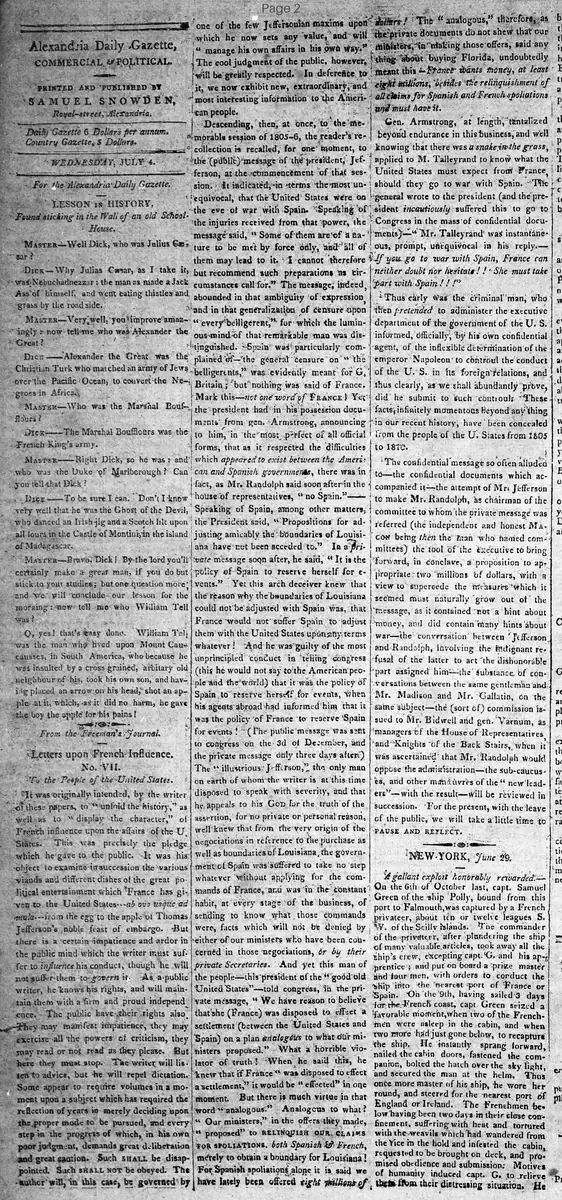
This editorial, the seventh in a series from the Freeman's Journal, criticizes Thomas Jefferson for misleading Congress about French control over Spanish policy on Louisiana boundaries in 1805-6, concealing documents showing France's dominance and Napoleon's intent to side with Spain against the US.
Clipping
OCR Quality
95%
Excellent
Full Text
From the Freeman's Journal.
Letters upon French Influence.
No. VII.
To the People of the United States.
It was originally intended, by the writer
of these papers, to "unfold the history," as
well as to "display the character," of
French influence upon the affairs of the U.
States. This was precisely the pledge
which he gave to the public. It was his
object to examine in succession the various
viands and different dishes of the great po:
litical entertainment which France has gi-
ven to the United States—from ab ovo usque ad
mala—from the egg to the apple of Thomas
Jefferson's noble feast of embargo. But
there is a certain impatience and ardor in
the public mind which the writer must suf-
fer to influence his conduct, though he will
not suffer them to govern it. As a public
writer, he knows his rights, and will main-
tain them with a firm and proud independ-
ence. The public have their rights also
They may manifest impatience, they may
exercise all the powers of criticism, they
may read or not read as they please. But
here they must stop. The writer will lis-
ten to advice, but he will repel dictation.
Some appear to require volumes in a mo:
ment upon a subject which has required the
reflection of years in merely deciding upon
the proper mode to be pursued, and every
step in the progress of which, in his own
poor judgment, demands great deliberation
and great caution. Such shall be disap-
pointed. Such shall not be obeyed. The
author will, in this case, be governed by
one of the few Jeffersonian maxims upon
which he now sets any value, and will
"manage his own affairs in his own way."
The cool judgment of the public, however,
will be greatly respected. In deference to
it, we now exhibit new, extraordinary, and
most interesting information to the Ameri-
can people.
Descending, then, at once, to the me-
memorable session of 1805-6, the reader's re-
collection is recalled, for one moment, to
the (public) message of the president, Jef-
ferson, at the commencement of that ses-
sion. It indicated in terms the most un-
equivocal, that the United States were on
the eve of war with Spain. Speaking of
the injuries received from that power, the
message said, "Some of them are of a na-
nature to be met by force only, and all of
them may lead to it. I cannot therefore
but recommend such preparations as cir-
cumstances call for." The message, indeed:
abounded in that ambiguity of expression
and in that generalization of censure upon
"every belligerent," for which the lumin-
ous mind of that remarkable man was dis-
tinguished. Spain was particularly com-
plained of—the general censure on "the
belligerents," was evidently meant for G.
Britain; "but nothing was said of France.
Mark this—not one word of France! Yet:
the president had in his possession docu-
ments from gen. Armstrong, announcing
to him, in the most perfect of all official
forms; that as it respected the difficulties
which appeared to exist between the Ameri:
can and Spanish governments, there was in
fact, as Mr. Randolph said soon after in the
house of representatives, "no Spain."
Speaking of Spain, among other matters,
the President said, "Propositions for ad-
justing amicably the boundaries of Louisi-
ana have not been acceded to."—In a pri-
vate message soon after, he said, "It is the
policy of Spain to reserve herself for e-
vents." Yet this arch deceiver knew that
the reason why the boundaries of Louisiana
could not be adjusted with Spain was, that
France would not suffer Spain to adjust
them with the United States upon any terms
whatever! And he was guilty of the most
unprincipled conduct in telling congress
(this he would not say to the American peo-
ple and the world) that it was the policy of
Spain to reserve herself for events, when
his agents abroad had informed him that it
was the policy of France to reserve Spain
for events! (The public message was sent
to congress on the 3d of December, and
the private message only three days after)
The "illustrious J-efferson," the only man
on earth of whom the writer is at this time
disposed to speak with severity, and that
he appeals to his God for the truth of the
assertion, for no private or personal reason,
well knew that from the very origin of the
negociations in reference to the purchase as
well as boundaries of Louisiana, the govern-
ment of Spain was suffered to take no step
whatever without applying for the com-
mands of France, and was in the constant
habit, at every stage of the business, of
sending to know what those commands
were, facts which will not be denied by
either of our ministers who have been con-
cerned in those negociations, or by their
private Secretaries. And yet this man of
the people—this president of the "good old
United States"—told congress, in the pri-
vate message, "We have reason to believe
that she (France) was disposed to effect a
settlement (between the United States and
Spain) on a plan analogous to what our mi-
nisters proposed." What a horrible vio-
lator of truth! When he said this, he
knew that if France "was disposed to effect
a settlement," it would be "effected" in one
moment. But there is much virtue in that
word "analogous." Analogous to what?
"Our ministers," in the offers they made,
"proposed" to RELINQUISH OUR CLAIMS
FOR SPOLIATIONS, both Spanish & French,
merely to obtain a boundary for Louisiana!
For Spanish spoliations alone it is said we
have lately been offered eight millions of
dollars: The "analogous," therefore, as
the private documents do not shew that our
ministers in making those offers, said any
thing about buying Florida, undoubtedly
meant this—France wants money, at least
eight millions; besides the relinquishment of
all claims for Spanish and French spoliations
and must have it.
Gen. Armstrong, at length, tantalized
beyond endurance in this business, and well
knowing that there was a snake in the grass.
applied to M. Talleyrand to know what the
United States must expect from France
should they go to war with Spain. The
general wrote to the president (and the pre-
sident incautiously suffered this to go to
Congress in the mass of confidential docu-
ments) "Mr. Talleyrand was instanta-
neous, prompt, unequivocal in his reply.—
If you go to war with Spain, France can
neither doubt nor hesitate!!—She must take
part with Spain!!!"
Thus early was the criminal man, who
then pretended to administer the executive
department of the government of the U. S.
-informed, officially, by his own confidential
agent, of the inflexible determination of the
emperor Napoleon to controul the conduct
of the U. S. in its foreign relations, and
thus clearly, as we shall abundantly prove,
did he submit to such controul: These
facts, infinitely momentous beyond any thing
in our recent history, have been concealed
from the people of the U. States from 1805
to 1810.
The confidential message so often alluded
to—the confidential documents which ac-
companied it—the attempt of Mr. Jefferson
to make Mr. Randolph, as chairman of the
committee to whom the private message was
referred (the independent and honest Mr.
Madison being then the man who named com-
mittees) the tool of the executive to bring
forward, in conclave, a proposition to ap-
propriate two "millions of dollars, with a
view to supercede the measures which it
seemed must naturally grow out of the
message, as it contained not a hint about
money, and did contain many hints about
war—the conversation between Jefferson
and Randolph, involving the indignant re-
fusal of the latter to act the dishonorable
part assigned him—the substance of con-
versations between the same gentleman and.
Mr. Madison and Mr. Gallatin, on the
same subject—the (sort of) commission is-
sued to Mr. Bidwell and gen. Varnum, as
managers of the House of Representatives
and Knights of the Back Stairs, when it
was ascertained that Mr. Randolph would
oppose the administration—the sub-caucus-
es, and other manoeuvres of the "new lead-
er"—with the result—will be reviewed in
succession. For the present, with the leave
of the public, we will take a little time to
PAUSE AND REFLECT.
Letters upon French Influence.
No. VII.
To the People of the United States.
It was originally intended, by the writer
of these papers, to "unfold the history," as
well as to "display the character," of
French influence upon the affairs of the U.
States. This was precisely the pledge
which he gave to the public. It was his
object to examine in succession the various
viands and different dishes of the great po:
litical entertainment which France has gi-
ven to the United States—from ab ovo usque ad
mala—from the egg to the apple of Thomas
Jefferson's noble feast of embargo. But
there is a certain impatience and ardor in
the public mind which the writer must suf-
fer to influence his conduct, though he will
not suffer them to govern it. As a public
writer, he knows his rights, and will main-
tain them with a firm and proud independ-
ence. The public have their rights also
They may manifest impatience, they may
exercise all the powers of criticism, they
may read or not read as they please. But
here they must stop. The writer will lis-
ten to advice, but he will repel dictation.
Some appear to require volumes in a mo:
ment upon a subject which has required the
reflection of years in merely deciding upon
the proper mode to be pursued, and every
step in the progress of which, in his own
poor judgment, demands great deliberation
and great caution. Such shall be disap-
pointed. Such shall not be obeyed. The
author will, in this case, be governed by
one of the few Jeffersonian maxims upon
which he now sets any value, and will
"manage his own affairs in his own way."
The cool judgment of the public, however,
will be greatly respected. In deference to
it, we now exhibit new, extraordinary, and
most interesting information to the Ameri-
can people.
Descending, then, at once, to the me-
memorable session of 1805-6, the reader's re-
collection is recalled, for one moment, to
the (public) message of the president, Jef-
ferson, at the commencement of that ses-
sion. It indicated in terms the most un-
equivocal, that the United States were on
the eve of war with Spain. Speaking of
the injuries received from that power, the
message said, "Some of them are of a na-
nature to be met by force only, and all of
them may lead to it. I cannot therefore
but recommend such preparations as cir-
cumstances call for." The message, indeed:
abounded in that ambiguity of expression
and in that generalization of censure upon
"every belligerent," for which the lumin-
ous mind of that remarkable man was dis-
tinguished. Spain was particularly com-
plained of—the general censure on "the
belligerents," was evidently meant for G.
Britain; "but nothing was said of France.
Mark this—not one word of France! Yet:
the president had in his possession docu-
ments from gen. Armstrong, announcing
to him, in the most perfect of all official
forms; that as it respected the difficulties
which appeared to exist between the Ameri:
can and Spanish governments, there was in
fact, as Mr. Randolph said soon after in the
house of representatives, "no Spain."
Speaking of Spain, among other matters,
the President said, "Propositions for ad-
justing amicably the boundaries of Louisi-
ana have not been acceded to."—In a pri-
vate message soon after, he said, "It is the
policy of Spain to reserve herself for e-
vents." Yet this arch deceiver knew that
the reason why the boundaries of Louisiana
could not be adjusted with Spain was, that
France would not suffer Spain to adjust
them with the United States upon any terms
whatever! And he was guilty of the most
unprincipled conduct in telling congress
(this he would not say to the American peo-
ple and the world) that it was the policy of
Spain to reserve herself for events, when
his agents abroad had informed him that it
was the policy of France to reserve Spain
for events! (The public message was sent
to congress on the 3d of December, and
the private message only three days after)
The "illustrious J-efferson," the only man
on earth of whom the writer is at this time
disposed to speak with severity, and that
he appeals to his God for the truth of the
assertion, for no private or personal reason,
well knew that from the very origin of the
negociations in reference to the purchase as
well as boundaries of Louisiana, the govern-
ment of Spain was suffered to take no step
whatever without applying for the com-
mands of France, and was in the constant
habit, at every stage of the business, of
sending to know what those commands
were, facts which will not be denied by
either of our ministers who have been con-
cerned in those negociations, or by their
private Secretaries. And yet this man of
the people—this president of the "good old
United States"—told congress, in the pri-
vate message, "We have reason to believe
that she (France) was disposed to effect a
settlement (between the United States and
Spain) on a plan analogous to what our mi-
nisters proposed." What a horrible vio-
lator of truth! When he said this, he
knew that if France "was disposed to effect
a settlement," it would be "effected" in one
moment. But there is much virtue in that
word "analogous." Analogous to what?
"Our ministers," in the offers they made,
"proposed" to RELINQUISH OUR CLAIMS
FOR SPOLIATIONS, both Spanish & French,
merely to obtain a boundary for Louisiana!
For Spanish spoliations alone it is said we
have lately been offered eight millions of
dollars: The "analogous," therefore, as
the private documents do not shew that our
ministers in making those offers, said any
thing about buying Florida, undoubtedly
meant this—France wants money, at least
eight millions; besides the relinquishment of
all claims for Spanish and French spoliations
and must have it.
Gen. Armstrong, at length, tantalized
beyond endurance in this business, and well
knowing that there was a snake in the grass.
applied to M. Talleyrand to know what the
United States must expect from France
should they go to war with Spain. The
general wrote to the president (and the pre-
sident incautiously suffered this to go to
Congress in the mass of confidential docu-
ments) "Mr. Talleyrand was instanta-
neous, prompt, unequivocal in his reply.—
If you go to war with Spain, France can
neither doubt nor hesitate!!—She must take
part with Spain!!!"
Thus early was the criminal man, who
then pretended to administer the executive
department of the government of the U. S.
-informed, officially, by his own confidential
agent, of the inflexible determination of the
emperor Napoleon to controul the conduct
of the U. S. in its foreign relations, and
thus clearly, as we shall abundantly prove,
did he submit to such controul: These
facts, infinitely momentous beyond any thing
in our recent history, have been concealed
from the people of the U. States from 1805
to 1810.
The confidential message so often alluded
to—the confidential documents which ac-
companied it—the attempt of Mr. Jefferson
to make Mr. Randolph, as chairman of the
committee to whom the private message was
referred (the independent and honest Mr.
Madison being then the man who named com-
mittees) the tool of the executive to bring
forward, in conclave, a proposition to ap-
propriate two "millions of dollars, with a
view to supercede the measures which it
seemed must naturally grow out of the
message, as it contained not a hint about
money, and did contain many hints about
war—the conversation between Jefferson
and Randolph, involving the indignant re-
fusal of the latter to act the dishonorable
part assigned him—the substance of con-
versations between the same gentleman and.
Mr. Madison and Mr. Gallatin, on the
same subject—the (sort of) commission is-
sued to Mr. Bidwell and gen. Varnum, as
managers of the House of Representatives
and Knights of the Back Stairs, when it
was ascertained that Mr. Randolph would
oppose the administration—the sub-caucus-
es, and other manoeuvres of the "new lead-
er"—with the result—will be reviewed in
succession. For the present, with the leave
of the public, we will take a little time to
PAUSE AND REFLECT.
What sub-type of article is it?
Foreign Affairs
Partisan Politics
What keywords are associated?
French Influence
Jefferson Deception
Louisiana Boundaries
Spain Relations
Napoleon Control
Talleyrand Warning
What entities or persons were involved?
Thomas Jefferson
France
Spain
Gen. Armstrong
M. Talleyrand
Mr. Randolph
Emperor Napoleon
Mr. Madison
Mr. Gallatin
Editorial Details
Primary Topic
French Influence On Us Spain Relations And Jefferson's Deception
Stance / Tone
Strongly Critical Of Jefferson And French Control
Key Figures
Thomas Jefferson
France
Spain
Gen. Armstrong
M. Talleyrand
Mr. Randolph
Emperor Napoleon
Mr. Madison
Mr. Gallatin
Key Arguments
Jefferson Concealed French Dominance Over Spanish Policy On Louisiana Boundaries
President's Message Ambiguously Blamed Spain And Britain But Ignored France
France Dictated Spain's Actions In Negotiations With The Us
Talleyrand Stated France Would Side With Spain If Us Went To War
Jefferson Attempted To Manipulate Congress Through Randolph And Others
Facts Of French Control Hidden From Public Since 1805