Thank you for visiting SNEWPapers!
Sign up free
The Spokane Press
Spokane, Spokane County, Washington
What is this article about?
Profile of General Baron Gentaro Kodama, promoted to full general by Japan's Emperor, hailed as the strategic genius behind early successes in the Russo-Japanese War, including battles at Chiulienchen, Nanshan, and Tiehlissy.
Clipping
OCR Quality
Full Text
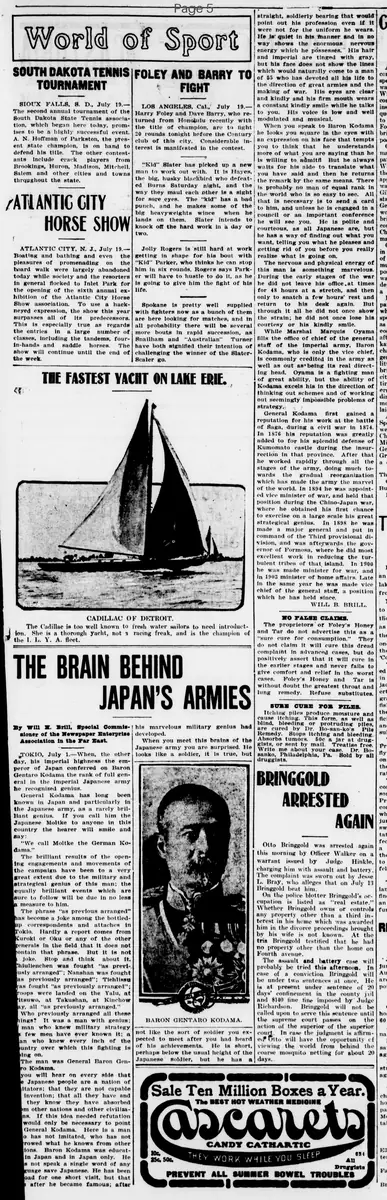
BRAIN
BEHIND
JAPAN'S
ARMIES
By Will K. Brill, Special Commissioner of the Newspaper Enterprise Association in the Far East.
TOKIO, July 1.-When, the other day, his imperial highness the emperor of Japan conferred on Baron Gentaro Kodama the rank of full general in the imperial Japanese army he recognized genius.
General Kodama has long been known in Japan and particularly in the Japanese army, as a rarely brilliant genius.
If you call him the Japanese Moltke to anyone in this country the hearer will smile and say:
"We call Moltke the German Kodama."
The brilliant results of the opening engagements and movements of the campaign have been to a very great extent due to the military and strategical genius of this man; the equally brilliant events which are sure to follow will be due in no less a measure to him.
The phrase "as previously arranged" has become a joke among the bottled-up correspondents and attaches in Tokio. Hardly a report comes from Kuroki or Oku or any of the other generals in the field that it does not contain that phrase.
But it is not a joke. Stop and think about it. Chiulienchen was fought "as previously arranged"; Nanshan was fought "as previously arranged"; Tiehlissy was fought "as previously arranged"; troops were landed on the Yalu, at Pitsuwo, at Takushan, at Kinchow bay, all "as previously arranged."
Who previously arranged all these things? It was a man with genius:
BARON GENTARO KODAMA
a man who knew military strategy as few men have ever known it; a man who knew every inch of the country over which this fighting is going on.
Of his achievements.
He is short, perhaps below the usual height of the Japanese soldier, but he has a straight, soldierly bearing that would point out his profession even if it were not for the uniform he wears. He is quiet in his manner and in no way shows the enormous, nervous energy which he possesses. His hair and imperial are tinged with gray, but his face does not show the lines which would naturally come to a man of 55 who has devoted all his life to the direction of great armies and the making of war. His eyes are clear and kindly and his firm mouth wears a constant kindly smile while he talks to you. His voice is low and well modulated and musical.
When you speak to Baron Kodama he looks you square in the eyes with an expression on his face that tempts you to think that he understands more of what you are saying than he is willing to admit. But he always waits for his aide to translate what you have said and then he returns the remark by the same means. There is probably no man of equal rank in the world who is so easy to see. All that is necessary is to send a card to him, and unless he is engaged in a council or an important conference he will see you. He is polite and courteous, as all Japanese are, but he has a way of finding out what you want, telling you what he pleases and getting rid of you before you really realize what is going on.
The nervous and physical energy of this man is something marvelous. During the early stages of the war he did not leave his office, at times for 48 hours at a stretch, and then only to snatch a few hours' rest and return to his desk again. But through it all he did not once show the strain; he did not once lose his courtesy or his kindly smile.
While Marshal Marquis Oyama fills the office of chief of the general staff of the imperial army, Baron Kodama, who is only the vice chief, is commonly credited in the army as well as out as being its real directing head. Oyama is a fighting man of great ability, but the ability of Kodama excels his in the direction of thinking out schemes and of working out seemingly impossible problems of strategy.
General Kodama first gained a reputation for his work at the battle of Saga, during a civil war in 1874. In 1876 his reputation was greatly added to for his splendid defense of Kumamoto castle during the insurrection in that province. After that he worked rapidly through all the stages of the army, doing much towards the gradual reorganization which has made the army the marvel of the world. In 1894 he was appointed vice minister of war, and held that position during the Chino-Japan war, where he obtained his first chance to exercise on a large scale his great strategical genius. In 1898 he was made a major general and put in command of the Third provisional division, and was afterwards the governor of Formosa, where he did most excellent work in reducing the turbulent tribes of that island. In 1900 he was made minister for war, and in 1903 minister of home affairs. Late in the same year he was made vice chief of the general staff, a position which he has held since.
WILL B. BRILL
What sub-type of article is it?
What keywords are associated?
What entities or persons were involved?
Where did it happen?
Foreign News Details
Primary Location
Tokio
Event Date
July 1
Key Persons
Outcome
baron gentaro kodama conferred rank of full general; credited with strategic successes in early war engagements including chiulienchen, nanshan, tiehlissy, and landings at yalu, pitsuwo, takushan, kinchow bay.
Event Details
Article profiles General Baron Gentaro Kodama as the strategic genius behind Japan's army during the ongoing war, detailing his promotion, physical description, energy, accessibility, and career history from 1874 civil war through positions in Chino-Japan war, Formosa governorship, and vice chief of general staff.