Thank you for visiting SNEWPapers!
Sign up free
Republican Herald
Providence, Providence County, Rhode Island
What is this article about?
Confessions of pirate Charles Gibbs in New York prison, March 1831, detailing his piracy career since 1810, robberies and destructions of over 40 vessels, murders of crews, personal regrets, and attempts to join other conflicts; includes a letter to a former acquaintance.
Merged-components note: These components form a single continuous story on the confessions of pirate Charles Gibbs, spanning page 4 with sequential reading orders and unbroken narrative flow.
Clipping
OCR Quality
Full Text
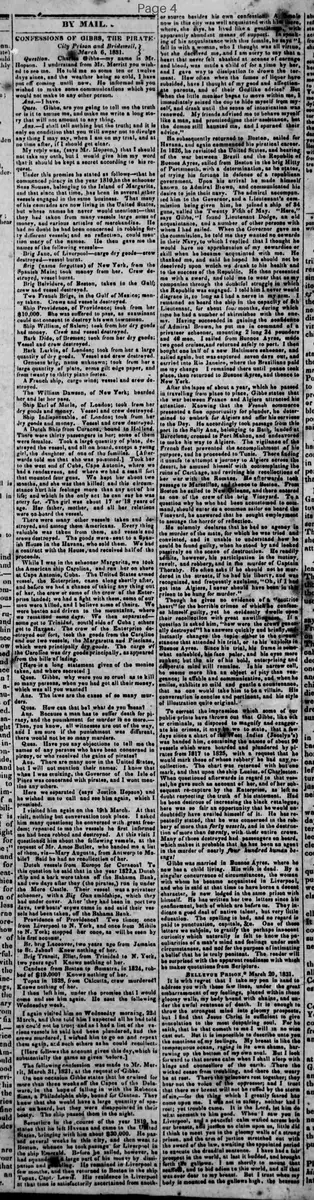
Confessions of Gibbs, the Pirate
City Prison and Bridewell,
On March 6, 1831:
Question. Charles Gibbs--my name is Mr. Hopson. I understand from Mr. Morritt you wished to see me. He told me so some ten or twelve days since, and the weather being so cold, I have put off coming until now. He informed me you wished to make some communications which you would not make to any other person.
Ans.--I have.
Ques. Gibbs, are you going to tell me the truth or is it to amuse me, and make me write a long story that will not amount to any thing.
Ans. I shall tell nothing but the truth; and it is only on condition that you will swear not to divulge any thing I may say, when I am on my trial, and at no time after, if I should get clear.
My reply was, (says Mr. Hopson,) that I should not take my oath, but I would give him my word that it should be kept a secret according to his request.
Under this promise he stated as follows--that he commenced piracy in the year 1810, in the schooner Sans Souci, belonging to the Island of Marguerita, and that since that time, has been in several other vessels engaged in the same business. That many of his comrades are now living in the United States, but whose names he never would mention;--that they had taken from many vessels large sums of money, and various articles of merchandize. He had no doubt he had been concerned in robbing forty different vessels; and on reflection, could mention many of the names. He then gave me the names of the following vessels--
Brig Jane, of Liverpool--cargo dry goods--crew destroyed--vessel burnt.
Brig (name forgotten) of New York, from the Spanish Main; took money from her. Crew destroyed, vessel burnt.
Brig Belvidere, of Boston, taken in the Gulf; crew and vessel destroyed.
Two French Brigs, in the Gulf of Mexico; money taken. Crews and vessels destroyed.
Ship Providence, of Providence; took from her $10,000. She was suffered to pass, as commandant could not consent to destroy his own townsmen.
Ship William, of Salem; took from her dry goods and money. Crew and vessel destroyed.
Bark Dido, of Bremen; took from her dry goods Vessel and crew destroyed.
Bark Larkin, of London; took from her a large quantity of dry goods. Vessel and crew destroyed.
Genoese brig, name unknown; took from her large quantity of plate, some gilt edge paper, and from twenty to thirty piano fortes.
A French ship, cargo wine; vessel and crew destroyed.
The William Dawson, of New York; boarded her and let her pass.
Ship Earl of Morla, of London; took from her dry goods and money. Vessel and crew destroyed.
Ship Indispensable, of London; took from her dry goods and money. Vessel and crew destroyed.
Dutch Ship from Curacoa, bound to Holland. There were thirty passengers in her; some of them were females. Took a large quantity of plate, destroyed the vessel, and all on board, except a young girl, the daughter of one of the families. Afterwards told me that she was poisoned. Took her to the west end of Cuba, Cape Antonio, where we had a rendezvous, and where we had a small fort that mounted four guns. We kept her about two months, and she was then killed; and this circumstance hurt his feelings more than any act of his life; and which is the only act he can say he was sorry for. The girl was about 17 or 18 years of age. Her father, mother, and all her relations were on board the vessel.
There were many other vessels taken and destroyed, and among them Americans. Every thing valuable was taken from them, and vessels and crews destroyed. The goods were sent to a Spanish House in the Havana, who sold them. We had a contract with the House, and received half of the proceeds,
While I was in the schooner Margarita, we took the American ship Carolina, and run her on shore at Cape Antonio, Cuba. The United States armed vessel, the Enterprise, came along shortly after, and before we had a chance of taking any thing out of her, the crew or some of the crew of the Enterprise landed; we had a fight with them, some of our men were killed, and I believe some of theirs. We were beaten and driven to the mountains, where we remained some days. We then separated-- some got to Trinidad, south side of Cuba; others got to Havana. The crew of the Enterprise destroyed our fort, took the goods from the Carolina and our two vessels, the Margaretta and Puciente, which were principally dry goods. The cargo of the Caroline was dry goods principally, as appeared from the bills of lading
[Here is long statement given of the monies taken, and where secreted ]
Ques. Gibbs, why were you so cruel as to kill so many persons, when you had got all their money, which was all you wanted?
Ans. The laws are the cause many murders.
Ques. How can that be? what do you mean?
Ans. Because a man has to suffer death or piracy, and the punishment for murder is no more.-- Then, you know, all witnesses are out of the way, and I am sure if the punishment was different, there would not be so many murders.
Ques. Have you any objections to tell me the names of any persons who have been concerned in piracy, or who received the gains of pirates?
Ans. There are many now in the United States, but I will not mention their names. I know that when I was cruising, the Governor of the Isle of Pines was concerned with pirates, and I won't mention any others.
Here we separated (says Justice Hopson) and he wished me to call and see him again, which I promised.
I visited him again on the 19th March. At that visit, nothing but conversation took place. I asked him many questions; he conversed with great freedom; repeated to me the vessels he first informed me had been robbed and destroyed. At this visit I questioned him about the following vessels, at the request of Mr. Amos Butler, who handed me a list of them, viz--Mary Augusta, from Antwerp to Mobile? Said he had no recollection of her.
Dutch vessels from Europe for Curacoa? To this question he said that in the year 1822. Dutch ship and a bark were taken off the Bahama Bank, and two days after they (the pirates,) run in under the Moro Castle. Their vessel was a privateer schooner, with a Big Gun amidships, which they had under cover. After they had been in port two days, two boats' crews came in and said their vessels had been taken, off the Bahama Bank.
Providence of Providence? Two times; once from Liverpool to N. York, and once from Mobile to N. York; stopped her once, as will be seen by his first account.
Br. brig Lacoover, two years ago from Jamaica to St. Johns? Knew nothing of her.
Brig Transit, Ellet, from Trinidad to N. York, two years ago? Knows nothing of her.
Candace from Boston to Sumatra, in 1824, robbed of $19,000? Knows nothing of her.
Topaz in 1825, from Calcutta, crew murdered? Knows nothing of her.
I then left him, under the promise that I would come and see him again. He said the following Wednesday week.
I again visited him on Wednesday morning, 23d March, and then told him I expected all he had told me could not be true;--and as I had a list of the various vessels he said had been plundered, and the crews murdered, I wished him to go on and repeat them again, and such others as he could recollect.
[Here follows the account given this day, which is substantially the same as given before.]
The following confession was made to Mr. Merritt, March 31, 1831, at the request of Gibbs.
On one occasion Gibbs states that he cruised for more than three weeks off the Cape of the Delaware, in the hope of falling in with the Rebecca Sims, Philadelphia ship, bound for Canton. They knew that she would have a large quantity of specie on board, but they were disappointed in their booty. The ship passed them in the night.
Sometime in the course of the year 1819, he states that he left Havana and came to the United States, bringing with him about $30,000. He passed several weeks in this city, and then went to Boston, whence he took passage for Liverpool in the ship Emerald. Before he sailed, however, he had squandered large part of his money by dissipation and gambling. He remained in Liverpool a few months, and then returned to Boston in the ship Topaz, Capt. Lewis. His residence in Liverpool at that time is satisfactorily ascertained from another source besides his own confession.
A man now in this city was well acquainted with him there where, she says, he lived like a gentleman, with apparently abundant means of support. In speaking of his acquaintance with this female, he says "I fell in with a woman, who I thought was all virtue but she deceived me, and I am sorry to say that heart that never felt abashed at scenes of carnage and blood, was made a child of for a time by her, and I gave way to dissipation to drown the torment. How often when the fumes of liquor have subsided, have I thought of my good and affectionate parents, and of their Godlike advice! But when the little monitor began to move within me, I immediately seized the cup to hide myself from myself, and drank until the sense of intoxication was renewed. My friends advised me to behave myself like a man, and promised me their assistance, but the demon still haunted me, and I spurned their advice."
He subsequently returned to Boston, sailed for Havana, and again commenced his piratical career.
In 1826, he revisited the United States, and hearing of the war between Brazil and the Republic of Buenos Ayres, sailed from Boston in the brig Hitty of Portsmouth, with a determination, as he states, of trying his fortune in defence of a republican government. Upon his arrival he made himself known to Admiral Brown, and communicated his desire to join their navy.
The admiral accompanied him to the Governor, and a Lieutenant's commission being given him, he joined ship of 84 guns, called the Twenty Fifth of May. "Here," says Gibbs, "I found Lieutenant Dodge, an old acquaintance, and a number of other persons with whom I had sailed. When the Governor gave me the commission, he told me they wanted no cowards in their Navy, to which I replied that I thought he would have no apprehension of my cowardice or skill when he became acquainted with me: He thanked me, and said he hoped he should not be deceived; upon which we drank to his health and to the success of the Republic. He then presented me with a sword, and told me to wear that as my companion through the doubtful struggle in which the Republic was engaged. I told him I never would disgrace it, so long as I had a nerve in my arm. I remained on board the ship in the capacity of 8th Lieutenant, for about four months, during which time he had a number of skirmishes with the enemy. Having succeeded in gaining the confidence of Admiral Brown, he put me in command of a privateer schooner, mounting 2 long 24 pounders and 46 men,
I sailed from Buenos Ayres, made two good cruises, and returned safely to port. I then bought one half of a new Baltimore schooner, and sailed again, but was captured seven days out, and carried into Rio Janeiro, where the Brazilians paid me my change I remained there until peace took place, then returned to Buenos Ayres, and thence to New York.
After the lapse of about a year, which he passed in travelling from place to place, Gibbs states that the war between France and Algiers attracted his attention. Knowing that the French commerce presented an opportunity for plunder, he determined to embark for Algiers and offer his services to the Dey.
He accordingly took passage from this port in the Sally Ann, belonging to Bath, landed at Barcelona, crossed to Port Mahon, and endeavored to make his way to Algiers.
The vigilance of the French fleet prevented the accomplishment of his purpose, and he proceeded to Tunis. There finding it unsafe to attempt a journey to Algiers across the desert, he amused himself with contemplating the ruins of Carthage, and reviving his recollections of her war with the Romans,
He afterwards took passage to Marseilles, and thence to Boston. From Boston he sailed to New Orleans, and there entered as one of the crew of the brig Vineyard. To a question why he who had been accustomed to command, should enter do common sailor on board the Vineyard, he answered that he sought employment to assuage the horror of reflection.
He solemnly declares that he had no agency in the murder of the mate, for which he was tried and convicted, and is unable to understand how he could be found guilty, when he stood by and looked passively on the scene of destruction.
He readily admits, however his participation in the mutiny revolt, and robbery, and in the murder of Captain Thoraby. He often asks if he should not be murdered in the streets, if he had his liberty, and recognized, and frequently exclaims, "Oh, if I had got into Algiers, I never should have been in this Prison to be hung for murder."
Though he gives no evidence of a "contrite heart" or the horrible crimes of which he confesses as himself guilty, yet he evidently dwells upon their recollection with great unwillingness. If a question is asked him, how were the crews generally destroyed? he answers quickly and briefly, and instantly changes the topic either to the circumstances that attended his trial, or to his exploits in Buenos Ayres.
Since his trial, his frame in some what enfeebled, his eye paler, and his eyes more sunken; but the air of his bold, enterprising and desperate mind still remains. In his narrow cell, he seems more like an object of pity than vengeance; is affable and communicative, and when he smiles, exhibits so mild and gentle a countenance, that no one would take him to be a villain. His conversation is concise and pertinent, and his style of illustration quite original.
To correct the impression which some of our public prints have thrown out that Gibbs, like other criminals, is disposed to magnify and exaggerate his crimes, it may be well to state, that a few days since a chart of the West Indies (Jocelyn's) was handed him, containing the names of about 90 vessels which were boarded and plundered by pirates from 1817 to 1825, with a request that he would mark those of whose robbery he had any recollection. The chart was returned with but one mark, and that upon the ship Lucius, of Charleston.
When questioned afterwards in regard to that vessel, he gave such an account of her, and of her subsequent re-capture by the Enterprise, as left no doubt respecting the truth of his statement. Had he been desirous of increasing the black catalogue; here was so fair an opportunity that he would undoubtedly have availed himself of it. He has repeatedly stated, that he was concerned in the robbery of more than forty vessels, and in the destruction of more than twenty, with their entire crews.
Many of those destroyed had passengers on board, which makes it probable that he has been an agent in the murder of nearly one hundred human beings!
Gibbs was married in Buenos Ayres, where he now has a child living. His wife is dead. By a singular concurrence of circumstances, the woman with whom he became acquainted in Liverpool, and who is said at that time to have borne a decent character, is now lodged in the same prison with himself. He has written her two letters since his confinement, both of which are before us. They indicate a good deal of native talent, but very little education. The spelling is bad, and no regard is paid to punctuation, capitals, &c. One of these letters we subjoin, to gratify the perhaps innocent curiosity which naturally is apt to know the peculiarities of a man's mind and feelings under such circumstances, and not for the purpose of intimating a belief that he is truly penitent. The reader will be surprised with the apparent readiness with which he makes quotations from Scripture.
Bellevue Prison, March 20, 1831
It is with regret that I take my pen in hand to address you with these few lines, under the great embarrassment of my feelings, placed within these gloomy walls, my body bound with chains, and under the awful sentence of death. It is enough to throw the strongest mind into gloomy prospects, but I find that Jesus Christ is sufficient to give consolation to the most despairing soul.
For he saith, that he that cometh to me I will in no wise cast out.
But it is impossible to describe unto you the emotions of my feelings.
My breast is like the tempestuous ocean, raging in its own shame, harrowing up the bottom of my own soul. But I look forward to that serene calm when I shall sleep with kings and counsellors of the earth. There the wicked cease from troubling, and there the weary be at rest.
Therefore the prisoners rest together; they hear not the voice of the oppressor; and I trust that there my breast will not be ruffled by the storm of sin, for the thing which greatly feared has come upon me.
I was not in safety, neither had I rest; yet trouble came.
It is the Lord, let him do what seemeth to him good.
When I saw you in Liverpool, and a peaceful calm wafted across both our breasts, and justice no claim upon us, little did I think to meet you in the gloomy walls of a strong prison. and the arm of justice stretched out with the sword of the law, awaiting the appointed period to execute the dreadful sentence.
I have had a fair prospect in the world, at last it budded, and brought forth the gallows. I am shortly to mount that scaffold, and to bid adieu to this world, and if that was ever dear my breast body is mounted on the gallows high, the heavens above will smile and pity Hope that you will reflect on your past, and try to, that Jesus who stands with open arms to receive you. Your character is lost, it is true. When the wicked turneth from the wickedness that they have committed, they shall save their soul alive.
Let us imagine for a moment that we see, the souls standing before the awful tribunal, and we hear its dreadful sentence, depart ye cursed into everlasting fire.
Imagine you hear the awful Jamonitions of a soul in hell.
It would be enough to melt your heart it was ad hard as adamant You would fall upon your knees and plead for God's mercy, as a starved person would for food, or as a dying criminal would for a pardon.
We soon, very soon, must the was hence we shall me'er return. Our names will be struck off the records of the living, and enrolled in the vast catalogues of the dead.
But may it ne'er be numbered with the damned.
I hope it will please God to set you at your liberty, and that you may see the sin and follies of your life past.
I shall now close my letter with a few words which I hope you will receive as from a dying man: and I hope that every important truth of this letter may sink deep in your heart and be a lesson to you through life.
Rising griefs distress my soul,
And tears on tears successive roll,--
For many an evil voice is near,
To chide my woes and mock my fear;
And silent memory weeps alone,
O'er hours of peace and gladness flown,
I still remain your sincere friend.
Charles Gibbs.
We have thought best to correct the spelling and punctuation. In other respects the letter stands as it was written.--Edis. J C
What sub-type of article is it?
What themes does it cover?
What keywords are associated?
What entities or persons were involved?
Where did it happen?
Story Details
Key Persons
Location
City Prison, New York; At Sea; Cuba; Havana; Liverpool; Buenos Ayres
Event Date
March 6, 1831; Career From 1810
Story Details
Charles Gibbs confesses to Mr. Hopson his piracy starting in 1810 aboard schooner Sans Souci, detailing robberies and destructions of over 40 vessels including crews and passengers murdered; recounts specific ships plundered, a regretted killing of a young girl, encounters with US vessel Enterprise, attempts to join wars in Buenos Ayres and Algiers, mutiny on Vineyard, and writes a reflective letter from prison.