Thank you for visiting SNEWPapers!
Sign up free
Literary
June 17, 1929
The Daily Worker
Chicago, Cook County, Illinois
What is this article about?
Gleb Chumalov, a Red Army commander, leads the reconstruction of a ruined cement factory on the Black Sea after the Civil War. Amid enthusiastic labor, a bandit attack from the mountains causes panic, but Gleb rallies Communists and workers to defend the site while continuing work.
Clipping
OCR Quality
95%
Excellent
Full Text
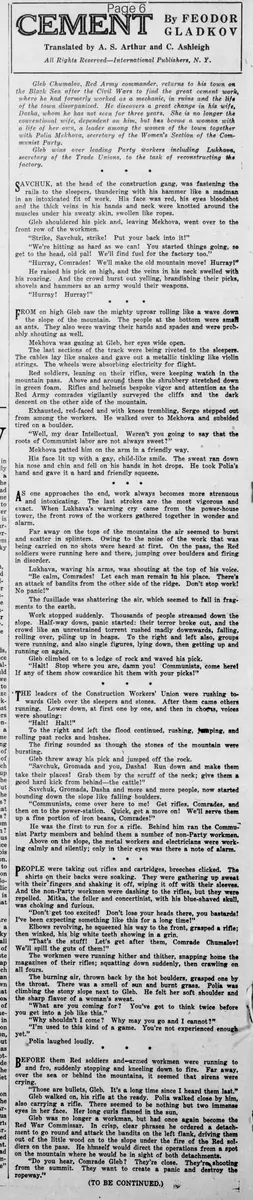
CEMENT
GLADKOV
By FEODOR
Translated by A. S. Arthur and C. Ashleigh
All Rights Reserved—International Publishers, N. Y.
Gleb Chumalov, Red Army commander, returns to his town on the Black Sea after the Civil War to find the great cement work where he had formerly worked as a mechanic, in ruins and the life of the town disorganized. He discovers a great change in his wife, Dasha, whom he has not seen for three years. She is no longer the conventional wife, dependent on him, but has become a woman with a life of her own, a leader among the women of the town together with Polia Mekhova, secretary of the Women's Section of the Communist Party.
Gleb wins over leading Party workers including Lukhava, secretary of the Trade Unions, to the task of reconstructing the factory.
SAVCHUK, at the head of the construction gang, was fastening the rails to the sleepers, thundering with his hammer like a madman in an intoxicated fit of work. His face was red, his eyes bloodshot and the thick veins in his hands and neck were knotted around the muscles under his sweaty skin, swollen like ropes.
Gleb shouldered his pick and, leaving Mekhova, went over to the front row of the workmen.
"Strike, Savchuk, strike! Put your back into it!"
"We're hitting as hard as we can! You started things going, so get to the head, old pal! We'll find fuel for the factory too."
"Hurray, Comrades! We'll make the old mountain move! Hurray!"
He raised his pick on high, and the veins in his neck swelled with his roaring. And the crowd burst out yelling, brandishing their picks, shovels and hammers as an army would their weapons.
"Hurray! Hurray!"
FROM on high Gleb saw the mighty uproar rolling like a wave down the slope of the mountain. The people at the bottom were small as ants. They also were waving their hands and spades and were probably shouting as well.
Mekhova was gazing at Gleb, her eyes wide open.
The last sections of the track were being riveted to the sleepers. The cables lay like snakes and gave out a metallic tinkling like violin strings. The wheels were absorbing electricity for flight.
Red soldiers, leaning on their rifles, were keeping watch in the mountain pass. Above and around them the shrubbery stretched down in green foam. Rifles and helmets bespoke vigor and attention as the Red Army comrades vigilantly surveyed the cliffs and the dark descent on the other side of the mountain.
Exhausted, red-faced and with knees trembling, Serge stepped out from among the workers. He walked over to Mekhova and subsided tired on a boulder.
"Well, my dear Intellectual. Weren't you going to say that the roots of Communist labor are not always sweet?"
Mekhova patted him on the arm in a friendly way.
His face lit up with a gay, child-like smile. The sweat ran down his nose and chin and fell on his hands in hot drops. He took Polia's hand and gave it a hard and friendly squeeze.
S one approaches the end, work always becomes more strenuous and intoxicating. The last strokes are the most vigorous and exact. When Lukhava's warning cry came from the power-house tower, the front rows of the workers gathered together in wonder and alarm.
Far away on the tops of the mountains the air seemed to burst and scatter in splinters. Owing to the noise of the work that was being carried on no shots were heard at first. On the pass, the Red soldiers were running here and there, jumping over boulders and firing in disorder.
Lukhava, waving his arms, was shouting at the top of his voice.
"Be calm, Comrades! Let each man remain in his place. There's an attack of bandits from the other side of the ridge. Don't stop work! No panic!"
The fusillade was shattering the air, which seemed to fall in fragments to the earth.
Work stopped suddenly. Thousands of people streamed down the slope. Half-way down, panic started: their terror broke out, and the crowd like an unrestrained torrent rushed madly downwards, falling, rolling over, piling up in heaps. To the right and left also, groups were running, and also single figures, lying down, then getting up and running on again.
Gleb climbed on to a ledge of rock and waved his pick.
"Halt! Stop where you are, damn you! 'Communists, come here! If any of them show cowardice hit them with your picks!"
THE leaders of the Construction Workers' Union were rushing towards Gleb over the sleepers and stones. After them came others running. Lower down, at first one by one, and then in choirs, voices were shouting:
"Halt! Halt!"
To the right and left the flood continued, rushing, jumping, and rolling past rocks and bushes.
The firing sounded as though the stones of the mountain were bursting.
Gleb threw away his pick and jumped off the rock.
"Savchuk, Gromada and you, Dasha! Run down and make them take their places! Grab them by the scruff of the neck; give them a good hard kick from behind—the cattle!"
Savchuk, Gromada, Dasha and more and more people, now started bounding down the slope like falling boulders.
"Communists, come over here to me! Get rifles, Comrades, and then on to the power-station. Quick, get a move on! We'll serve them up a fine portion of iron beans, Comrades!"
He was the first to run for a rifle. Behind him ran the Communist Party members and behind them a number of non-Party workmen.
Above on the slope, the metal workers and electricians were working calmly and silently; only in their eyes was there a note of alarm.
PEOPLE were taking out rifles and cartridges, breeches clicked. The shirts on their backs were soaking. They were gathering up sweat with their fingers and shaking it off, wiping it off with their sleeves.
And the non-Party workmen were dashing to the rifles, but they were repelled. Mitka, the feller and concertinist, with his blue-shaved skull, was choking and furious.
"Don't get too excited! Don't lose your heads there, you bastards! I've been expecting something like this for a long time!"
Elbows revolving, he squeezed his way to the front, grasped a rifle; then winked, his big white teeth showing in a grin.
"That's the stuff! Let's get after them, Comrade Chumalov! We'll spill the guts of them!"
The workmen were running hither and thither, snapping home the magazines of their rifles; squatting down suddenly, then crawling on all fours.
The burning air, thrown back by the hot boulders, grasped one by the throat. There was a smell of sun and burnt grass. Polia was climbing the stony slope next to Gleb. He felt her soft shoulder and the sharp flavor of a woman's sweat.
"What are you coming for? You've got to think twice before you get into a job like this."
"Why shouldn't I come? Why may you go and I cannot?"
"I'm used to this kind of a game. You're not experienced enough yet."
Polia laughed loudly.
BEFORE them Red soldiers and armed workmen were running to and fro, suddenly stopping and kneeling down to fire. Far away, over the sea or behind the mountains, it seemed that sirens were crying.
"Those are bullets, Gleb. It's a long time since I heard them last."
Gleb walked on, his rifle at the ready. Polia walked close by him, also carrying a rifle. There seemed to be nothing but two immense eyes in her face. Her long curls flamed in the sun.
Gleb was no longer a workman, but had once again become the Red War Commissar. In crisp, clear phrases he ordered a detachment to go round and attack the bandits on the left flank, driving them out of the little wood on to the slope under the fire of the Red soldiers on the pass. He himself would direct the operations from a spot on the mountain where he would be in sight of both detachments.
"Do you hear, Comrade Gleb? They're close. They're shooting from the summit. They want to create a panic and destroy the ropeway."
(TO BE CONTINUED.)
GLADKOV
By FEODOR
Translated by A. S. Arthur and C. Ashleigh
All Rights Reserved—International Publishers, N. Y.
Gleb Chumalov, Red Army commander, returns to his town on the Black Sea after the Civil War to find the great cement work where he had formerly worked as a mechanic, in ruins and the life of the town disorganized. He discovers a great change in his wife, Dasha, whom he has not seen for three years. She is no longer the conventional wife, dependent on him, but has become a woman with a life of her own, a leader among the women of the town together with Polia Mekhova, secretary of the Women's Section of the Communist Party.
Gleb wins over leading Party workers including Lukhava, secretary of the Trade Unions, to the task of reconstructing the factory.
SAVCHUK, at the head of the construction gang, was fastening the rails to the sleepers, thundering with his hammer like a madman in an intoxicated fit of work. His face was red, his eyes bloodshot and the thick veins in his hands and neck were knotted around the muscles under his sweaty skin, swollen like ropes.
Gleb shouldered his pick and, leaving Mekhova, went over to the front row of the workmen.
"Strike, Savchuk, strike! Put your back into it!"
"We're hitting as hard as we can! You started things going, so get to the head, old pal! We'll find fuel for the factory too."
"Hurray, Comrades! We'll make the old mountain move! Hurray!"
He raised his pick on high, and the veins in his neck swelled with his roaring. And the crowd burst out yelling, brandishing their picks, shovels and hammers as an army would their weapons.
"Hurray! Hurray!"
FROM on high Gleb saw the mighty uproar rolling like a wave down the slope of the mountain. The people at the bottom were small as ants. They also were waving their hands and spades and were probably shouting as well.
Mekhova was gazing at Gleb, her eyes wide open.
The last sections of the track were being riveted to the sleepers. The cables lay like snakes and gave out a metallic tinkling like violin strings. The wheels were absorbing electricity for flight.
Red soldiers, leaning on their rifles, were keeping watch in the mountain pass. Above and around them the shrubbery stretched down in green foam. Rifles and helmets bespoke vigor and attention as the Red Army comrades vigilantly surveyed the cliffs and the dark descent on the other side of the mountain.
Exhausted, red-faced and with knees trembling, Serge stepped out from among the workers. He walked over to Mekhova and subsided tired on a boulder.
"Well, my dear Intellectual. Weren't you going to say that the roots of Communist labor are not always sweet?"
Mekhova patted him on the arm in a friendly way.
His face lit up with a gay, child-like smile. The sweat ran down his nose and chin and fell on his hands in hot drops. He took Polia's hand and gave it a hard and friendly squeeze.
S one approaches the end, work always becomes more strenuous and intoxicating. The last strokes are the most vigorous and exact. When Lukhava's warning cry came from the power-house tower, the front rows of the workers gathered together in wonder and alarm.
Far away on the tops of the mountains the air seemed to burst and scatter in splinters. Owing to the noise of the work that was being carried on no shots were heard at first. On the pass, the Red soldiers were running here and there, jumping over boulders and firing in disorder.
Lukhava, waving his arms, was shouting at the top of his voice.
"Be calm, Comrades! Let each man remain in his place. There's an attack of bandits from the other side of the ridge. Don't stop work! No panic!"
The fusillade was shattering the air, which seemed to fall in fragments to the earth.
Work stopped suddenly. Thousands of people streamed down the slope. Half-way down, panic started: their terror broke out, and the crowd like an unrestrained torrent rushed madly downwards, falling, rolling over, piling up in heaps. To the right and left also, groups were running, and also single figures, lying down, then getting up and running on again.
Gleb climbed on to a ledge of rock and waved his pick.
"Halt! Stop where you are, damn you! 'Communists, come here! If any of them show cowardice hit them with your picks!"
THE leaders of the Construction Workers' Union were rushing towards Gleb over the sleepers and stones. After them came others running. Lower down, at first one by one, and then in choirs, voices were shouting:
"Halt! Halt!"
To the right and left the flood continued, rushing, jumping, and rolling past rocks and bushes.
The firing sounded as though the stones of the mountain were bursting.
Gleb threw away his pick and jumped off the rock.
"Savchuk, Gromada and you, Dasha! Run down and make them take their places! Grab them by the scruff of the neck; give them a good hard kick from behind—the cattle!"
Savchuk, Gromada, Dasha and more and more people, now started bounding down the slope like falling boulders.
"Communists, come over here to me! Get rifles, Comrades, and then on to the power-station. Quick, get a move on! We'll serve them up a fine portion of iron beans, Comrades!"
He was the first to run for a rifle. Behind him ran the Communist Party members and behind them a number of non-Party workmen.
Above on the slope, the metal workers and electricians were working calmly and silently; only in their eyes was there a note of alarm.
PEOPLE were taking out rifles and cartridges, breeches clicked. The shirts on their backs were soaking. They were gathering up sweat with their fingers and shaking it off, wiping it off with their sleeves.
And the non-Party workmen were dashing to the rifles, but they were repelled. Mitka, the feller and concertinist, with his blue-shaved skull, was choking and furious.
"Don't get too excited! Don't lose your heads there, you bastards! I've been expecting something like this for a long time!"
Elbows revolving, he squeezed his way to the front, grasped a rifle; then winked, his big white teeth showing in a grin.
"That's the stuff! Let's get after them, Comrade Chumalov! We'll spill the guts of them!"
The workmen were running hither and thither, snapping home the magazines of their rifles; squatting down suddenly, then crawling on all fours.
The burning air, thrown back by the hot boulders, grasped one by the throat. There was a smell of sun and burnt grass. Polia was climbing the stony slope next to Gleb. He felt her soft shoulder and the sharp flavor of a woman's sweat.
"What are you coming for? You've got to think twice before you get into a job like this."
"Why shouldn't I come? Why may you go and I cannot?"
"I'm used to this kind of a game. You're not experienced enough yet."
Polia laughed loudly.
BEFORE them Red soldiers and armed workmen were running to and fro, suddenly stopping and kneeling down to fire. Far away, over the sea or behind the mountains, it seemed that sirens were crying.
"Those are bullets, Gleb. It's a long time since I heard them last."
Gleb walked on, his rifle at the ready. Polia walked close by him, also carrying a rifle. There seemed to be nothing but two immense eyes in her face. Her long curls flamed in the sun.
Gleb was no longer a workman, but had once again become the Red War Commissar. In crisp, clear phrases he ordered a detachment to go round and attack the bandits on the left flank, driving them out of the little wood on to the slope under the fire of the Red soldiers on the pass. He himself would direct the operations from a spot on the mountain where he would be in sight of both detachments.
"Do you hear, Comrade Gleb? They're close. They're shooting from the summit. They want to create a panic and destroy the ropeway."
(TO BE CONTINUED.)
What sub-type of article is it?
Prose Fiction
What themes does it cover?
Political
War Peace
What keywords are associated?
Cement Factory
Red Army
Bandit Attack
Communist Labor
Factory Reconstruction
What entities or persons were involved?
By Feodor Gladkov Translated By A. S. Arthur And C. Ashleigh
Literary Details
Title
Cement
Author
By Feodor Gladkov Translated By A. S. Arthur And C. Ashleigh
Subject
Reconstruction Of Cement Factory Interrupted By Bandit Attack
Form / Style
Narrative Prose Excerpt From Novel
Key Lines
"Strike, Savchuk, Strike! Put Your Back Into It!"
"Hurray, Comrades! We'll Make The Old Mountain Move! Hurray!"
"Halt! Stop Where You Are, Damn You! 'Communists, Come Here! If Any Of Them Show Cowardice Hit Them With Your Picks!"
"Communists, Come Over Here To Me! Get Rifles, Comrades, And Then On To The Power Station. Quick, Get A Move On! We'll Serve Them Up A Fine Portion Of Iron Beans, Comrades!"