Thank you for visiting SNEWPapers!
Sign up free
Letter to Editor
August 28, 1832
Richmond Enquirer
Richmond, Richmond County, Virginia
What is this article about?
A physician submits facts on cholera morbus, comparing it to historical epidemics like yellow fever and medieval plagues, to alleviate public fear and dread in the United States, emphasizing it's not more contagious or deadly than past diseases.
Clipping
OCR Quality
95%
Excellent
Full Text
FOR THE ENQUIRER.
CHOLERA MORBUS.
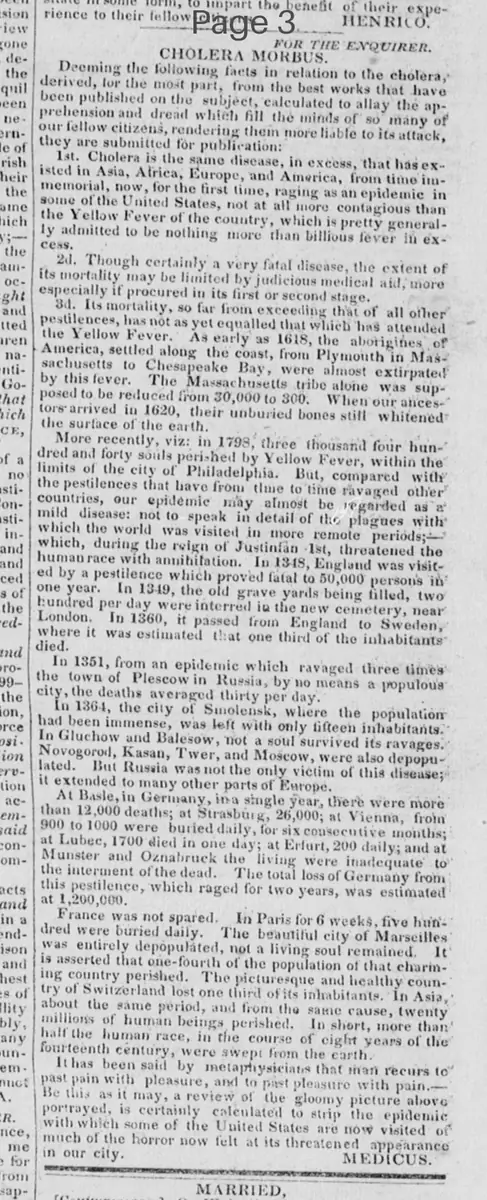
Deeming the following facts in relation to the cholera, derived, for the most part, from the best works that have been published on the subject, calculated to allay the apprehension and dread which fill the minds of so many of our fellow citizens, rendering them more liable to its attack, they are submitted for publication:
1st. Cholera is the same disease, in excess, that has existed in Asia, Africa, Europe, and America, from time immemorial, now, for the first time, raging as an epidemic in some of the United States, not at all more contagious than the Yellow Fever of the country, which is pretty generally admitted to be nothing more than billious fever in excess.
2d. Though certainly a very fatal disease, the extent of its mortality may be limited by judicious medical aid, more especially if procured in its first or second stage.
3d. Its mortality, so far from exceeding that of all other pestilences, has not as yet equalled that which has attended the Yellow Fever. As early as 1618, the aborigines of America, settled along the coast, from Plymouth in Massachusetts to Chesapeake Bay, were almost extirpated by this fever. The Massachusetts tribe alone was supposed to be reduced from 30,000 to 300. When our ancestors arrived in 1620, their unburied bones still whitened the surface of the earth.
More recently, viz: in 1793. three thousand four hundred and forty souls perished by Yellow Fever, within the limits of the city of Philadelphia. But, compared with the pestilences that have from time to time ravaged other countries, our epidemic may almost be regarded as a mild disease: not to speak in detail of the plagues with which the world was visited in more remote periods; which, during the reign of Justinian Ist, threatened the human race with annihilation. In 1348, England was visited by a pestilence which proved fatal to 50,000 persons in one year. In 1349, the old grave yards being filled, two hundred per day were interred in the new cemetery, near London. In 1360, it passed from England to Sweden, where it was estimated that one third of the inhabitants died.
In 1351, from an epidemic which ravaged three times the town of Plescow in Russia, by no means a populous city, the deaths averaged thirty per day.
In 1364, the city of Smolensk, where the population had been immense, was left with only fifteen inhabitants. In Gluchow and Balesow, not a soul survived its ravages. Novogorod, Kasan, Twer, and Moscow, were also depopulated. But Russia was not the only victim of this disease; it extended to many other parts of Europe.
At Basle, in Germany, in a single year, there were more than 12,000 deaths; at Strasburg, 26,000; at Vienna, from 900 to 1000 were buried daily, for six consecutive months; at Lubec, 1700 died in one day; at Erfurt, 200 daily; and at Munster and Oznabruck the living were inadequate to the interment of the dead. The total loss of Germany from this pestilence, which raged for two years, was estimated at 1,200,000.
France was not spared. In Paris for 6 weeks, five hundred were buried daily. The beautiful city of Marseilles was entirely depopulated, not a living soul remained. It is asserted that one-fourth of the population of that charming country perished. The picturesque and healthy country of Switzerland lost one third of its inhabitants. In Asia, about the same period, and from the same cause, twenty millions of human beings perished. In short, more than half the human race, in the course of eight years of the fourteenth century, were swept from the earth.
It has been said by metaphysicians that man recurs to past pain with pleasure, and to past pleasure with pain.- Be this as it may, a review of the gloomy picture above portrayed, is certainly calculated to strip the epidemic with which some of the United States are now visited of much of the horror now felt at its threatened appearance in our city.
MEDICUS.
CHOLERA MORBUS.
Deeming the following facts in relation to the cholera, derived, for the most part, from the best works that have been published on the subject, calculated to allay the apprehension and dread which fill the minds of so many of our fellow citizens, rendering them more liable to its attack, they are submitted for publication:
1st. Cholera is the same disease, in excess, that has existed in Asia, Africa, Europe, and America, from time immemorial, now, for the first time, raging as an epidemic in some of the United States, not at all more contagious than the Yellow Fever of the country, which is pretty generally admitted to be nothing more than billious fever in excess.
2d. Though certainly a very fatal disease, the extent of its mortality may be limited by judicious medical aid, more especially if procured in its first or second stage.
3d. Its mortality, so far from exceeding that of all other pestilences, has not as yet equalled that which has attended the Yellow Fever. As early as 1618, the aborigines of America, settled along the coast, from Plymouth in Massachusetts to Chesapeake Bay, were almost extirpated by this fever. The Massachusetts tribe alone was supposed to be reduced from 30,000 to 300. When our ancestors arrived in 1620, their unburied bones still whitened the surface of the earth.
More recently, viz: in 1793. three thousand four hundred and forty souls perished by Yellow Fever, within the limits of the city of Philadelphia. But, compared with the pestilences that have from time to time ravaged other countries, our epidemic may almost be regarded as a mild disease: not to speak in detail of the plagues with which the world was visited in more remote periods; which, during the reign of Justinian Ist, threatened the human race with annihilation. In 1348, England was visited by a pestilence which proved fatal to 50,000 persons in one year. In 1349, the old grave yards being filled, two hundred per day were interred in the new cemetery, near London. In 1360, it passed from England to Sweden, where it was estimated that one third of the inhabitants died.
In 1351, from an epidemic which ravaged three times the town of Plescow in Russia, by no means a populous city, the deaths averaged thirty per day.
In 1364, the city of Smolensk, where the population had been immense, was left with only fifteen inhabitants. In Gluchow and Balesow, not a soul survived its ravages. Novogorod, Kasan, Twer, and Moscow, were also depopulated. But Russia was not the only victim of this disease; it extended to many other parts of Europe.
At Basle, in Germany, in a single year, there were more than 12,000 deaths; at Strasburg, 26,000; at Vienna, from 900 to 1000 were buried daily, for six consecutive months; at Lubec, 1700 died in one day; at Erfurt, 200 daily; and at Munster and Oznabruck the living were inadequate to the interment of the dead. The total loss of Germany from this pestilence, which raged for two years, was estimated at 1,200,000.
France was not spared. In Paris for 6 weeks, five hundred were buried daily. The beautiful city of Marseilles was entirely depopulated, not a living soul remained. It is asserted that one-fourth of the population of that charming country perished. The picturesque and healthy country of Switzerland lost one third of its inhabitants. In Asia, about the same period, and from the same cause, twenty millions of human beings perished. In short, more than half the human race, in the course of eight years of the fourteenth century, were swept from the earth.
It has been said by metaphysicians that man recurs to past pain with pleasure, and to past pleasure with pain.- Be this as it may, a review of the gloomy picture above portrayed, is certainly calculated to strip the epidemic with which some of the United States are now visited of much of the horror now felt at its threatened appearance in our city.
MEDICUS.
What sub-type of article is it?
Informative
Historical
Persuasive
What themes does it cover?
Health Medicine
What keywords are associated?
Cholera Morbus
Yellow Fever
Historical Epidemics
Public Fear
Medical Aid
Plagues
Mortality Rates
What entities or persons were involved?
Medicus.
For The Enquirer.
Letter to Editor Details
Author
Medicus.
Recipient
For The Enquirer.
Main Argument
cholera morbus is a familiar disease in excess, not more contagious than yellow fever, and its mortality can be limited with early medical aid; historical epidemics show it is less severe than past plagues, aiming to reduce public fear.
Notable Details
Compares Cholera To Yellow Fever Epidemics In 1618 And 1793 Philadelphia
Details Medieval Plagues In Europe, Russia, Asia With Massive Death Tolls
Quotes Metaphysicians On Recalling Past Pain