Thank you for visiting SNEWPapers!
Sign up free
Richmond Enquirer
Richmond, Richmond County, Virginia
What is this article about?
John Howe of King George recants his vote in the Virginia House of Delegates for an amendment to the Expunging Resolutions that would allow U.S. Senators to judge the constitutionality of instructions from the legislature. He strongly supports the right of instruction, arguing senators should resign if they disagree rather than disobey the people's will. Dated March 2, 1836.
Clipping
OCR Quality
Full Text
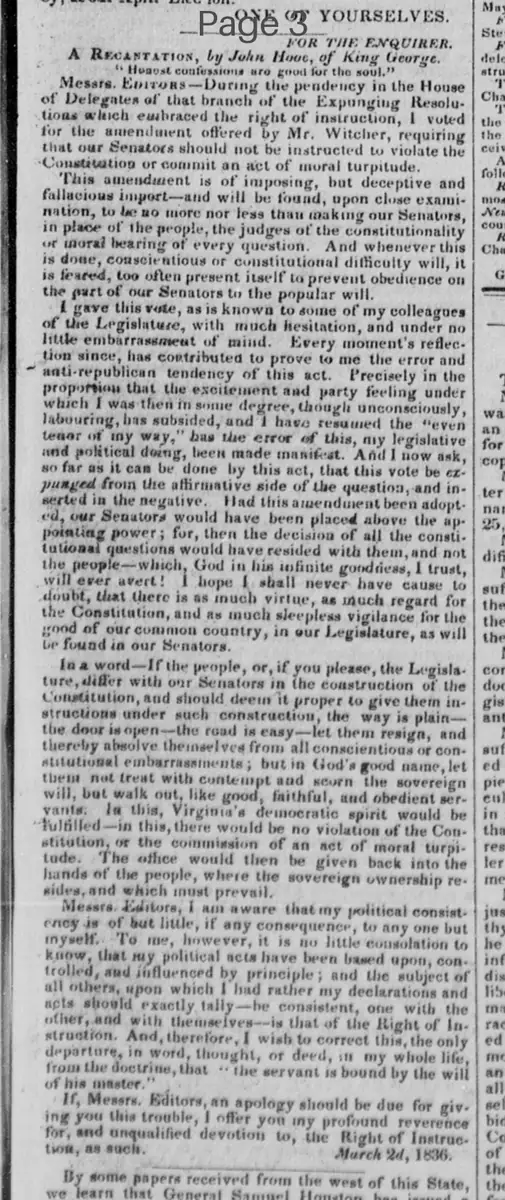
A Recantation, by John Howe, of King George.
"Honest confessions are good for the soul."
Messrs. Editors—During the pendency in the House of Delegates of that branch of the Expunging Resolutions which embraced the right of instruction, I voted for the amendment offered by Mr. Witcher, requiring that our Senators should not be instructed to violate the Constitution or commit an act of moral turpitude. This amendment is of imposing, but deceptive and fallacious import—and will be found, upon close examination, to be no more nor less than making our Senators, in place of the people, the judges of the constitutionality or moral bearing of every question. And whenever this is done, conscientious or constitutional difficulty will, it is feared, too often present itself to prevent obedience on the part of our Senators to the popular will.
I gave this vote, as is known to some of my colleagues of the Legislature, with much hesitation, and under no little embarrassment of mind. Every moment's reflection since, has contributed to prove to me the error and anti-republican tendency of this act. Precisely in the proportion that the excitement and party feeling under which I was then in some degree, though unconsciously, labouring, has subsided, and I have resumed the "even tenor of my way," has the error of this, my legislative and political doing, been made manifest.
And I now ask, so far as it can be done by this act, that this vote be expunged from the affirmative side of the question, and inserted in the negative. Had this amendment been adopted, our Senators would have been placed above the appointing power; for, then the decision of all the constitutional questions would have resided with them, and not the people—which, God in his infinite goodness, I trust, will ever avert!
I hope I shall never have cause to doubt, that there is as much virtue, as much regard for the Constitution, and as much sleepless vigilance for the good of our common country, in our Legislature, as will be found in our Senators.
In a word—If the people, or, if you please, the Legislature, differ with our Senators in the construction of the Constitution, and should deem it proper to give them instructions under such construction, the way is plain—the door is open—the road is easy—let them resign, and thereby absolve themselves from all conscientious or constitutional embarrassments; but in God's good name, let them not treat with contempt and scorn the sovereign will, but walk out, like good, faithful, and obedient servants. In this, Virginia's democratic spirit would be fulfilled—in this, there would be no violation of the Constitution, or the commission of an act of moral turpitude. The office would then be given back into the hands of the people, where the sovereign ownership resides, and which must prevail.
Messrs. Editors, I am aware that my political consistency is of but little, if any consequence, to any one but myself. To me, however, it is no little consolation to know, that my political acts have been based upon, controlled, and influenced by principle; and the subject of all others, upon which I had rather my declarations and acts should exactly tally—be consistent, one with the other, and with themselves—is that of the Right of Instruction.
And, therefore, I wish to correct this, the only departure, in word, thought, or deed, in my whole life, from the doctrine, that "the servant is bound by the will of his master."
If, Messrs. Editors, an apology should be due for giving you this trouble, I offer you my profound reverence for, and unqualified devotion to, the Right of Instruction, as such.
March 2d, 1836.
What sub-type of article is it?
What themes does it cover?
What keywords are associated?
What entities or persons were involved?
Letter to Editor Details
Author
John Howe, Of King George
Recipient
Messrs. Editors
Main Argument
john howe recants his vote for an amendment to the expunging resolutions that would allow u.s. senators to override legislative instructions on constitutional grounds, affirming that senators must obey the people's will or resign, upholding the right of instruction.
Notable Details