Thank you for visiting SNEWPapers!
Sign up free
Henderson Daily Dispatch
Henderson, Vance County, North Carolina
What is this article about?
In Raleigh, NC, educational leaders like UNC President Frank Graham advocate for a state sales tax, believing it would have prevented 1931 salary cuts for teachers and professors, blaming Governor O. Max Gardner. However, figures show a 1% sales tax would yield only $3,920,000 annually, insufficient to offset $4,500,000 tax increases.
Merged-components note: Continuation of the article on educational advocates for sales tax from page 1 to page 6.
Clippings
1 of 2
OCR Quality
Full Text
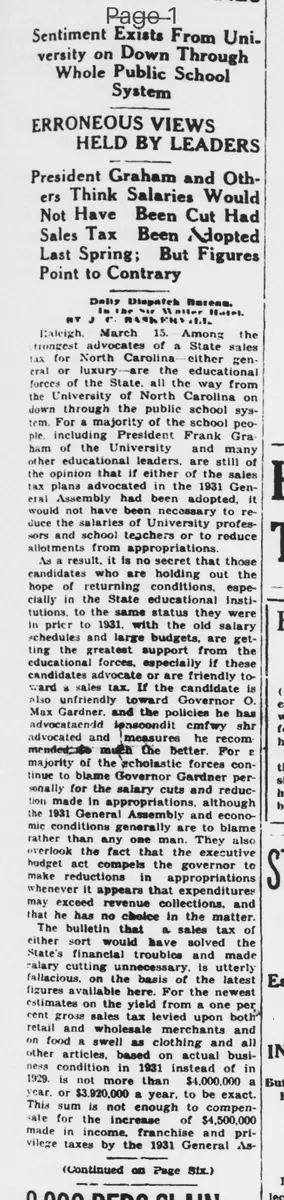
ERRONEOUS VIEWS HELD BY LEADERS
President Graham and Others Think Salaries Would Not Have Been Cut Had Sales Tax Been Adopted Last Spring;
But Figures Point to Contrary.
Raleigh, March 15. Among the strongest advocates of a State sales tax for North Carolina—either general or luxury—are the educational forces of the State, all the way from the University of North Carolina on down through the public school system. For a majority of the school people, including President Frank Graham of the University and many other educational leaders, are still of the opinion that if either of the sales tax plans advocated in the 1931 General Assembly had been adopted, it would not have been necessary to reduce the salaries of University professors and school teachers or to reduce allotments from appropriations.
As a result, it is no secret that those candidates who are holding out the hope of returning conditions, especially in the State educational institutions, to the same status they were in prior to 1931, with the old salary schedules and large budgets, are getting the greatest support from the educational forces, especially if these candidates advocate or are friendly toward a sales tax. If the candidate is also unfriendly toward Governor O. Max Gardner, and the policies he has advocated and measures he recommended to run the better. For a majority of the scholastic forces continue to blame Governor Gardner personally for the salary cuts and reductions made in appropriations, although the 1931 General Assembly and economic conditions generally are to blame rather than any one man. They also overlook the fact that the executive budget act compels the governor to make reductions in appropriations whenever it appears that expenditures may exceed revenue collections, and that he has no choice in the matter.
The belief that a sales tax of either sort would have solved the State's financial troubles and made salary cutting unnecessary, is utterly fallacious, on the basis of the latest figures available here. For the newest estimates on the yield from a one per cent gross sales tax levied upon both retail and wholesale merchants and on food as well as clothing and all other articles, based on actual business condition in 1931 instead of in 1929, is not more than $4,000,000 a year, or $3,920,000 a year, to be exact.
This sum is not enough to compensate for the increase of $4,500,000 made in income, franchise and privilege taxes by the 1931 General Assembly
(Continued on Page Six.)
What sub-type of article is it?
What keywords are associated?
What entities or persons were involved?
Where did it happen?
Domestic News Details
Primary Location
Raleigh, North Carolina
Event Date
March 15
Key Persons
Outcome
estimated 1% sales tax yield: $3,920,000 annually; insufficient to offset $4,500,000 increase in income, franchise, and privilege taxes; salary cuts and appropriation reductions occurred in 1931.
Event Details
Educational leaders in North Carolina, including UNC President Frank Graham, advocate for a state sales tax, believing its adoption in the 1931 General Assembly would have prevented salary reductions for professors and teachers and cuts in appropriations. They blame Governor O. Max Gardner personally, overlooking the role of the General Assembly, economic conditions, and the executive budget act. However, latest figures show the belief is fallacious, as a 1% gross sales tax based on 1931 business conditions would yield only $3,920,000 yearly, not enough to cover the $4,500,000 tax increases enacted.