Thank you for visiting SNEWPapers!
Sign up free
Gazette Of The United States, & Philadelphia Daily Advertiser
Philadelphia, Philadelphia County, Pennsylvania
What is this article about?
General Moreau reports French Army of the Rhine and Moselle's successes after crossing the Rhine on June 17, 1796, including captures at Villingen, Griesbach, and Bitsch camp near Offenburg, repulsing Austrian forces under Wurmser and Conde, with prisoners, cannons taken, and enemy retreats.
Clipping
OCR Quality
Full Text
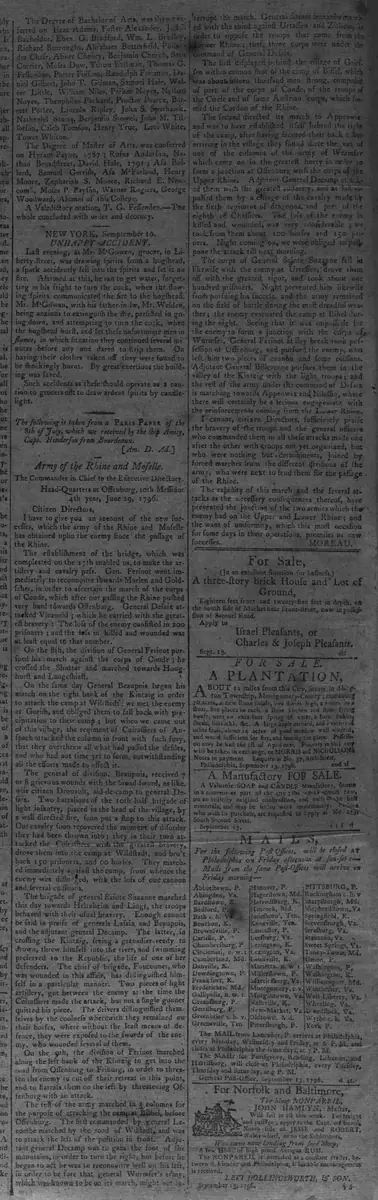
Army of the Rhine and Moselle.
The Commander in Chief to the Executive Directory.
Head-Quarters at Offenbach, 10th Messidor 4th year, June 29, 1796.
Citizen Directors,
I have to give you an account of the new successes, which the army of the Rhine and Moselle has obtained upon the enemy since the passage of the Rhine.
The establishment of the bridge, which was completed on the 17th enabled us, to make the artillery and cavalry pass. Gen. Ferino went immediately to reconnoitre towards Mahlen and Goldach, in order to ascertain the march of the corps of Conde, which after our passing the Rhine pushed very hard towards Offenburg. General Desaix attacked Villingen: which he carried with the greatest bravery: The loss of the enemy consisted in 200 prisoners; and the loss in killed and wounded was at least equal to that number.
On the 18th, the division of General Ferino pursued his march against the corps of Conde; he crossed the Kinzig and marched towards Hugsthal and Langenbronn.
On the same day General Beaupuis began his march on the right bank of the Kinzig in order to attack the camp at Wildstadt: we met the enemy at Griesbach, and obliged them to fall back with precipitation to their camp; but when we came out of this village, the regiment of Cuirassiers of Anspach attacked the column in front with such fury, that they overthrew all what had passed the defiles, and who had not time yet to form, notwithstanding all the efforts made to effect it.
The general of division, Beaupuis, received 7 or 8 grievous wounds with the broad-sword, as like wise citizen Drouault, aid-de-camp to general Desaix. Two battalions of the 10th half brigade of light infantry, placed in the head of the village, by a well directed fire, soon put a stop to this attack. Our cavalry soon recovered the moment of disorder they had been thrown into; they in their turn attacked the Cuirassiers with the greatest bravery, drove them into the camp at Wildstadt, and brought back 150 prisoners, and 60 horses. They marched immediately against the camp, from whence the enemy was dislodged, with the loss of one cannon and several caissons.
The brigade of general Sainte Suzanne marched this day towards Helzheim and Lahr, the troops behaved with their usual bravery. Enough cannot be said in praise of generals Desaix and Beaupuis, and the adjutant general Decamp. The latter, in crossing the Kinzig, seeing a grenadier ready to drown, threw himself into the river, and swimming preserved to the Republic, the life of one of her defenders. The chief of brigade, Fouconnet, who was wounded in this affair, has distinguished himself in a particular manner. Two pieces of light artillery, got between the enemy at the time the Cuirassiers made the attack, but not a single gunner quitted his piece. The drivers distinguished themselves by the coolness wherewith they remained on their horses, where without the least means of defence, they were exposed to the swords of the enemy, who wounded several of them.
On the 19th, the division of Ferino marched along the left bank of the Kinzig to get into the road from Offenburg to Freiburg, in order to threaten the enemy to cut off their retreat in this point, and to harass them on the left by threatening Offenburg with an attack.
The rest of the army marched in 3 columns for the purpose of attacking the camp at Bitsch, before Offenburg. The first commanded by general Leclerc marched by the road of Wildstadt and was to attack the left of the position in front. Adjutant general Decamp was to gain the foot of the mountains, in order to turn the right, but before he began to act he was to reconnoitre well on his left, in order to be sure that general Wurmser's army, which was known to be on its march, might not interrupt the march. General Sainte Suzanne marched with the third against Urtaffen and Zittern, in order to oppose the troops that came from the Lower Rhine: these three corps were under the command of General Desaix.
The first displayed behind the village of Griesen within cannon shot of the camp of Bitsch, which was about fifteen thousand men strong, composed of part of the corps of Conde, of the troops of the Circle and of some Austrian corps, which formed the Cordon of the Rhine.
The second directed its march to Appenweier and was to have established itself behind the right of the camp, after having secured their back: but arriving in the village they found there the van of one of the columns of the army of Wurmser which came on in the greatest hurry in order to form a junction at Offenburg with the corps of the Upper Rhine. Adjutant General Decamp attacked them with the greatest audacity, and at last repulsed them by a charge of the cavalry made by the sixth regiment of dragoons, and part of the eighth of Chasseurs. The loss of the enemy in killed and wounded, was very considerable; we took from them about 100 horses and 150 prisoners. Night coming on, we were obliged to postpone the attack till next morning.
The corps of General Sainte Suzanne fell in likewise with the enemy at Urtaffen, drove them off with the greatest vigor, and took about one hundred prisoners. Night prevented him likewise from pursuing his success. and the army remained on the field of battle during the most dreadful weather; the enemy evacuated the camp at Bitsch during the night. Seeing that it was impossible for the enemy to form a junction with the corps of Wurmser, General Ferino at day break took possession of Offenburg. and pursued the enemy, who left him two pieces of cannon and some caissons. Adjutant General Bellenave pursues them in the valley of the Kinzig with the light troops; and the rest of the army under the command of Desaix is marching towards Appenweier and Nillheim, where there will certainly be a serious engagement with the reinforcements coming from the Lower Rhine.
I cannot, citizen Directors, sufficiently praise the bravery of the troops and the general officers who commanded them in all these attacks made one after the other with groups not yet organized, but who were nothing but detachments, joined by forced marches from the different divisions of the army, who were next to send them for the passage of the Rhine.
The rapidity of this march and the several attacks as the necessary consequences thereof, have prevented the junction of the two armies which the enemy had on the Upper and Lower Rhine; and the want of uniformity, which this must occasion for some days in their operations, promises us new successes.
MOREAU.
What sub-type of article is it?
What keywords are associated?
What entities or persons were involved?
Where did it happen?
Foreign News Details
Primary Location
Upper Rhine
Event Date
June 17 19, 1796
Key Persons
Outcome
french captured villingen with 200 prisoners; at griesbach, 150 prisoners, 60 horses, 1 cannon, caissons; at appenweier, 100 horses, 150 prisoners; at urtaffen, 100 prisoners; enemy evacuated bitsch and offenburg, leaving 2 cannons and caissons; prevented austrian junction.
Event Details
After crossing the Rhine on the 17th, French forces under Generals Ferino, Desaix, and Beaupuis attacked Austrian positions: captured Villingen; pursued Conde's corps; repelled Cuirassiers at Griesbach, dislodged enemy from Wildstadt; on 19th, attacked Bitsch camp near Offenburg, repulsed Wurmser's vanguard at Appenweier and Urtaffen, enemy evacuated during night, French occupied Offenburg and pursued.