Thank you for visiting SNEWPapers!
Sign up free
The Virginia Gazette
Williamsburg, Virginia
What is this article about?
A colonial writer defends the legality of the Continental Congress against British claims, arguing it aligns with constitutional principles and the Glorious Revolution. Urges unity, rejection of divisive separate treaties, and continued resistance until British forces withdraw, citing Locke, Coke, and Chatham.
Clipping
OCR Quality
Full Text
SIR,
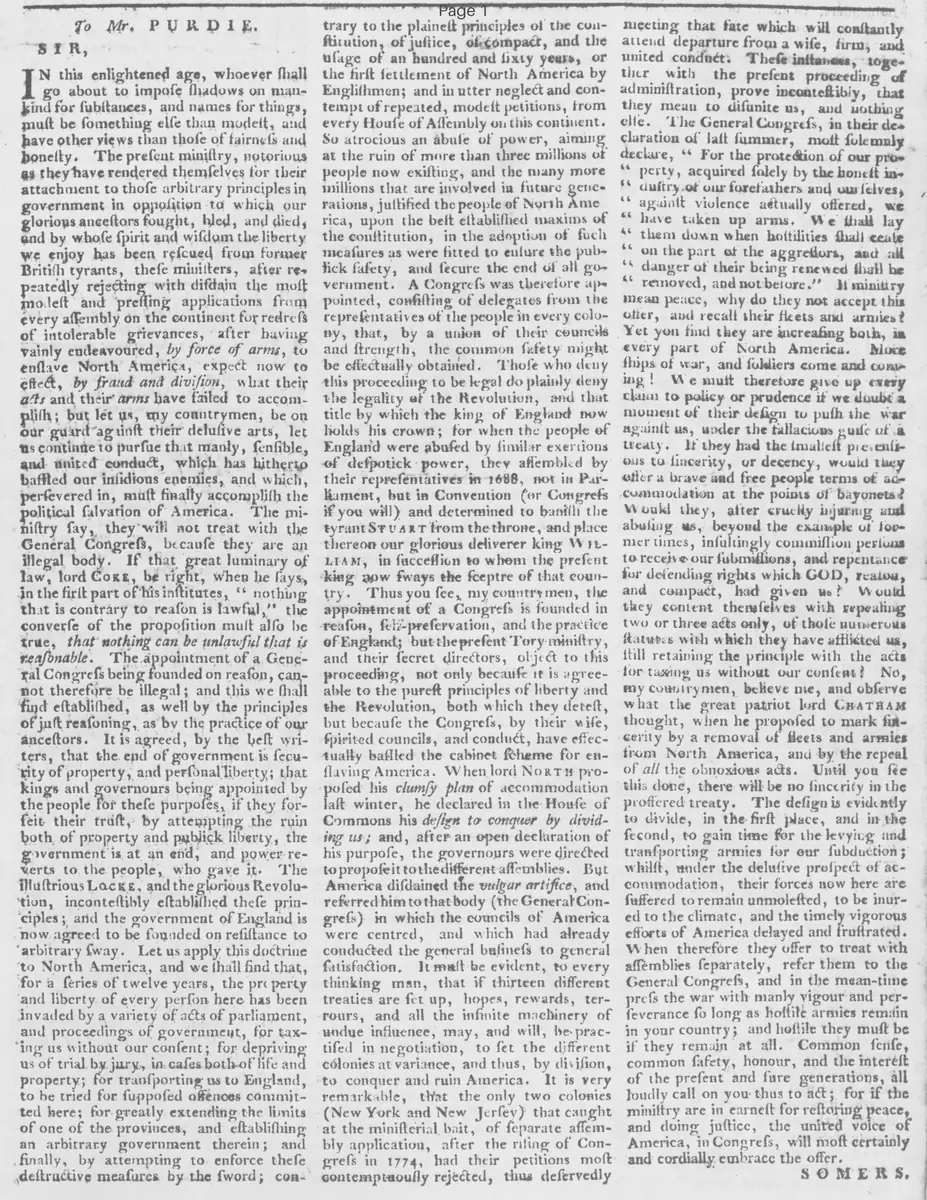
In this enlightened age, whoever shall go about to impose shadows on mankind for substances, and names for things, must be something else than modest, and have other views than those of fairness and honesty. The present ministry, notorious as they have rendered themselves for their attachment to those arbitrary principles in government in opposition to which our glorious ancestors fought, bled, and died, and by whose spirit and wisdom the liberty we enjoy has been rescued from former British tyrants, these ministers, after repeatedly rejecting with disdain the most modest and pressing applications from every assembly on the continent for redress of intolerable grievances, after having vainly endeavoured, by force of arms, to enslave North America, expect now to effect, by fraud and division, what their acts and their arms have failed to accomplish; but let us, my countrymen, be on our guard against their delusive arts, let us continue to pursue that manly, sensible, and united conduct, which has hitherto baffled our insidious enemies, and which, persevered in, must finally accomplish the political salvation of America.
The ministry say, they will not treat with the General Congress, because they are an illegal body. If that great luminary of law, Lord Coke, be right, when he says, in the first part of his Institutes, "nothing that is contrary to reason is lawful," the converse of the proposition must also be true, that nothing can be unlawful that is reasonable. The appointment of a General Congress being founded on reason, cannot therefore be illegal; and this we shall find established, as well by the principles of just reasoning, as by the practice of our ancestors. It is agreed, by the best writers, that the end of government is security of property, and personal liberty; that kings and governors being appointed by the people for these purposes, if they forfeit their trust, by attempting the ruin both of property and publick liberty, the government is at an end, and power reverts to the people, who gave it. The illustrious Locke, and the glorious Revolution, incontestibly established these principles; and the government of England is now agreed to be founded on resistance to arbitrary sway. Let us apply this doctrine to North America, and we shall find that, for a series of twelve years, the property and liberty of every person here has been invaded by a variety of acts of parliament, and proceedings of government, for taxing us without our consent; for depriving us of trial by jury, in cases both of life and property; for transporting us to England, to be tried for supposed offences committed here; for greatly extending the limits of one of the provinces, and establishing an arbitrary government therein; and finally, by attempting to enforce these destructive measures by the sword; contrary to the plainest principles of the constitution, of justice, of compact, and the usage of an hundred and sixty years, or the first settlement of North America by Englishmen; and in utter neglect and contempt of repeated, modest petitions, from every House of Assembly on this continent.
So atrocious an abuse of power, aiming at the ruin of more than three millions of people now existing, and the many more millions that are involved in future generations, justified the people of North America, upon the best established maxims of the constitution, in the adoption of such measures as were fitted to ensure the publick safety, and secure the end of all government. A Congress was therefore appointed, consisting of delegates from the representatives of the people in every colony, that, by a union of their councils and strength, the common safety might be effectually obtained. Those who deny this proceeding to be legal do plainly deny the legality of the Revolution, and that title by which the king of England now holds his crown; for when the people of England were abused by similar exertions of despotick power, they assembled by their representatives in 1688, not in Parliament, but in Convention (or Congress if you will) and determined to banish the tyrant Stuart from the throne, and place thereon our glorious deliverer king William, in succession to whom the present king now sways the sceptre of that country. Thus you see, my countrymen, the appointment of a Congress is founded in reason, self-preservation, and the practice of England; but the present Tory ministry, and their secret directors, object to this proceeding, not only because it is agreeable to the purest principles of liberty and the Revolution, both which they detest, but because the Congress, by their wise, spirited councils, and conduct, have effectually baffled the cabinet scheme for enslaving America. When Lord North proposed his clumsy plan of accommodation last winter, he declared in the House of Commons his design to conquer by dividing us; and, after an open declaration of his purpose, the governors were directed to propose it to the different assemblies. But America disdained the vulgar artifice, and referred him to that body (the General Congress) in which the councils of America were centred, and which had already conducted the general business to general satisfaction. It must be evident, to every thinking man, that if thirteen different treaties are set up, hopes, rewards, terrors, and all the infinite machinery of undue influence, may, and will, be practised in negotiation, to set the different colonies at variance, and thus, by division, to conquer and ruin America. It is very remarkable, that the only two colonies (New York and New Jersey) that caught at the ministerial bait, of separate assembly application, after the rising of Congress in 1774, had their petitions most contemptuously rejected, thus deservedly meeting that fate which will constantly attend departure from a wise, firm, and united conduct.
These instances, together with the present proceeding of administration, prove incontestibly, that they mean to disunite us, and nothing else. The General Congress, in their declaration of last summer, most solemnly declare, "For the protection of our property, acquired solely by the honest industry of our forefathers and ourselves, against violence actually offered, we have taken up arms. We shall lay them down when hostilities shall cease on the part of the aggressors, and all danger of their being renewed shall be removed, and not before." If ministry mean peace, why do they not accept this offer, and recall their fleets and armies? Yet you find they are increasing both, in every part of North America. More ships of war, and soldiers come and coming! We must therefore give up every claim to policy or prudence if we doubt a moment of their design to push the war against us, under the fallacious guide of a treaty. If they had the smallest pretence to sincerity, or decency, would they offer a brave and free people terms of accommodation at the points of bayonets? Would they, after cruelly injuring and abusing us, beyond the example of former times, insultingly commission persons to receive our submissions, and repentance for defending rights which God, reason, and compact, had given us? Would they content themselves with repealing two or three acts only, of those numerous statutes with which they have afflicted us, still retaining the principle with the acts for taxing us without our consent? No, my countrymen, believe me, and observe what the great patriot Lord Chatham thought, when he proposed to mark sincerity by a removal of fleets and armies from North America, and by the repeal of all the obnoxious acts. Until you see this done, there will be no sincerity in the proffered treaty. The design is evidently to divide, in the first place, and in the second, to gain time for the levying and transporting armies for our subduction; whilst, under the delusive prospect of accommodation, their forces now here are suffered to remain unmolested, to be inured to the climate, and the timely vigorous efforts of America delayed and frustrated. When therefore they offer to treat with assemblies separately, refer them to the General Congress, and in the mean-time press the war with manly vigour and perseverance so long as hostile armies remain in your country; and hostile they must be if they remain at all. Common sense, common safety, honour, and the interest of the present and future generations, all loudly call on you thus to act; for if the ministry are in earnest for restoring peace, and doing justice, the united voice of America, in Congress, will most certainly and cordially embrace the offer.
SOMERS.
What sub-type of article is it?
What themes does it cover?
What keywords are associated?
What entities or persons were involved?
Letter to Editor Details
Author
Somers.
Recipient
Mr. Purdie.
Main Argument
the british ministry seeks to divide the american colonies through fraudulent separate treaties after failing militarily; the general congress is legal per constitutional reason, locke, and the glorious revolution; americans must unite, refer all to congress, and resist until fleets, armies, and obnoxious acts are removed.
Notable Details