Thank you for visiting SNEWPapers!
Sign up free
National Gazette
Philadelphia, Philadelphia County, Pennsylvania
What is this article about?
A letter to the National Gazette translates and refutes an extract from Brissot's 1788 book, which falsely accuses Quakers Roberts and Carlisle of treason during the Revolution and slanders Joseph Reed for blocking their pardon; the author corrects the timeline and facts using records to defend reputations.
Clipping
OCR Quality
Full Text
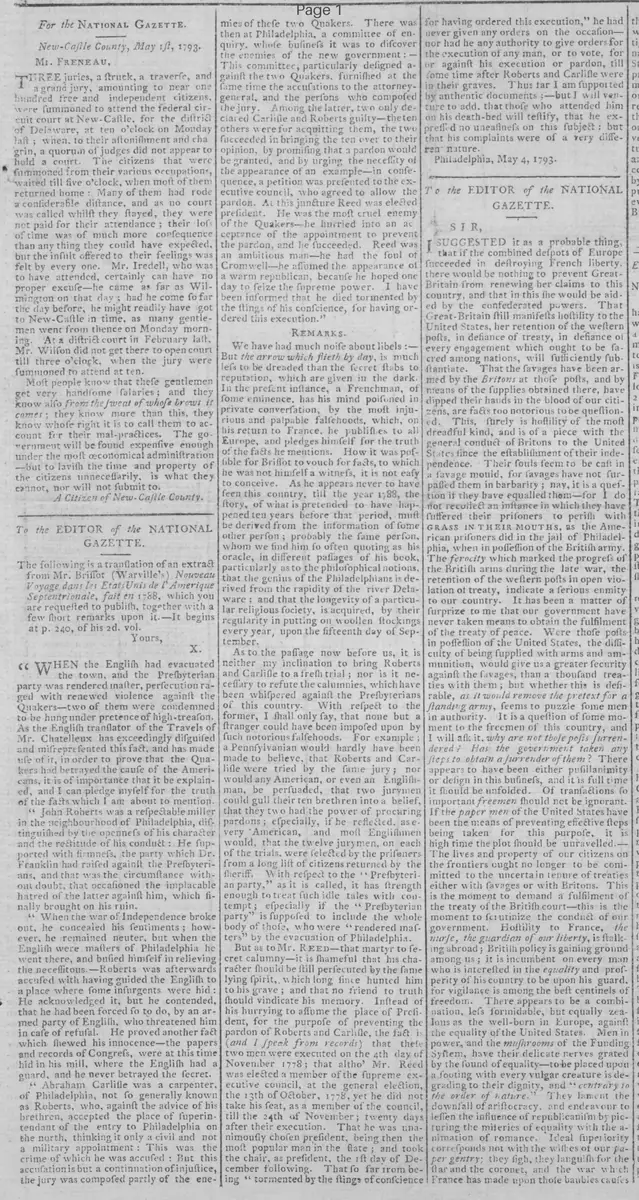
The following is a translation of an extract from Mr. Brissot (Warville's) Nouveau Voyage dans les Etats Unis de l'Amerique Septentrionale, fait en 1788, which you are requested to publish, together with a few short remarks upon it.—It begins at p. 240, of his 2d. vol.
Yours,
X.
"WHEN the English had evacuated the town, and the Presbyterian party was rendered master, persecution raged with renewed violence against the Quakers—two of them were condemned to be hung under pretence of high-treason. As the English translator of the Travels of Mr. Chastellux has exceedingly disguised and misrepresented this fact, and has made use of it, in order to prove that the Quakers had betrayed the cause of the Americans, it is of importance that it be explained, and I can pledge myself for the truth of the facts which I am about to mention."
"John Roberts was a respectable miller in the neighbourhood of Philadelphia, distinguished by the openness of his character and the rectitude of his conduct: He supported with firmness, the party which Dr. Franklin had raised against the Presbyterians, and that was the circumstance, without doubt, that occasioned the implacable hatred of the latter against him, which finally brought on his ruin."
"When the war of Independence broke out, he concealed his sentiments; however, he remained neuter, but when the English were masters of Philadelphia he went there, and busied himself in relieving the necessitous.—Roberts was afterwards accused with having guided the English to a place where some insurgents were hid: He acknowledged it, but he contended, that he had been forced so to do, by an armed party of English, who threatened him in case of refusal. He proved another fact which shewed his innocence—the papers and records of Congress, were at this time hid in his mill, where the English had a guard, and he never betrayed the secret."
"Abraham Carlisle was a carpenter of Philadelphia, not so generally known as Roberts, who, against the advice of his brethren, accepted the place of superintendent of the entry to Philadelphia on the north, thinking it only a civil and not a military appointment: This was the crime of which he was accused: But this accusation is but a continuation of injustice, the jury was composed partly of the enemies of these two Quakers. There was then at Philadelphia, a committee of enquiry, whose business it was to discover the enemies of the new government:—This committee, particularly designed against the two Quakers, furnished at the same time the accusations to the attorney-general, and the persons who composed the jury. Among the latter, two only declared Carlisle and Roberts guilty—the ten others were for acquitting them, the two succeeded in bringing the ten over to their opinion, by promising that a pardon would be granted, and by urging the necessity of the appearance of an example—in consequence, a petition was presented to the executive council, who agreed to allow the pardon. At this juncture Reed was elected president. He was the most cruel enemy of the Quakers—he hurried into an acceptance of the appointment to prevent the pardon, and he succeeded. Reed was an ambitious man—he had the soul of Cromwell—he assumed the appearance of a warm republican, because he hoped one day to seize the supreme power. I have been informed that he died tormented by the stings of his conscience, for having ordered this execution."
REMARKS.
We have had much noise about libels:—But the arrow which flieth by day, is much less to be dreaded than the secret stabs to reputation, which are given in the dark. In the present instance, a Frenchman, of some eminence, has his mind poisoned in private conversation, by the most injurious and palpable falsehoods, which, on his return to France, he publishes to all Europe, and pledges himself for the truth of the facts he mentions. How it was possible for Brissot to vouch for facts, to which he was not himself a witness, it is not easy to conceive. As he appears never to have seen this country, till the year 1788, the story, of what is pretended to have happened ten years before that period, must be derived from the information of some other person; probably the same person, whom we find him so often quoting as his oracle, in different passages of his book, particularly as to the philosophical notions, that the genius of the Philadelphians is derived from the rapidity of the river Delaware; and that the longevity of a particular religious society, is acquired, by their regularity in putting on woollen stockings every year, upon the fifteenth day of September.
As to the passage now before us, it is neither my inclination to bring Roberts and Carlisle to a fresh trial; nor is it necessary to refute the calumnies, which have been whispered against the Presbyterians of this country. With respect to the former, I shall only say, that none but a stranger could have been imposed upon by such notorious falsehoods. For example; a Pennsylvanian would hardly have been made to believe, that Roberts and Carlisle were tried by the same jury; nor would any American, or even an Englishman, be persuaded, that two jurymen could gull their ten brethren into a belief, that they two had the power of procuring pardons; especially, if he reflected, as every American, and most Englishmen would, that the twelve jurymen, on each of the trials, were selected by the prisoners from a long list of citizens returned by the sheriff. With respect to the "Presbyterian party," as it is called, it has strength enough to treat such idle tales with contempt; especially if the "Presbyterian party" is supposed to include the whole body of those, who were "rendered masters" by the evacuation of Philadelphia.
But as to Mr. REED—that martyr to secret calumny—it is shameful that his character should be still persecuted by the same lying spirit, which long since hunted him to his grave; and that no friend to truth should vindicate his memory. Instead of his hurrying to assume the place of President, for the purpose of preventing the pardon of Roberts and Carlisle, the fact is (and I speak from records) that these two men were executed on the 4th day of November 1778; that altho' Mr. Reed was elected a member of the supreme executive council, at the general election, the 13th of October, 1778, yet he did not take his seat, as a member of the council, till the 24th of November; twenty days after their execution. That he was unanimously chosen president, being then the most popular man in the state; and took the chair, as president, the 1st day of December following. That so far from being "tormented by the stings of conscience for having ordered this execution," he had never given any orders on the occasion—nor had he any authority to give orders for the execution of any man, or to vote, for or against his execution or pardon, till some time after Roberts and Carlisle were in their graves. Thus far I am supported by authentic documents;—but I will venture to add, that those who attended him on his death-bed will testify, that he expressed no uneasiness on this subject; but that his complaints were of a very different nature.
Philadelphia, May 4, 1793.
What sub-type of article is it?
What themes does it cover?
What keywords are associated?
What entities or persons were involved?
Letter to Editor Details
Author
X.
Recipient
To The Editor Of The National Gazette.
Main Argument
the letter provides a translation of an extract from brissot's book accusing quakers john roberts and abraham carlisle of treason and slandering joseph reed, then refutes these claims by detailing the historical facts, jury composition, and timeline showing reed had no role in their 1778 executions or pardon decisions.
Notable Details