Thank you for visiting SNEWPapers!
Sign up free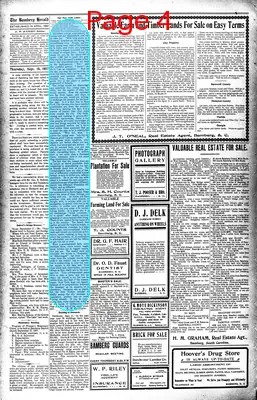
Literary
September 19, 1907
The Bamberg Herald
Bamberg, Bamberg County, South Carolina
What is this article about?
An essay cautioning young men against hastily leaving rural homes for city opportunities like New York, highlighting urban vices, high failure rates, lack of genuine relationships, and contrasts with wholesome country life; introduced by a short advisory poem.
Clipping

OCR Quality
98%
Excellent
Full Text
"Come boys. I have something to tell you;"
Draw near. I would whisper it low:
You are thinking of leaving the homestead:
Don't be in a hurry to go.
"The city has many attractions,
But think of the vices and sin:"
When once in the vortex of fashion.
How soon the course downward begins."
Anywhere you go, everywhere, the young men are dissatisfied, and older ones too. "Hills look green at a distance" is rather an old saying, but nevertheless true. People, particularly young men, read of the successes in cities, and every one imagines that only a chance is needed for him to equal or eclipse them. Some do, many do not; by far about 999 of every 1,000 fail to reach the goal.
The one of a thousand is made prominent; the nine hundred and ninety-nine are kept in the background. "But," says the youthful genius, "I know I can do it; I am an exception." Now let me say, you may be, you must be, to even out where there are so many to compete and contend with. For blasted lives, hopes, ambitions, a great city is the place—a perfect graveyard of failures.
The writer would not discourage any ambitious boy, young man, or older, for the matter of that, but would caution. Even the successes are far from happy, and there is scarcely one who would not willingly exchange his present for his humble past. It is a fact that in New York City the men who have reached prominence are from the country; there is no denying this fact; it is a matter of history that they come from outside the city. City birth, raising and training is groove-like: one idea narrowness, there is not that general all-round knowledge of men and things acquired by those in less populated sections, nor is there bred within these essentials that go to make the man as he is constituted elsewhere.
"Why not, then," inquires the young man, "are not my chances good? I am an outsider." If you possess these qualities, your chances are better where you are: where you know and are known. If you do succeed here, you are not satisfied as you would be while partially succeeding there. A million here is not more than a thousand there; eminence here is not more than prominence there.
The fact that the masses here are by nature as stated precludes their respecting or appreciating you here as friends there look on you. The contamination here not only of bad, but of differently constituted human beings, is sure to strike you, adhere, penetrate. He or she who can withstand it is indeed the rare exception.
Associations are altogether different: family ties different: friendship different, and so different.
The lack of genuine sympathy you are accustomed to discourages, drags down the sense of finer feelings you bring with you. At home you have genuine, true and tried friends to mingle with, to rejoice with you in prosperity, to grieve with you in adversity, to soothe your griefs and pains, to lay you away with tender loving hands. In a great city it is all mechanical—"hired mourners," so to speak, after death; envious, grasping or unconcerned while living.
There is not, cannot be the home life as in the country. The family that gather around the board at meals, or the hearthstone evenings, in a large city, is rare, very exceptional. It is for male and female one continual grind, hurry, bustle, rushing, to keep up in every day pursuits, or, if moderation is attempted, you are left far behind or get run out or over.
More is accomplished here, more business done, more money made, more strokes put in, bigger results, but less net. The reader must not conclude the writer is "dyspeptic" or "discouraged"; far from it. He came from the outside; knows both ends in the matter; has no regrets, but is endeavoring to look the matter square in the face and, from close study and observation, picture things as they really are to the average run. Your correspondent came here to stay, is here, and will remain: his record is not the one he writes from, but that of the masses.
Again, New York does not, cannot, because of its propositions, welcome the stranger as he expects, or is elsewhere. Incomers are so plentiful: the New Yorker, instead of gladly seeing the city increase in population, prefers less—so overflowing already. If you do come, young man, come expecting nothing at the hands of Gothamites other than you hew out of the stone yourself.
H. W. FINLAYSON.
Draw near. I would whisper it low:
You are thinking of leaving the homestead:
Don't be in a hurry to go.
"The city has many attractions,
But think of the vices and sin:"
When once in the vortex of fashion.
How soon the course downward begins."
Anywhere you go, everywhere, the young men are dissatisfied, and older ones too. "Hills look green at a distance" is rather an old saying, but nevertheless true. People, particularly young men, read of the successes in cities, and every one imagines that only a chance is needed for him to equal or eclipse them. Some do, many do not; by far about 999 of every 1,000 fail to reach the goal.
The one of a thousand is made prominent; the nine hundred and ninety-nine are kept in the background. "But," says the youthful genius, "I know I can do it; I am an exception." Now let me say, you may be, you must be, to even out where there are so many to compete and contend with. For blasted lives, hopes, ambitions, a great city is the place—a perfect graveyard of failures.
The writer would not discourage any ambitious boy, young man, or older, for the matter of that, but would caution. Even the successes are far from happy, and there is scarcely one who would not willingly exchange his present for his humble past. It is a fact that in New York City the men who have reached prominence are from the country; there is no denying this fact; it is a matter of history that they come from outside the city. City birth, raising and training is groove-like: one idea narrowness, there is not that general all-round knowledge of men and things acquired by those in less populated sections, nor is there bred within these essentials that go to make the man as he is constituted elsewhere.
"Why not, then," inquires the young man, "are not my chances good? I am an outsider." If you possess these qualities, your chances are better where you are: where you know and are known. If you do succeed here, you are not satisfied as you would be while partially succeeding there. A million here is not more than a thousand there; eminence here is not more than prominence there.
The fact that the masses here are by nature as stated precludes their respecting or appreciating you here as friends there look on you. The contamination here not only of bad, but of differently constituted human beings, is sure to strike you, adhere, penetrate. He or she who can withstand it is indeed the rare exception.
Associations are altogether different: family ties different: friendship different, and so different.
The lack of genuine sympathy you are accustomed to discourages, drags down the sense of finer feelings you bring with you. At home you have genuine, true and tried friends to mingle with, to rejoice with you in prosperity, to grieve with you in adversity, to soothe your griefs and pains, to lay you away with tender loving hands. In a great city it is all mechanical—"hired mourners," so to speak, after death; envious, grasping or unconcerned while living.
There is not, cannot be the home life as in the country. The family that gather around the board at meals, or the hearthstone evenings, in a large city, is rare, very exceptional. It is for male and female one continual grind, hurry, bustle, rushing, to keep up in every day pursuits, or, if moderation is attempted, you are left far behind or get run out or over.
More is accomplished here, more business done, more money made, more strokes put in, bigger results, but less net. The reader must not conclude the writer is "dyspeptic" or "discouraged"; far from it. He came from the outside; knows both ends in the matter; has no regrets, but is endeavoring to look the matter square in the face and, from close study and observation, picture things as they really are to the average run. Your correspondent came here to stay, is here, and will remain: his record is not the one he writes from, but that of the masses.
Again, New York does not, cannot, because of its propositions, welcome the stranger as he expects, or is elsewhere. Incomers are so plentiful: the New Yorker, instead of gladly seeing the city increase in population, prefers less—so overflowing already. If you do come, young man, come expecting nothing at the hands of Gothamites other than you hew out of the stone yourself.
H. W. FINLAYSON.
What sub-type of article is it?
Essay
What themes does it cover?
Agriculture Rural
Commerce Trade
Moral Virtue
What keywords are associated?
Rural Homestead
City Vices
Youthful Ambition
New York Failures
Genuine Friendship
What entities or persons were involved?
H. W. Finlayson
Literary Details
Author
H. W. Finlayson
Subject
Caution To Young Men Against Leaving Rural Home For City Life
Form / Style
Prose Essay With Introductory Poem
Key Lines
"Come Boys. I Have Something To Tell You;"
Draw Near. I Would Whisper It Low:
You Are Thinking Of Leaving The Homestead:
Don't Be In A Hurry To Go.
"The City Has Many Attractions,
But Think Of The Vices And Sin:"
When Once In The Vortex Of Fashion.
How Soon The Course Downward Begins.