Thank you for visiting SNEWPapers!
Sign up free
The Butte Daily Bulletin
Butte, Silver Bow County, Montana
What is this article about?
In Passaic, New Jersey, the Amalgamated Textile Workers union and ACLU challenge police restrictions on labor meetings to assert free speech rights. On March 23, 1920, a planned speech by Dr. Norman Thomas and others is disrupted by police turning off lights and using clubs, but the group persists by candlelight, reading the state constitution.
Merged-components note: Merged concluding paragraph of 'Testing the Workers' Right to Free Speech' story on page 4.
Clipping
OCR Quality
Full Text
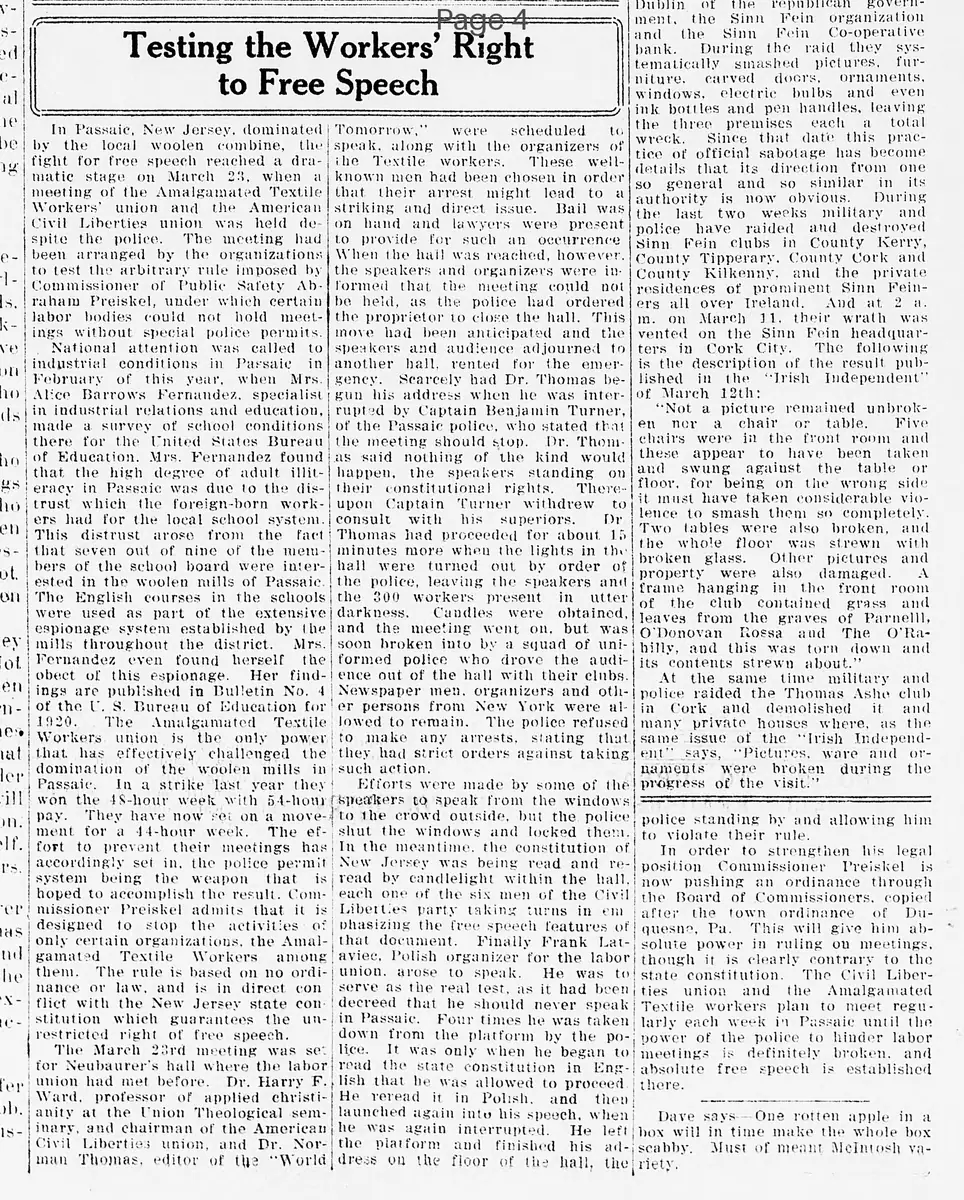
In Passaic, New Jersey, dominated by the local woolen combine, the fight for free speech reached a dramatic stage on March 23, when a meeting of the Amalgamated Textile Workers' union and the American Civil Liberties union was held despite the police.
The meeting had been arranged by the organizations to test the arbitrary rule imposed by Commissioner of Public Safety Abraham Preiskel, under which certain labor bodies could not hold meetings without special police permits.
National attention was called to industrial conditions in Passaic in February of this year, when Mrs. Alice Barrows Fernandez, specialist in industrial relations and education, made a survey of school conditions there for the United States Bureau of Education. Mrs. Fernandez found that the high degree of adult illiteracy in Passaic was due to the distrust which the foreign-born workers had for the local school system. This distrust arose from the fact that seven out of nine of the members of the school board were interested in the woolen mills of Passaic.
The English courses in the schools were used as part of the extensive espionage system established by the mills throughout the district. Mrs. Fernandez even found herself the object of this espionage. Her findings are published in Bulletin No. 4 of the U. S. Bureau of Education for 1920.
The Amalgamated Textile Workers union is the only power that has effectively challenged the domination of the woolen mills in Passaic. In a strike last year they won the 48-hour week with 54-hour pay. They have now set on a movement for a 44-hour week. The effort to prevent their meetings has accordingly set in, the police permit system being the weapon that is hoped to accomplish the result. Commissioner Preiskel admits that it is designed to stop the activities of only certain organizations, the Amalgamated Textile Workers among them.
The rule is based on no ordinance or law, and is in direct conflict with the New Jersey state constitution which guarantees the unrestricted right of free speech.
The March 23rd meeting was set for Neubauer's hall where the labor union had met before. Dr. Harry F. Ward, professor of applied christianity at the Union Theological seminary, and chairman of the American Civil Liberties union, and Dr. Norman Thomas, editor of the "World Tomorrow" were scheduled to speak, along with the organizers of the Textile workers.
These well-known men had been chosen in order that their arrest might lead to a striking and direct issue. Bail was on hand and lawyers were present to provide for such an occurrence.
When the hall was reached, however, the speakers and organizers were informed that the meeting could not be held, as the police had ordered the proprietor to close the hall. This move had been anticipated and the speakers and audience adjourned to another hall, rented for the emergency. Scarcely had Dr. Thomas begun his address when he was interrupted by Captain Benjamin Turner, of the Passaic police, who stated that the meeting should stop.
Dr. Thomas said nothing of the kind would happen, the speakers standing on their constitutional rights. Thereupon Captain Turner withdrew to consult with his superiors.
Dr. Thomas had proceeded for about 15 minutes more when the lights in the hall were turned out by order of the police, leaving the speakers and the 300 workers present in utter darkness. Candles were obtained, and the meeting went on, but was soon broken into by a squad of uniformed police who drove the audience out of the hall with their clubs.
Newspaper men, organizers and other persons from New York were allowed to remain. The police refused to make any arrests, stating that they had strict orders against taking such action.
Efforts were made by some of the speakers to speak from the windows to the crowd outside, but the police shut the windows and locked them.
In the meantime, the constitution of New Jersey was being read and re-read by candlelight within the hall each one of the six men of the Civil Liberties party taking turns in emphasizing the free speech features of that document.
Finally Frank Lataviec, Polish organizer for the labor union, arose to speak. He was to serve as the real test, as it had been decreed that he should never speak in Passaic. Four times he was taken down from the platform by the police.
It was only when he began to read the state constitution in English that he was allowed to proceed. He reread it in Polish, and then launched again into his speech, when he was again interrupted.
He left the platform and finished his address on the floor of the hall, the police standing by and allowing him to violate their rule.
In order to strengthen his legal position Commissioner Preiskel is now pushing an ordinance through the Board of Commissioners, copied after the town ordinance of Duquesne, Pa. This will give him absolute power in ruling on meetings, though it is clearly contrary to the state constitution. The Civil Liberties union and the Amalgamated Textile workers plan to meet regularly each week in Passaic until the power of the police to hinder labor meetings is definitely broken, and absolute free speech is established there.
Dave says—One rotten apple in a box will in time make the whole box scabby. Must of meant McIntosh variety.
What sub-type of article is it?
What themes does it cover?
What keywords are associated?
What entities or persons were involved?
Where did it happen?
Story Details
Key Persons
Location
Passaic, New Jersey
Event Date
March 23, 1920
Story Details
Labor unions and ACLU hold a meeting despite police bans to test free speech rights; police disrupt by closing halls, turning off lights, and using clubs, but speakers continue by candlelight reading the constitution and delivering addresses.