Thank you for visiting SNEWPapers!
Sign up free
Gazette Of The United States, & Philadelphia Daily Advertiser
Philadelphia, Philadelphia County, Pennsylvania
What is this article about?
Proceedings of the U.S. House of Representatives on January 11-12, including reports on claims petitions, a proposed society for promoting agriculture, a Senate bill on crimes punishment, notice on revenue provision, bill for Monsieur Poireau's claim, and debate in committee on direct taxes for revenue including detailed financial statements on national debt and expenses.
Merged-components note: The tables provide financial data embedded in the congressional report on revenue and debt; the page 3 component is a direct continuation of the debate, all forming a single domestic news article on U.S. Congress proceedings.
Clippings
1 of 2
OCR Quality
Full Text
THE UNITED STATES.
HOUSE OF REPRESENTATIVES.
Wednesday, January 11.
Mr. Dwight Foster, from the committee of claims, made reports on the petitions of John Baptist Dumont and Michael Hillegas, which were against the petitioners; they were twice read and concurred in by the House.
Mr. Swift, from the committee to whom was referred that part of the President's speech relating to the promotion of agriculture, made a report, recommending the institution of a society for that purpose under the patronage of government, which might act as a common centre to all other societies of a similar kind throughout the United States.
No public provision is contemplated, except for the salary of a secretary and for stationery: but if the state of the treasury should make even this unadvisable, it is stated that it might be carried into effect without pecuniary aid. The report is accompanied by a plan, the principal articles of which are, that a society shall be established at the seat of government; that it shall comprehend the legislature of the United States, the judges, the secretary of state, the secretary of the treasury, the secretary of war, the attorney general, and such other members as should choose to become members agreeable to the rules prescribed; that an annual meeting should be held at the seat of government, at which is to be chosen the President, secretary, &c. and a board to consist of not more than thirty persons, which shall be called a "Board of Agriculture;" that the society shall be a body corporate; that a report shall be made annually, &c. The report concluded in these words, "Resolved that a society for the promotion of agriculture ought to be established at the seat of government of the United States."
A bill was received from the senate for repealing the limitation of the act in addition to an act for the punishment of certain crimes against the United States, and to continue in force the same.
It was twice read, and ordered to be committed to a committee of the whole on Monday.
Mr. W. Smith gave notice that he should tomorrow call up the report of the committee of ways and means, on the subject of providing further revenue.
Mr. Madison called for the order of the day on the bill for making provision for the claim of Monsieur Poireau, as secretary and aid-de-camp to Major General La Fayette. The house then took it up, when after some debate it was ordered to be engrossed for a third reading tomorrow. Adjourned.
Thursday, January 12.
The house having resolved itself into a committee of the whole on the report of the committee of ways and means on the subject of further revenue, Mr. Dent in the chair, and the following resolution being under consideration.
"Resolved that there ought to be apportioned according to the last census of the several states, the sum of
to be raised by the
following direct taxes, viz.
"A tax ad valorem upon all lands, with their improvements, including town lots with the buildings thereon.
"A tax on slaves with certain exceptions."
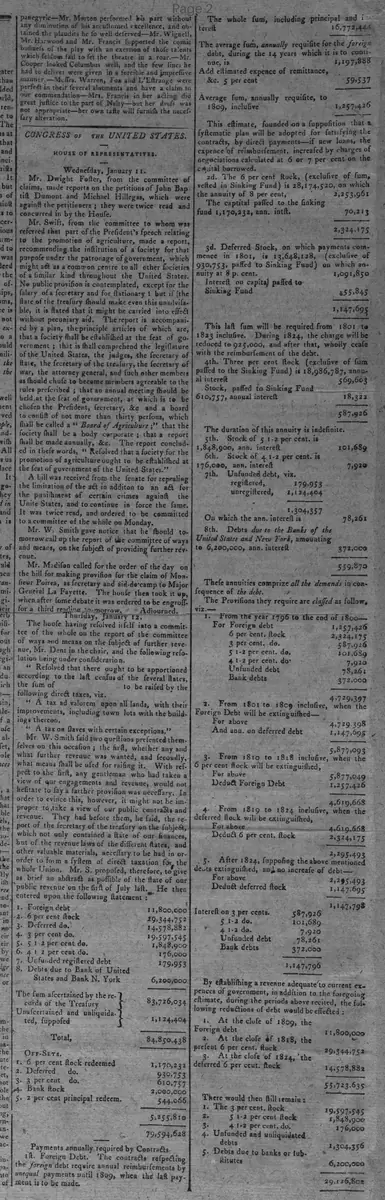
Mr. W. Smith said two questions presented themselves on this occasion; the first, whether any and what further revenue was wanted, and secondly, what means shall be used for raising it. With respect to the first, any gentleman who had taken a view of our engagements and revenue, would not hesitate to say a farther provision was necessary. In order to evince this, however, it might not be improper to take a view of our public contracts and revenue. They had before them, he said, the report of the secretary of the treasury on the subject, which not only contained a state of our finances, but of the revenue laws of the different states, and other valuable materials, necessary to be had in order to form a system of direct taxation for the whole Union. Mr. S. proposed, therefore, to give as brief an abstract as possible of the state of our public revenue on the 1st of July last. He then entered upon the following statement:
The sum ascertained by the records of the Treasury:
83,726,034
Unascertained and unliquidated, supposed
.404
Total,
84,850,438
Payments annually required by Contracts.
1st. Foreign Debt. The contracts respecting the foreign debt require annual reimbursements by unequal payments until 1809, when the last payment is to be made.
The whole sum, including principal and interest
16,772,444
The average sum, annually requisite for the foreign debt; during the 14 years which it is to continue, is.:
1,197,888
Add estimated expense of remittance, &c. 5 per cent
59,537
Average sum, annually requisite, to 1809, inclusive
1,257,425
This estimate, founded on a supposition that a systematic plan will be adopted for satisfying the contracts, by direct payments—if new loans, the expense of reimbursement, increased by charges of negotiations calculated at 6 or 7 per cent on the capital borrowed.
2d. The 6 per cent stock, (exclusive of sum, vested in Sinking Fund) is 28,174,520, on which the annuity of 6 per cent,
2,253,961
The capital passed to the sinking fund 1,170,232, ann. int.
70,213
2,324,174
3d. Deferred Stock, on which payments commence in 1801, is 13,648,128, (exclusive of 930,753, passed to Sinking Fund) on which annuity at 6 p. cent.
1,091,850
Interest on capital passed to Sinking Fund
55,845
1,147,695
This last sum will be required from 1801 to 1823 inclusive. During 1824, the charge will be reduced to 925,000, and after that, wholly cease with the reimbursement of the debt.
4th. Three per cent stock (exclusive of sum passed to the Sinking Fund) is 18,986,787, annual interest
569,603
Stock, passed to Sinking Fund 610,757, annual interest
18,227
587,830
The duration of this annuity is indefinite.
5th. Stock of 5 1-2 per cent.
1,848,900, ann; interest
101,689
6th. Stock of, 4 1-2 per cent.
176,000, ann, interest
7,920
7th, Unfunded debt, viz.
registered, 179,953
unregistered, 1,124,404
1,304,357
On which the ann. interest is
78,261
8th. Debts due to the Banks of the United States and New-York, amounting to 6,200,000, ann, interest
372,000
559,870
These annuities comprise all the demands in consequence of the debt.:
The Provisions they require are classed as follow.
4,729,397
From 1801 to 1809.inclusive,
when
Foreign Debt will be extinguished
For above
1,257,425
And ann. on deferred debt
1,147,695
5,877,093
From 1810 to 1818 inclusive
,when the
6 per cent stock:will be extinguished
For above
5,877,093.
Deduct Foreign Debt
1,257,426
4,619,667
From 1819. to 1824 inclusive, when the
deferred stock will be extinguished,
For.above
4,619,667.
Deduct 6 per cent. stock
2,324,175
2,295,492
After 1824, supposing the above mentioned
debts extinguished, and no increase of debt-
For above
2,295,492
Deduct deferred stock
1,147,695
1,147,797
By establishing a revenue adequate to current
expences of government, in addition to,the foregoing
estimate, during the periods above recited, the
following reductions of debt would be effected
-At the close'of 1809,
Foreign debt
11,800,000
At 'the close
1818
present 6 per cent. stock.
29,344,752
3. At the close of 1824.
deferred 6 per cent. stock.
14,578,832
There would then still remain
The 3 per cent, stock
19,597,545
5 1-2 per cent stock
1,848,900
4 1-2 per cent. do:
176,000
Unfunded and unliquidated
, debts
1,304,357
Debts due to banks or sub-
stitutes
6,200,000
29,126,802
| 1. Foreign debt | 11,800,000 |
| 2. 6 per cent stock | 29,344,752 |
| 3. Deferred do. | 14,578,882 |
| 4. 3 per cent do. | 19,597,545 |
| 5. 5 1 2 per cent do. | 1,848,900 |
| 6. 4 1 2 per cent do. | 176,000 |
| 7. Unfunded regiflered debt | 179,953 |
| 8. Debts due to Bank of United States and Bank N. York | 6,200,000 |
| OFF-SETS. | |
| 1. 6 per cent flock redeemed | 1,170,232 |
| 2. Deferred do. | 930,753 |
| 3. 3 per cent do. | 610,757 |
| 4. Bank flock | 2,000,000 |
| 5. 2 per cent principal redeem. | 544,066 |
| 1. From the year 1796 to the end of 1800—For Foreign debt 6 per cent. stock 3 per cent. do. 5 1-2 per cent. do. 4 1-2 per cent. do. Unfunded debt Bank debts | 1,257,426 2,324,175 587,926 101,689 7,920 78,261 372,000 |
| Intereft on 3 per cents. | 587,926 |
| 5 1-2 do. | 101,689 |
| 4 1-2 do. | 7,920 |
| Unfunded debt | 78,261 |
| Bank debts | 372,000 |
But if a revenue be established equal to charges of 1801, (viz. Expenses of gov. 2,700,000 For the debt 5,877,094 8,577,094 the whole debt may be extinguished by the year 1824, besides a considerable additional debt, if such should arise from contingencies. Probable permanent annual Expenses of Government Civil list 486,000 Intercourse with foreign nations 100,000 Military establishment 40,000 Light houses 25,000 Loan offices 12,000 Miscellaneous objects and contingent expenses 37,000 Militia and naval department, and pensions: 2,000,000 2,700,000 Estimating the expenses of government at 2,700,000, it follows that, to avoid future loans, it is requisite to establish a revenue, to the close of 1800, viz. For the debt 4,729,368 Expenses gov 2,700,000 7,429,368 And, from the year 1801 to 1809, inclusive; viz: Expenses of gov. For the debt 5,877,694 2,700,000 8,577,094 Though revenue on this last scale would be more than sufficient to discharge the whole debt before 1824, at the absolute engagements of the United States will not require, after 1800, more than 7,319,668 viz. for debt 4,619,668 for expenses of gov. 2,700,000 Existing contracts and expenses require: therefore at present 7,429,398 Contracting expenses existing after the year 1800 and 1809 inclusive require : 8,577,094 Probable Revenues from existing laws, Duties on imports and tonnage 5,588,961 on domestic distilled spirits refined sugar at auction, &c. carriages 337,000 Revenue from post offices 35,000 Dividends on bank stock, calculated on the last 150,000 Inter. on stock in sinking Fund 88,636 Duties on stamped and contingent receipts 746 Estimated amt. revenue 6,200,600 It results the following sums must be provided, in addition to existing revenues, viz. 1: From the present time to the end of 1801 228,798 2. From 1801 the end of. 1809 2,376,494 3. From 181 the end of 1823 3,119,061 To provide thus annually required till 1801 may be done without imposing inconvenient burdens. To reimburse whole foreign debt, by direct payment before 1801 may be practicable. It is however probable that after 1801 occasional loans will be advisable, with a view of postponing the final reimbursement part until after 1818, when the present 6 per cent debt will be discharged. Mr. Smith said loans could not now be had upon any reasonable terms, there was no way of raising the money wanted but by tax upon the people. The question was what sort of taxes should be resorted to? Members, he said were divided between direct and indirect taxes; all were agreed that an additional revenue of 1,200,000 dollars being wanted, some effectual steps were necessary to be taken. If indirect taxes had proved insufficient, it was necessary to have recourse to some other he knew of no other that would be so effectual direct tax on land. With respect to raising further revenue from commerce, he believed it not possible to do it to any considerable extent, as our source, he said, was at best but a precarious one, then, they had tried all other sources without success, they should be obliged to have recourse to a direct tax. And he would submit it to gentlemen whether it was not best to meet the difficulty at once. If, as the necessities of government, the public safety credit of the country, required it, it is necessary proper we should look the evil in the face. Notwithstanding he held this opinion, Mr. S. said, he should be glad for the sentiments of gentlemen on the subject, were in favor of other plans, though he was convinced they should be obliged to have recourse to source he had mentioned. Indeed there was one view of the subject which would make such a measure desirable, though our necessities did not immediately require it. At present, he said, almost the whole of revenue arose from commerce, and was liable to much deranged by any European war, and wholly destroyed, if this country should engage war. It were to be wished, therefore, that there should be a plan created, which might at any time, short notice, be carried into effect to an extent which would be equal to the necessities of government nothing would answer this purpose so well as a tax land. Suppose, he said, the plan was originated with 200,000 dollars, having the system open, they could time raise it to one or two millions; as, if cedescriptions of land were charged a quarter per hey might easily be advanced to one half, three quarters or one per cent. without embarrassment. Mr. S. said, this subject had n frequently under the consideration of the comof ways and means and had always been conide bject of great importance, and as attended with considerable difficulties. There had always been a div that committee on this subject, certain of them to raise the mo ney by indirect, and others It taxation, but it had always been found that hey turned from direct to indirect taxation, o objections were brought against any plan wh propoed, that there was no possibility of pro In the last es fion several objects were proput they were ob jected to and abandoned, and th they had de termined to resort to a system a taxation, and had accordingly given directions ecretary of the treasury to prepare a plan purpoe. This plan had been reported, and referred the committee of ways and means: and before ommittee chose to go farther into the business, fhed the house ao determin upon the principle vards, if a ma. jority should be in favor of direct taxation, the com mittee would bring in such a bill as should appear to them to be least burthensome to the people. But, if gentlemen were of opinion the money wanted could be better raised in any other way, they would, of course, propose their plans; but he hoped they should not shift from one thing to another, without fixing on any thing, since the wants of government must be supplied. Mr. Coit hoped the resolution would be adopted: not that he wished to pledge himself to agree to any system of direct taxation which might be proposed He looked upon the agreeing to the resolution as only one step. Whether eventually such a plan could be devised as the house should approve was uncertain ; but he should wish to look at the plan which gentlemen had in contemplation. Mr. Harper said, if they could look at the plan, as the gentleman from Connecticut (Mr Coit) had supposed, without pledging themselves to adopt a system of direct taxation, he would also be glad to see it ; but, he believed, to adopt the resolution before them, would be to decide upon the principle of direct taxation. Afterwards, all the question would be as to the modification of the system, and the manner in which it should be carried into effect. But, he believed, a majority of that house, neither was, nor would be prepared to say this was the most eligible and convenient mode of raising revenue. It was true that they all knew, they knew it last session, that the money wanted must be raised from the people by means of taxation. The question was only about the mode. The committee of ways and means had given them a resolution of four lines, that direct taxes ought to be laid; but how, or under what modification, or how the difficulties which were acknowledged to exist, were to be got over, they were not told; but they were called upon to determine upon the principle, without any information on the subject He wished the committee of ways and means might be instructed to give them the data upon which they meant to found their plan; that they might be instructed to shew them the means by which this plan was to be effected. They doubtless had considered this; but the committee of the whole had not considered it; nor had they the materials for going into the investigation. It was his desire, that before they committed themselves, that they might know more about the matter than they then knew ; that they should have the system before them, and that they might not decide upon the abstract principle, without having that system He should, therefore, be against the resolution, and move for the committee to rise, that the report might be re-committed, for the purpose of obtaining a sketch of the plan which had been contemplated. Mr. Swanwick hoped the committee would not rise, until they had determined upon a question which was of the first importance to this country ; a question which it had been well for us if it had been introduced long ago, but which, he trusted was not now too late to be of essential service. At present, he said, produce was falling, and of course, any tax upon the farmer would not be so well received as if their produce was upon the rise ; but, he trusted, the wealth of the country must have become so considerable, from the high price which every agricultural production had long been at, as to enable them very well to support the necessary expenses of government. These expenses, they knew, must be supplied from one of three sources ; either from loans which have heretofore been made in Europe, at great expense of agency, brokerage, commission, &c. or from impost, or by internal revenue,or excise. Into what situation, he asked, had this loan-ma king business brought this country ? They have created, what seemed to be wished on all hands to be avoided, a foreign influence over this country. It had made us dependent upon what it was not in our power to controul; upon every accident which might happen at Amsterdam or Antwerp. So far as related to imposts, this source of revenue was exposed to the influence of war, and absolutely dependent upon any foreign government which might please to annoy us. Was this, he asked, an enviable situation? He thought not. This dependence upon foreign nations, was a great disadvantage in all negociations. With respect to excise, he need not say how unproductive it had been. The article of snuff, instead of producing any thing, had brought the revenue in debt ; and the excise on another article, had called forth the military to enforce it. For his part, he saw no way of avoiding these difficulties, but to come to that cardinal point, which they had in view, of direct taxation He should, therefore, be in favour of the resolution before them, because it fixed the principle. It was necessary, Mr. S, said, to the importance and firmness of Government, to determine whether the land of the country be not equal to bear its share in the expenses of Government. This had hitherto been evaded; but he trusted this mass of property would no longer escape from paying its due proportion towards the public burthens. For, when it was known in foreign countries, that all our revenue was bottomed upon our commerce, it was holding out an invitation to them to play off hostilities upon us. Great Britain, he said, had taken the lead in annoying our trade, which had brought us to the British treaty. We were now brought into another situation by that instrument ; the French were now laying hold of our commerce. It was said that Great Britain drew very little support from her land, in comparison to what she drew from her commerce; but he had a fleet to defend her commerce, and therefore, if she drew a great deal from it, he was also at some expense in supporting it. Our trade, he said, was unprotected. It was true, we obtained even millions of dollars from it, without being at any expense in return. But, he said, there was no certainty of this ; and without some plan like the present, there would be no security for supporting the expenses of our government; nor could any negociation ever be properly supported, until the yeomanry of our country should join in the support of our common interest. It was absolutely necessary, Mr. S. said, to decide upon one of two principles, either to support commerce by a navy and thereby secure the revenue arising from it, or else call upon agriculture to bear its full share of the public burthens. He therefore wished the principle to be settled without regard to modification, because the more simple the light in which the object was placed the better. The modification would probably be an after business; and, when members had agreed upon the necessity of adopting the principle of a direct tax, their opposition to any particular plans which might be offered would be moderated, so that the best system which could be devised would probably be adopted. To be Continued.
What sub-type of article is it?
What keywords are associated?
What entities or persons were involved?
Where did it happen?
Domestic News Details
Primary Location
United States
Event Date
Wednesday, January 11 And Thursday, January 12
Key Persons
Event Details
House of Representatives proceedings: reports denying claims of Dumont and Hillegas; report recommending a government-patronized society for agriculture promotion with detailed plan; Senate bill received to repeal limitation on crimes punishment act and continue it, committed; notice to call up revenue report; bill for Poireau's claim advanced to third reading; committee debate on resolution for direct taxes on lands and slaves to raise revenue, with W. Smith's detailed financial abstract on debt, expenses, and revenues, and speeches by Smith, Coit, Harper, Swanwick on adopting direct taxation principle.