Thank you for visiting SNEWPapers!
Sign up free
Letter to Editor
August 23, 1826
Phenix Gazette
Alexandria, Virginia
What is this article about?
A letter to the editors of the Phenix Gazette praises Edward Everett as the most eloquent member of Congress, highlighting his graceful style, speeches on aid for Revolutionary War veterans and a constitutional amendment on slavery, and his background as a scholar and statesman.
Clipping
OCR Quality
98%
Excellent
Full Text
For the Phenix Gazette.
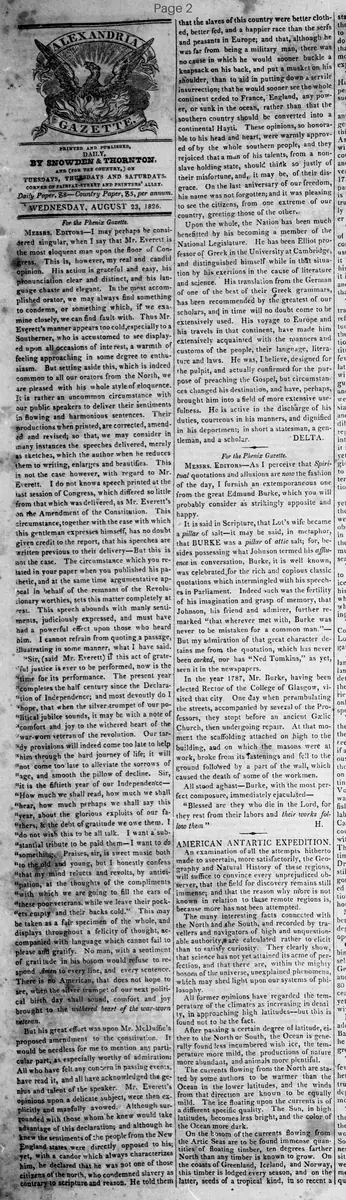
Messrs. Editors—I may perhaps be considered singular, when I say that Mr. Everett is the most eloquent man upon the floor of Congress. This is, however, my real and candid opinion. His action is graceful and easy, his pronunciation clear and distinct, and his language chaste and elegant. In the most accomplished orator, we may always find something to condemn, or something which, if we examine closely, we can find fault with. Thus Mr. Everett's manner appears too cold, especially to a Southerner, who is accustomed to see displayed upon all occasions of interest, a warmth of feeling approaching in some degree to enthusiasm. But setting aside this, which is indeed common to all our orators from the North, we are pleased with his whole style of eloquence. It is rather an uncommon circumstance with our public speakers to deliver their sentiments in flowing and harmonious sentences. Their productions when printed, are corrected, amended and revised; so that, we may consider in many instances the speeches delivered, merely as sketches, which the author when he reduces them to writing, enlarges and beautifies. This is not the case however, with regard to Mr. Everett. I do not know a speech printed at the last session of Congress, which differed so little from that which was delivered, as Mr. Everett's on the Amendment of the Constitution. This circumstance, together with the ease with which this gentleman expresses himself, has no doubt given credit to the report, that his speeches are written previous to their delivery—But this is not the case. The circumstance which you related in your paper when you published his pathetic, and at the same time argumentative appeal in behalf of the remnant of the Revolutionary worthies, sets this matter completely at rest. This speech abounds with manly sentiments, judiciously expressed, and must have had a powerful effect upon those who heard him. I cannot refrain from quoting a passage, illustrating in some manner, what I have said.
"Sir, (said Mr. Everett) if this act of grateful justice is ever to be performed, now is the time for its performance. The present year completes the half century since the Declaration of Independence; and most devoutly do I hope, that when the silver trumpet of our political jubilee sounds, it may be with a note of comfort and joy to the withered heart of the war-worn veteran of the revolution. Our tardy provisions will indeed come too late to help him through the hard journey of life; it will not come too late to alleviate the sorrows of age, and smooth the pillow of decline. Sir, it is the fiftieth year of our Independence—How much we shall read, how much we shall hear, how much perhaps we shall say this year, about the glorious exploits of our ancestors, & the debt of gratitude we owe them. I do not wish this to be all talk. I want a substantial tribute to be paid them—I want to do something. Praises, sir, is sweet music both to the old and young, but I honestly confess that my mind relucts and revolts, by anticipation, at the thoughts of the compliments with which we are going to fill the ears of these poor veterans, while we leave their pockets empty and their backs cold." This may be taken as a fair specimen of the whole, and displays throughout a felicity of thought, accompanied with language which cannot fail to please and gratify. No man, with a sentiment of gratitude in his bosom would refuse to respond Amen to every line, and every sentence. There is no American, that does not hope to see, when the silver trumpet of our next political birth day shall sound, comfort and joy brought to the withered heart of the war-worn veteran.
But his great effort was upon Mr. McDuffie's proposed amendment to the constitution. It would be needless for me to mention any particular part, as especially worthy of admiration: All who have felt any concern in passing events, have read it, and all have acknowledged the genius and talent of the speaker. Mr. Everett's opinions upon a delicate subject, were then explicitly and manfully avowed. Although surrounded with those whom he knew would take advantage of this declaration; and although he knew the sentiments of the people from the New England states were directly opposed to his; yet, with a candor which always characterizes him, he declared that he was not one of those citizens of the north, who condemned slavery as contrary to scripture and reason. He told them that the slaves of this country were better clothed, better fed, and a happier race than the serfs and peasants in Europe; and that, although he was far from being a military man, there was no cause in which he would sooner buckle a knapsack on his back, and put a musket on his shoulder, than to aid in putting down a servile insurrection; that he would sooner see the whole continent ceded to France, England, any power, or sunk in the ocean, rather than that the southern country should be converted into a continental Hayti. These opinions, so honorable to his head and heart, were warmly approved of by the whole southern people, and they rejoiced that a man of his talents, from a non-slave holding state, should think so justly of grace. On the last anniversary of our freedom, their misfortune, and, it may be, of their disgrace. his name was not forgotten; and it was pleasing to see the citizens, from one extreme of our country, greeting those of the other.
Upon the whole, the Nation has been much benefitted by his becoming a member of the National Legislature. He has been Elliot professor of Greek in the University at Cambridge, and distinguished himself while in that situation by his exertions in the cause of literature and science. His translation from the German of one of the best of their Greek grammars, has been recommended by the greatest of our scholars, and in time will no doubt come to be extensively used. His voyage to Europe and his travels in that continent, have made him extensively acquainted with the manners and customs of the people, their language, literature and laws. He was, I believe, designed for the pulpit, and actually confirmed for the purpose of preaching the Gospel, but circumstances changed his destination, and have, perhaps, brought him into a field of more extensive usefulness. He is active in the discharge of his duties, courteous in his manners, and dignified in his deportment; in short a statesman, a gentleman, and a scholar.
DELTA.
Messrs. Editors—I may perhaps be considered singular, when I say that Mr. Everett is the most eloquent man upon the floor of Congress. This is, however, my real and candid opinion. His action is graceful and easy, his pronunciation clear and distinct, and his language chaste and elegant. In the most accomplished orator, we may always find something to condemn, or something which, if we examine closely, we can find fault with. Thus Mr. Everett's manner appears too cold, especially to a Southerner, who is accustomed to see displayed upon all occasions of interest, a warmth of feeling approaching in some degree to enthusiasm. But setting aside this, which is indeed common to all our orators from the North, we are pleased with his whole style of eloquence. It is rather an uncommon circumstance with our public speakers to deliver their sentiments in flowing and harmonious sentences. Their productions when printed, are corrected, amended and revised; so that, we may consider in many instances the speeches delivered, merely as sketches, which the author when he reduces them to writing, enlarges and beautifies. This is not the case however, with regard to Mr. Everett. I do not know a speech printed at the last session of Congress, which differed so little from that which was delivered, as Mr. Everett's on the Amendment of the Constitution. This circumstance, together with the ease with which this gentleman expresses himself, has no doubt given credit to the report, that his speeches are written previous to their delivery—But this is not the case. The circumstance which you related in your paper when you published his pathetic, and at the same time argumentative appeal in behalf of the remnant of the Revolutionary worthies, sets this matter completely at rest. This speech abounds with manly sentiments, judiciously expressed, and must have had a powerful effect upon those who heard him. I cannot refrain from quoting a passage, illustrating in some manner, what I have said.
"Sir, (said Mr. Everett) if this act of grateful justice is ever to be performed, now is the time for its performance. The present year completes the half century since the Declaration of Independence; and most devoutly do I hope, that when the silver trumpet of our political jubilee sounds, it may be with a note of comfort and joy to the withered heart of the war-worn veteran of the revolution. Our tardy provisions will indeed come too late to help him through the hard journey of life; it will not come too late to alleviate the sorrows of age, and smooth the pillow of decline. Sir, it is the fiftieth year of our Independence—How much we shall read, how much we shall hear, how much perhaps we shall say this year, about the glorious exploits of our ancestors, & the debt of gratitude we owe them. I do not wish this to be all talk. I want a substantial tribute to be paid them—I want to do something. Praises, sir, is sweet music both to the old and young, but I honestly confess that my mind relucts and revolts, by anticipation, at the thoughts of the compliments with which we are going to fill the ears of these poor veterans, while we leave their pockets empty and their backs cold." This may be taken as a fair specimen of the whole, and displays throughout a felicity of thought, accompanied with language which cannot fail to please and gratify. No man, with a sentiment of gratitude in his bosom would refuse to respond Amen to every line, and every sentence. There is no American, that does not hope to see, when the silver trumpet of our next political birth day shall sound, comfort and joy brought to the withered heart of the war-worn veteran.
But his great effort was upon Mr. McDuffie's proposed amendment to the constitution. It would be needless for me to mention any particular part, as especially worthy of admiration: All who have felt any concern in passing events, have read it, and all have acknowledged the genius and talent of the speaker. Mr. Everett's opinions upon a delicate subject, were then explicitly and manfully avowed. Although surrounded with those whom he knew would take advantage of this declaration; and although he knew the sentiments of the people from the New England states were directly opposed to his; yet, with a candor which always characterizes him, he declared that he was not one of those citizens of the north, who condemned slavery as contrary to scripture and reason. He told them that the slaves of this country were better clothed, better fed, and a happier race than the serfs and peasants in Europe; and that, although he was far from being a military man, there was no cause in which he would sooner buckle a knapsack on his back, and put a musket on his shoulder, than to aid in putting down a servile insurrection; that he would sooner see the whole continent ceded to France, England, any power, or sunk in the ocean, rather than that the southern country should be converted into a continental Hayti. These opinions, so honorable to his head and heart, were warmly approved of by the whole southern people, and they rejoiced that a man of his talents, from a non-slave holding state, should think so justly of grace. On the last anniversary of our freedom, their misfortune, and, it may be, of their disgrace. his name was not forgotten; and it was pleasing to see the citizens, from one extreme of our country, greeting those of the other.
Upon the whole, the Nation has been much benefitted by his becoming a member of the National Legislature. He has been Elliot professor of Greek in the University at Cambridge, and distinguished himself while in that situation by his exertions in the cause of literature and science. His translation from the German of one of the best of their Greek grammars, has been recommended by the greatest of our scholars, and in time will no doubt come to be extensively used. His voyage to Europe and his travels in that continent, have made him extensively acquainted with the manners and customs of the people, their language, literature and laws. He was, I believe, designed for the pulpit, and actually confirmed for the purpose of preaching the Gospel, but circumstances changed his destination, and have, perhaps, brought him into a field of more extensive usefulness. He is active in the discharge of his duties, courteous in his manners, and dignified in his deportment; in short a statesman, a gentleman, and a scholar.
DELTA.
What sub-type of article is it?
Informative
Persuasive
Reflective
What themes does it cover?
Politics
Slavery Abolition
Morality
What keywords are associated?
Edward Everett
Congress Eloquence
Revolutionary Veterans
Slavery Defense
Constitutional Amendment
Southern Approval
Oratory Style
What entities or persons were involved?
Delta.
Messrs. Editors
Letter to Editor Details
Author
Delta.
Recipient
Messrs. Editors
Main Argument
edward everett is the most eloquent member of congress, praised for his graceful oratory, authentic speeches on aiding revolutionary war veterans and defending southern views on slavery in a constitutional amendment debate, demonstrating his integrity and scholarly background.
Notable Details
Quotes Everett's Speech Advocating Substantial Aid For Revolutionary Veterans On The 50th Anniversary Of Independence
Discusses Everett's Speech On Mcduffie's Constitutional Amendment, Avowing Non Condemnation Of Slavery And Readiness To Suppress Insurrection
Background: Elliot Professor Of Greek At Cambridge, Translated German Greek Grammar, Traveled Europe, Originally Intended For Pulpit