Thank you for visiting SNEWPapers!
Sign up free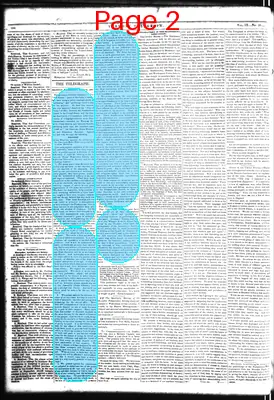
Vermont Telegraph
Brandon, Rutland County, Vermont
What is this article about?
The 'Old School' majority in the Presbyterian General Assembly dissolved the 1801 Plan of Union, excluded several synods, and voted out the American Home Missionary and Education Societies. A minority protested the decision. Western Reserve Synod served notice claiming the Assembly dissolved, prompting potential lawsuit over funds.
Clipping
OCR Quality
Full Text
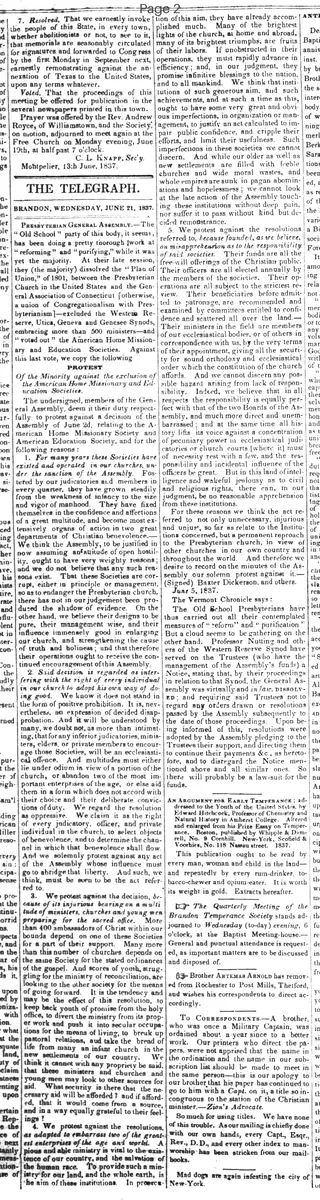
Presbyterian General Assembly.—The "Old School" party of this body, it seems, has been doing a pretty thorough work at "reforming" and "purifying," while it was yet the majority. At their late session, they (the majority) dissolved the "Plan of Union," of 1801, between the Presbyterian Church in the United States and the General Association of Connecticut [otherwise, a union of Congregationalism with Presbyterianism]—excluded the Western Reserve, Utica, Geneva and Genesee Synods, embracing more than 500 ministers—and "voted out" the American Home Missionary and Education Societies. Against this last vote, we copy the following
PROTEST
Of the Minority against the exclusion of the American Home Missionary and Education Societies.
The undersigned, members of the General Assembly, deem it their duty respectfully to protest against a decision of the Assembly of June 2d, relating to the American Home Missionary Society and American Education Society, and for the following reasons:
1. For many years these Societies have existed and operated in our churches, under the sanction of the Assembly. Fostered by our judicatories and members in every quarter, they have grown steadily from the weakness of infancy to the size and vigor of manhood. They have fixed themselves in the confidence and affections of a great multitude, and become most extensively organs of action in two great departments of Christian benevolence.— We think the Assembly, to be justified in now assuming an attitude of open hostility, ought to have very weighty reasons; and we do not believe that any such reasons exist. That these Societies are corrupt, either in principle or management so as to endanger the Presbyterian church, there has not in our judgement been produced the shadow of evidence. On the other hand, we believe their designs to be pure, their management wise, and their influence immensely good in enlarging our church, and strengthening the cause of truth and holiness; and that therefore their operations ought to receive the continued encouragement of this Assembly.
2. Said decision is regarded as interfering with the right of every individual in our church to adopt his own way of doing good. We know it does not stand in the form of positive prohibition. It is, nevertheless, an expression of decided disapprobation. And it will be understood by many, we doubt not, as more than intimating, that for any inferior judicatories, ministers, elders, or private members to encourage those Societies, will be an ecclesiastical offence. And multitudes must either lie under odium in view of a portion of the church, or abandon two of the most important enterprises of the age, or else aid them in a form which does not accord with their choice and their deliberate convictions of duty. We regard the resolution as oppressive. We claim it as the right of every judicatory, officer, and private individual in the church, to select objects of benevolence, and to determine the channel in which that benevolence shall flow. And we solemnly protest against any act of the Assembly whose influence must go to abridge that liberty. And such, we think, must be seen to be the act referred to.
3. We protest against the decision, because of its injurious bearing on a multitude of ministers, churches and young men preparing for the sacred office. More than 400 ambassadors of Christ within our bounds depend on one of these Societies for a part of their support. Many more than this number of churches depend on the same Society for the stated ordinances of the gospel. And scores of youth, struggling for the ministry of reconciliation, are looking to the other society for the means of going forward. It is the tendency and may be the effect of this resolution, to keep back youth of promise from the holy office, to divert the ministry from its proper work and push it into secular occupations for the means of living, to break up pastoral relations, and take the bread of life from many an infant church in the new settlements of our country. We think it cannot with any propriety be said, that these ministers and churches and young men may look to other sources for aid. What security is there that the necessary aid will be afforded? and if afforded, that it would come from a source, and in a way equally grateful to their feelings?
4. We protest against the resolutions, as adapted to embarrass two of the greatest enterprises of the age and world. A pious and able ministry is vital to the existence of our country, and the salvation of the human race. To provide such a ministry for our land, and the whole earth, is the aim of these institutions. In prosecution of this aim, they have already accomplished much. Many of the brightest lights of the church, at home and abroad, many of its brightest triumphs, are fruits of their labors. If unobstructed in their operations, they must rapidly advance in efficiency; and, in our judgment, they promise ineffable blessings to the nation and to all mankind. We think that institutions of such generous aim, and such achievements, and at such a time as this, ought to have some very great and obvious imperfections, in organization or management, to justify an act calculated to impair public confidence, and cripple their efforts, and limit their usefulness. Such imperfections in these societies we cannot discern. And while our older as well as new settlements are filled with feeble churches and wide moral wastes, and whole empires are sunk in pagan abominations and hopelessness; we cannot look at the late action of the Assembly touching these institutions without deep pain, nor suffer it to pass without kind but decided remonstrance.
5. We protest against the resolutions referred to, because founded, as we believe, on misapprehension as to the responsibility of said societies. Their funds are all the free-will offerings of the Christian public. Their officers are all elected annually by the members of the societies. Their operations are all subject to the strictest review. Their beneficiaries before admitted to patronage, are recommended and examined by committees entitled to confidence and scattered all over the land.— Their ministers in the field are members of our ecclesiastical bodies, or of others in correspondence with us, by the very terms of their appointment, giving all the security for sound orthodoxy and ecclesiastical order which the constitution of the church affords. And we cannot discern any possible hazard arising from lack of responsibility. Indeed, we believe that in all respects the responsibility is equally perfect with that of the two Boards of the Assembly, and much more direct and unembarrassed; and at the same time all history lifts its voice against a concentration of pecuniary power in ecclesiastical judicatories or church courts [where it] must of necessity rest with a few, and the responsibility and incidental influence of the officers be great. But in this land of intelligence and wakeful jealousy as to civil and religious rights, there can, in our judgment, be no reasonable apprehension from these institutions.
For these reasons we think the act referred to not only unnecessary, injurious and unjust, so far as relate to the Institutions concerned, but a permanent reproach to the Presbyterian church, in view of other churches in our own country and throughout the world. And therefore we desire to record on the minutes of the Assembly our solemn protest against it.—
(Signed) Baxter Dickerson, and others.
June 5, 1837.
The Vermont Chronicle says:
The Old School Presbyterians have thus carried out all their contemplated measures of "reform" and "purification"
But a cloud seems to be gathering on the other hand. Professor Nutting and others of the Western Reserve Synod have served on the Trustees (who have the management of the Assembly's funds) a Notice, stating that, by their proceedings in relation to that Synod, the General Assembly was virtually and in law, DISSOLVED: and requiring said Trustees not to regard any orders drawn or resolutions passed by the Assembly subsequently to the date of those proceedings. Upon being informed of this, resolutions were adopted by the Assembly pledging to the Trustees their support, and directing them to continue their payments &c., as heretofore, and to disregard the Notice mentioned above and all similar ones. So there will probably be a law-suit for the funds.
What sub-type of article is it?
What keywords are associated?
What entities or persons were involved?
Domestic News Details
Event Date
June 2 5, 1837
Key Persons
Outcome
dissolution of 1801 plan of union; exclusion of western reserve, utica, geneva, and genesee synods (over 500 ministers); exclusion of american home missionary and education societies; minority protest; notice claiming assembly dissolved; potential lawsuit over funds.
Event Details
The 'Old School' majority in the Presbyterian General Assembly dissolved the Plan of Union of 1801, excluded several synods, and voted to exclude the American Home Missionary and Education Societies. A minority protested the exclusion of the societies on grounds of historical sanction, individual rights, impact on ministers and churches, importance of the enterprises, and misapprehension of responsibility. The Vermont Chronicle noted the reforms. Professor Nutting and others from Western Reserve Synod notified trustees that the Assembly was dissolved due to proceedings against their synod, leading to Assembly resolutions to disregard the notice and potential legal action over funds.