Thank you for visiting SNEWPapers!
Sign up free
The Dickinson Press
Dickinson, Stark County, North Dakota
What is this article about?
Dr. Talmage preaches a sermon at the dedication of the magnificent new organ at Brooklyn Tabernacle, emphasizing the biblical and historical power of sacred music in worship, its divine origins, and urging congregational singing over delegated choirs.
Clipping
OCR Quality
Full Text
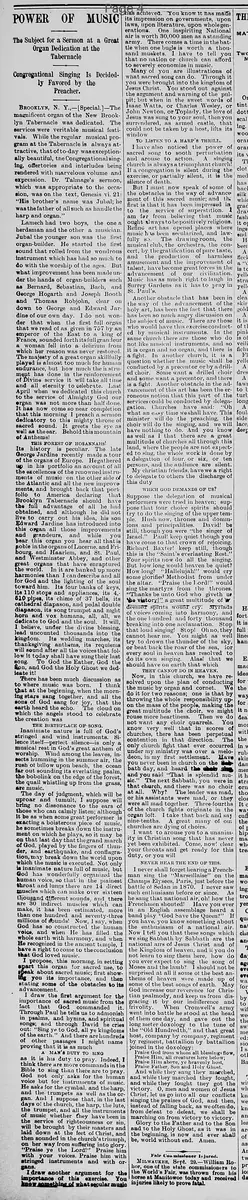
The Subject for a Sermon at a Great Organ Dedication at the Tabernacle
Congregational Singing Is Decidedly Favored by the Preacher.
BROOKLYN, N. Y., [Special.]—The magnificent organ of the New Brooklyn Tabernacle was dedicated. The services were veritable musical festivals. While the regular musical program at the Tabernacle is always attractive, that of to-day was exceptionally beautiful, the Congregational singing, offertories and interludes being rendered with marvelous volume and expression. Dr. Talmage's sermon, which was appropriate to the occasion, was on the text, Genesis iv. 21: "His brother's name was Jubal; he was the father of all such as handle the harp and organ."
Lamech had two boys, the one a herdsman and the other a musician. Jubal the younger son was the first organ-builder. He started the first sound that rolled from the wondrous instrument which has had so much to do with the worship of the ages. But what improvement has been made under the hands of organ-builders such as Bernard, Sebastian, Bach, and George Hogarth and Joseph Booth and Thomas Robjohn, clear on down to George and Edward Jardine of our own day. I do not wonder that when the first full organ that we read of as given in 757 by an emperor of the East to a king of France, sounded forth its full grandeur a woman fell into a delirium from which her reason was never restored.
The majesty of a great organ skillfully played is almost too much for human endurance. But how much the instrument has done in the reinforcement of Divine service it will take all time and all eternity to celebrate. Last April when we dedicated this church to the service of Almighty God our organ was not more than half done. It has now come so near completion that this morning I preach a sermon dedicatory to this mighty throne of sacred sound. It greets the eye as well as the ear. Behold this mountain of Anthems!
THIS FOREST OF HOSANNAHS!
Its history is peculiar. The late George Jardine recently made a tour of the organs of Europe. He gathered up in his portfolio an account of all the excellences of the renowned instruments of music on the other side of the Atlantic and all the new improvements, and brought back that portfolio to America declaring that Brooklyn Tabernacle should have the full advantage of all he had obtained, and although he did not live to carry out his idea, his son Edward Jardine has introduced into this organ all those improvements and grandeurs, and while you hear this organ you hear all that is noble in the organs of Lucerne, and Fribourg, and Haarlem, and St. Paul, and Westminster Abbey, and other great organs that have enraptured the world. In it are banked up more harmonies than I can describe and all for God and the lighting of the soul toward him. Its four banks of keys, its 110 stops and appliances, its 4,610 pipes, its chime of 37 bells, its cathedral diapason, and pedal double diapason, its song trumpet and night horn and vox humana, all, all, we dedicate to God and the soul. It will, I believe, under the divine blessing, lead uncounted thousands into the kingdom. Its wedding marches, its thanksgiving anthems, its requiems will sound after all the voices that follow it today shall have sung their last song.
To God the Father, God the Son, and God the Holy Ghost we dedicate it!
There has been much discussion as to where music was born. I think that at the beginning, when the morning stars sang together, and all the sons of God sang for joy, that the earth heard the echo. The cloud on which the angels stood to celebrate the creation was
THE BIRTHPLACE OF SONG.
Inanimate nature is full of God's stringed and wind instruments. Silence itself—perfect silence—is only a musical rest in God's great anthem of worship. Wind among the leaves, insects humming in the summer air, the rush of billow upon beach, the ocean roar out sounding its everlasting psalm, the bobolink on the edge of the forest, the quail whistling up from the grass, are music.
The day of judgment, which will be uproar and tumult, I suppose will bring no dissonance to the ears of those who can calmly listen; although it be as when some great performer is exacting a boisterous piece of music, he sometimes breaks down the instrument on which he plays, so it may be on that last day that the grand march of God, played by the fingers of thunder, and earthquake, and conflagration, may break down the world upon which the music is executed. Not only is inanimate nature full of music, but God has wonderfully organized the human voice, so that in the plainest throat and lungs there are 14 direct muscles which can make over sixteen thousand different sounds. and there are 30 indirect muscles which can make, it has been estimated, more than one hundred and seventy-three millions of sounds! Now, I say, when God has so constructed the human voice, and when He has filled the whole earth with harmony, and when He recognized in the ancient temple, I have a right to come to the conclusion that God loved music.
I propose, this morning, in setting apart this organ for sacred use, to speak about sacred music; first showing you its importance, and then stating some of the obstacles to its advancement.
I draw the first argument for the importance of sacred music from the fact that God commanded it. Through Paul he tells us to admonish in psalms, and hymns, and spiritual songs; and through David he cries out: "Sing ye to God, all ye kingdoms of the earth." And there are hundreds of other passages I might name proving that it is as much
A MAN'S DUTY TO SING
as it is his duty to pray. Indeed, I think there are more commands in the Bible to sing than there are to pray. God not only asks for the human voice but for instruments of music. He asks for the cymbal, and the harp, and the trumpets as well as the organ. And I suppose that, in the last days of the church, the harp, the lute, the trumpet, and all the instruments of music whether they have been in the service of righteousness or sin, will be brought by their masters and laid down at the feet of Christ, and then sounded in the church's triumph, on her way from suffering into glory.
"Praise ye the Lord!" Praise him with your voices. Praise him with stringed instruments and with organs.
I draw another argument for the importance of this exercise. You know something of what secular music has accomplished. It has made its impression on governments, upon laws, upon literature, upon whole generations. One inspiriting National air is worth 30,000 men as a standing army. There comes a time in the battle when one bugle is worth a thousand muskets. I have to tell you that no nation or church can afford to severely economize in music.
Many of you are illustrations of what sacred song can do. Through it you were brought into the kingdom of Jesus Christ. You stood out against the argument and warning of the pulpit: but when in the sweet words of Isaac Watts, or Charles Wesley, or John Newton, or Toplady, the love of Jesus was sung to your soul, then you surrendered, as armed castle, that could not be taken by a host, lifts its window
TO LISTEN TO A HARP'S THRILL.
I have also noticed the power of sacred song to soothe perturbation and arouse to action. A singing church is always a triumphant church. If a congregation is silent during the exercise, or partially silent, it is the silence of death.
But I must now speak of some of the obstacles in the way of advancement of this sacred music; and the first is that it has been impressed into the service of superstition. I am far from believing that music ought always to be positively religious. Refined art has opened places where music has been secularized, and lawfully so. The drawing-room, the musical club, the orchestra, the concert, by the gratification of pure taste, and the production of harmless amusement and the improvement of talent, have become great forces in the advancement of our civilization. Music has as much right to laugh in Surrey Gardens as it has to pray in St. Paul's.
Another obstacle that has been in the way of the advancement of the holy art, has been the fact that there has been so much angry discussion on the subject of music. There are those who would have this exercise conducted by musical instruments. In the same church there are those who do not like musical instruments, and so it is organ and no organ, and there is a fight. In another church, it is a question whether the music shall be conducted by a precentor or by a drilled choir. Some want a drilled choir and some want a precentor, and there is a fight. Another obstacle in the advancement of this art has been the erroneous notion that this part of the services could be conducted by delegation. Churches have said: "Oh what an easy time we shall have. This minister will do the preaching, the choir will do the singing, and we will have nothing to do." And you know as well as I that there are a great multitude of churches all through this land, where the people are not expected to sing, the whole work is done by a delegation of four, or six, or ten persons, and the audience are silent.
My Christian friends, have we a right to delegate to others the discharge of this duty
WHICH GOD DEMANDS OF US?
Suppose the delegation of musical performers were tried in heaven; suppose that four choice spirits should try to do the singing of the upper temple. Hush now, thrones and dominions and principalities. David! be still, though you were "the singer of Israel." Paul! keep quiet though you have come to that crown of rejoicing. Richard Baxter! keep still, though this is the "Saint's everlasting Rest." Four spirits now do all the singing. But how long would heaven be quiet? How long? "Hallelujah!" would cry some glorified Methodist from under the altar. "Praise the Lord!" would sing the martyrs from the thrones. "Thanks be unto God who giveth us the victory!" a great multitude of redeemed spirits would cry. Myriads of voices coming into harmony. and the one hundred and forty thousand breaking into one acclamation. Stop that loud singing! Stop! Oh no, they cannot hear me. You might as well try to drown the thunder of the sky. or beat back the roar of the sea. for every soul in heaven has resolved to do its own singing. Alas! that we should have on earth that which
THEY CANNOT DO IN HEAVEN.
Now, in this church, we have resolved upon the plan of conducting the music by organ and cornet. We do it for two reasons; one is that by throwing the whole responsibility upon the mass of the people, making the great multitude the choir, we might rouse more heartiness. Then we do not want any choir quarrels. You know very well that in scores of churches, there has been perpetual contention in that direction. The only church fight that ever occurred under my ministry was over a melodeon, in my first settlement. Have you never been in church on the Sabbath day, and heard the debate, and you said "That is splendid music." The next Sabbath, you were in that church, and there was no choir at all. Why? The leader was mad. or his assistants were mad, or they were all mad together. Three-fourths of the church fights originate in the organ loft. I take that back and say nine-tenths. A great many of our churches are dying of choirs.
I want to arouse you to a unanimity in Christian song that has never yet been exhibited. Come, now! clear your throats and get ready for this duty, or you will
NEVER HEAR THE END OF THIS.
I never shall forget hearing a Frenchman sing the "Marseillaise" on the Champs Elysees, Paris, just before the battle of Sedan in 1870. I never saw such enthusiasm before or since. As he sang that national air, oh! how the Frenchmen shouted! Have you ever in an English assemblage heard a band play "God Save the Queen?" If you have, you know something about the enthusiasm of a national air. Now I tell you that these songs which we sing Sabbath by Sabbath are the national airs of Jesus Christ and of the Kingdom of heaven, and if you do not learn to sing them here, how do you ever expect to sing the song of Moses and the lamb? I should not be surprised at all if some of the best anthems of heaven were made up of some of the best songs of earth. May God increase our reverence for Christian psalmody, and keep us from disgracing it by our indifference and frivolity.
When Cromwell's army went into battle he stood at the head of them one day, and gave out the long meter doxology to the tune of the "Old Hundredth," and that great host, company by company, regiment by regiment, battalion by battalion joined in the doxology:
Praise God from whom all blessings flow,
Praise Him, all creatures here below;
Praise Him above, ye heavenly host,
Praise Father. Son and Holy Ghost.
And while they sang they marched, and while they marched they fought, and while they fought they got the victory. O, men and women of Jesus Christ, let us go into all our conflicts singing the praises of God, and then, instead of falling back, as we often do, from defeat to defeat, we shall be marching on from victory to victory.
Glory to the Father and to the Son and to the Holy Ghost, as it was in the beginning, is now and ever shall be, world without end. Amen.
What sub-type of article is it?
What themes does it cover?
What keywords are associated?
What entities or persons were involved?
Where did it happen?
Story Details
Key Persons
Location
Brooklyn Tabernacle, Brooklyn, N. Y.
Event Date
Last April (Church Dedication); Today (Organ Dedication)
Story Details
Dr. Talmage delivers a sermon on Genesis iv. 21 at the organ dedication, tracing music's biblical origins with Jubal, historical developments by organ builders, divine command for sacred music, its power in worship and conversion, obstacles like superstition and church disputes, advocating congregational singing.