Thank you for visiting SNEWPapers!
Sign up free
Editorial
November 9, 1838
Western Enquirer
Lewisburg, Greenbrier County, West Virginia
What is this article about?
Committee address to Virginians urging recovery of direct foreign import trade lost to Northern states, advocating increased banking facilities under legislative restrictions and judicious internal improvements to boost commerce, agriculture, and industry. Includes trade statistics and arguments on capital needs.
Clipping
OCR Quality
95%
Excellent
Full Text
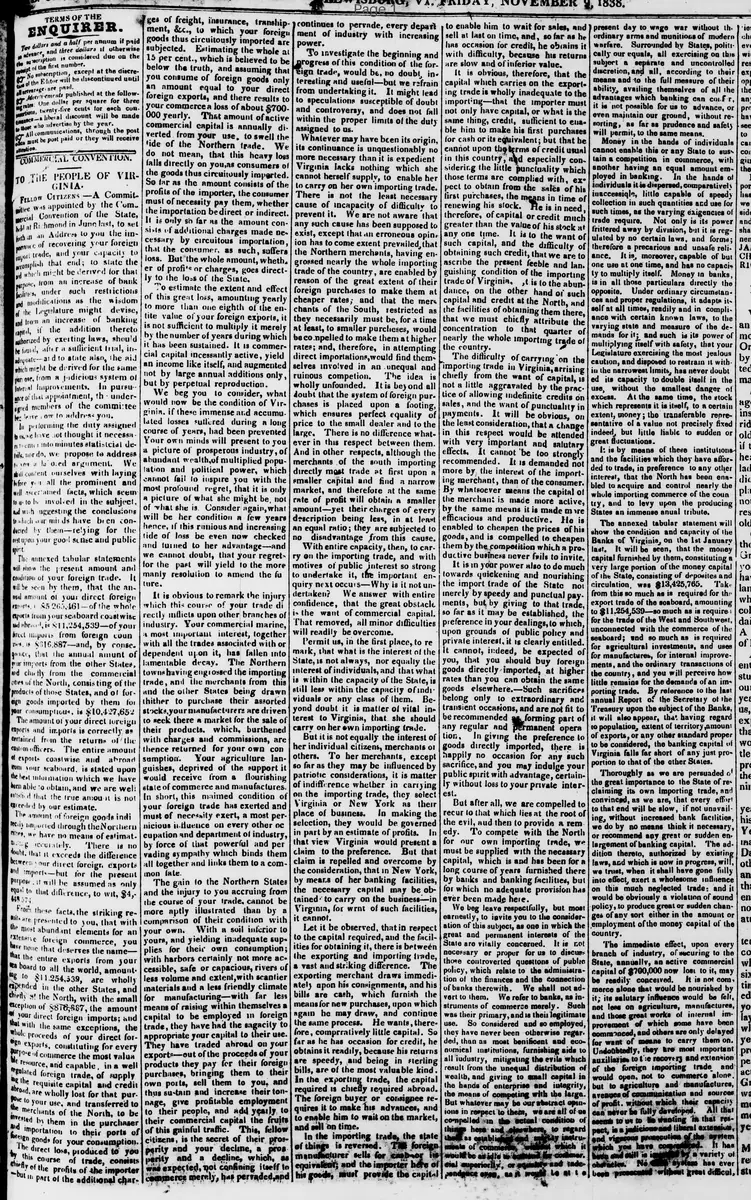
COMMERCIAL CONVENTION.
TO THE PEOPLE OF VIRGINIA.
Fellow Citizens—A Committee was appointed by the Commercial Convention of the State, held at Richmond in June last, to prepare an Address to you on the importance of recovering your foreign import trade, and your capacity to accomplish that end; to state the purpose, from an increase of bank facilities, under such restrictions and modifications as the wisdom of the Legislature might devise, and from an increase of banking capital, in the addition thereto authorized by existing laws, should be found, after a sufficient trial, inadequate—and to state also, the aid which might be derived for the same purpose, from a judicious system of internal improvements. In pursuance of that appointment, the undersigned members of the committee beg leave now to address you.
In performing the duty assigned us, we have not thought it necessary to enter into minute statistical details, nor do we propose to address you in a close-knit argument. We will content ourselves with laying before you all the prominent and well ascertained facts, which seem to be involved in the subject, and with suggesting the conclusions to which our minds have been conducted by them—relying for the rest upon your good sense and public spirit.
The annexed tabular statements will show the present amount and condition of your foreign trade. It will be seen by them, that the annual amount of your direct foreign exports, $5,263,161—of the whole exports from your seaboard coastwise and abroad, is $11,254,539—of your direct imports from foreign countries, is $916,887—and, by consequence, that the annual amount of your imports from the other States, and chiefly from the commercial cities of the North, consisting of the products of those States, and of foreign goods imported by them for your consumption, is $10,427,652.
The amount of your direct foreign exports and imports is correctly, as ascertained from the returns of the custom officers. The entire amount of exports coastwise and abroad from your seaboard, is stated upon the best information which we have been able to obtain, and we are well satisfied that the true amount is not exceeded by our estimate.
The amount of foreign goods indirectly imported through the Northern States, we have no means of estimating accurately. There is no doubt, that it exceeds the difference between your direct foreign exports and imports—but for the present purpose, it will be assumed as only equal to that difference, to wit, $4,448,374.
From these facts, the striking results are presented to you, that with the most abundant elements for an extensive foreign commerce, you have none that deserves the name—that the entire exports from your seaboard to all the world, amounting to $11,254,339, are wholly expended in the other States, and chiefly at the North, with the small exception of $916,887, the amount of your direct foreign imports; and that with the same exception, the whole proceeds of your direct foreign exports, constituting for every purpose of commerce the most valuable resource, and capable, in a well regulated foreign trade, of supplying the requisite capital abroad, are wholly lost for that purpose to your use, and transferred to the merchants of the North, to be invested by them in the purchase and importation of foreign goods for your consumption.
The direct loss, produced to you by this course of trade, consists chiefly of the profits of the importer—but in part of the additional charges of freight, insurance, transshipment, &c., to which your foreign goods thus circuitously imported are subjected. Estimating the whole at 15 per cent., which is believed to be below the truth, and assuming that you consume of foreign goods only an amount equal to your direct foreign exports, and there results to your commerce a loss of about $700,000 yearly. That amount of active commercial capital is annually diverted from your use, to swell the tide of the Northern trade. We do not mean, that this heavy loss falls directly on you, as consumers of the goods thus circuitously imported. So far as the amount consists of the profits of the importer, the consumer must of necessity pay them, whether the importation be direct or indirect. It is only so far as the amount consists of additional charges made necessary by circuitous importation, that the consumer, as such, suffers loss. But the whole amount, whether of profits or charges, goes directly to the loss of the State.
To estimate the extent and effect of this great loss, amounting yearly to more than one eighth of the entire value of your foreign exports, it is not sufficient to multiply it merely by the number of years during which it has been sustained. It is commercial capital incessantly active, yielding an income like itself, and augmented not by large annual additions only, but by perpetual reproduction. We beg you to consider, what would now be the condition of Virginia, if these immense and accumulated losses suffered during a long course of years, had been prevented. Your own minds will present to you a picture of prosperous industry, of abundant wealth, of multiplied population and political power, which cannot fail to inspire you with the most profound regret, that it is only a picture of what she might be, not of what she is. Consider again, what will be her condition a few years hence, if this ruinous and increasing tide of loss be even now checked and turned to her advantage—and we cannot doubt, that your regrets for the past will yield to the more manly resolution to amend the future.
It is obvious to remark the injury which this course of your trade directly inflicts upon other branches of industry. Your commercial marine, a most important interest, together with all the trades associated with or dependent upon it, has fallen into lamentable decay. The Northern towns having engrossed the importing trade, and the merchants from this and the other States being drawn thither to purchase their assorted stocks, your manufacturers are driven to seek there a market for the sale of their products, which, burdened with charges and commissions, are thence returned for your own consumption. Your agriculture languishes, deprived of the support it would receive from a flourishing state of commerce and manufactures. In short, this maimed condition of your foreign trade has exerted and must of necessity exert, a most pernicious influence on every other occupation and department of industry, by force of that powerful and pervading sympathy which binds them all together and links them to a common fate.
The gain to the Northern States and the injury to you accruing from the course of your trade, cannot be more aptly illustrated than by a comparison of their condition with your own. With a soil inferior to yours, and yielding inadequate supplies for their own consumption; with harbors certainly not more accessible, safe or capacious, rivers of less volume and extent, with scantier materials and a less friendly climate for manufacturing—with far less means of raising within themselves a capital to be employed in foreign trade, they have had the sagacity to appropriate your capital to their use. They have traded abroad on your exports—out of the proceeds of your products they pay for their foreign purchases, bringing them to their own ports, sell them to you, and thus sustain and increase their tonnage, give profitable employment to their people, and add yearly, to their commercial capital the fruits of this gainful traffic. This, fellow citizens, is the secret of their prosperity and your decline, a prosperity and a decline, which, as was expected, not confining itself to commerce merely, has pervaded, and continues to pervade, every department of industry with increasing power.
To investigate the beginning and progress of this condition of the foreign trade, would be, no doubt, interesting and useful—but we refrain from undertaking it. It might lead to speculations susceptible of doubt and controversy, and does not fall within the proper limits of the duty assigned to us.
Whatever may have been its origin, its continuance is unquestionably no more necessary than it is expedient. Virginia lacks nothing which she cannot herself supply, to enable her to carry on her own importing trade. There is not the least necessary cause of incapacity or difficulty to prevent it. We are not aware that any such cause has been supposed to exist, except that an erroneous opinion has to some extent prevailed, that the Northern merchants, having engrossed nearly the whole importing trade of the country, are enabled by reason of the great extent of their foreign purchases to make them at cheaper rates; and that the merchants of the South, restricted as they necessarily must be, for a time at least, to smaller purchases, would be compelled to make them at higher rates; and, therefore, in attempting direct importations, would find themselves involved in an unequal and ruinous competition. The idea is wholly unfounded. It is beyond all doubt that the system of foreign purchases is placed upon a footing, which ensures perfect equality of price to the small dealer and to the large. There is no difference whatever in this respect between them. And in other respects, although the merchants of the south importing directly most trade at first upon a smaller capital and find a narrower market, and therefore at the same rate of profit will obtain a smaller amount—yet their charges of every description being less, in at least an equal ratio; they are subjected to no disadvantage from this cause.
With entire capacity, then, to carry on the importing trade, and with motives of public interest so strong to undertake it, the important enquiry next occurs—Why is it not undertaken? We answer with entire confidence, that the great obstacle is the want of commercial capital. That removed, all minor difficulties will readily be overcome.
Permit us, in the first place, to remark, that what is the interest of the State, is not always, nor equally the interest of individuals, and that what is within the capacity of the State, is still less within the capacity of individuals or any class of them. Beyond doubt it is matter of vital interest to Virginia, that she should carry on her own importing trade. But it is not equally the interest of her individual citizens, merchants or others. To her merchants, except so far as they may be influenced by patriotic considerations, it is matter of indifference whether in carrying on the importing trade, they select Virginia or New York as their place of business. In making the selection, they would be governed in part by an estimate of profits. In that view Virginia would present a claim to the preference. But that claim is repelled and overcome by the consideration, that in New York, by means of her banking facilities, the necessary capital may be obtained; to carry on the business in Virginia, for want of such facilities, it cannot.
Let it be observed, that in respect to the capital required, and the facilities for obtaining it, there is between the exporting and importing trade, a vast and striking difference. The exporting merchant draws immediately upon his consignments, and his bills are cash, which furnish the means for new purchases, upon which again he may draw, and continue the same process. He wants, therefore, comparatively little capital. So far as he has occasion for credit, he obtains it readily, because his returns are speedy, and being in sterling bills, are of the most valuable kind. In the exporting trade, the capital required is chiefly required abroad. The foreign buyer or consignee requires it to make his advances, and to enable him to wait on the market, and sell on time.
In the importing trade, the state of things is reversed. The foreign manufacturer sells for cash or its equivalent; and the importer here of his goods, must provide the capital to enable him to wait for sales, and sell at last on time, and, so far as he has occasion for credit, he obtains it with difficulty, because his returns are slow and of inferior value.
It is obvious, therefore, that the capital which carries on the exporting trade is wholly inadequate to the importing—that the importer must not only have capital, or what is the same thing, credit, sufficient to enable him to make his first purchases for cash or its equivalent; but that he cannot upon the terms of credit usual in this country, and especially considering the little punctuality with which those terms are complied with, expect to obtain from the sales of his first purchases, the means in time of renewing his stock. He is in need, therefore, of capital or credit much greater than the value of his stock at any one time. It is to the want of such capital, and the difficulty of obtaining such credit, that we are to ascribe the present feeble and languishing condition of the importing trade of Virginia. It is to the abundance, on the other hand, of such capital and credit at the North, and the facilities of obtaining them there, that we must chiefly attribute the concentration to that quarter of nearly the whole importing trade of the country.
The difficulty of carrying on the importing trade in Virginia, arising chiefly from the want of capital, is not a little aggravated by the practice of allowing indefinite credits on sales, and the want of punctuality in payments. It will be obvious, on the least consideration, that a change in this respect would be attended with very important and salutary effects. It cannot be too strongly recommended. It is demanded not more by the interest of the importing merchant, than of the consumer. By whatsoever means the capital of the merchant is made more active, by the same means it is made more efficacious and productive. He is enabled to cheapen the prices of his goods, and is compelled to cheapen them by the competition which a productive business never fails to invite.
It is in your power also to do much towards quickening and nourishing the import trade of the State not merely by speedy and punctual payments, but by giving to that trade, so far as it may be established, the preference in your dealings, to which, upon grounds of public policy and private interest, it is clearly entitled. It cannot, indeed, be expected of you, that you should buy foreign goods directly imported, at higher rates than you can obtain the same goods elsewhere. Such sacrifices belong only to extraordinary and transient occasions, and are not fit to be recommended as forming part of any regular and permanent operation. In giving the preference to goods directly imported, there is happily no occasion for any such sacrifice, and you may indulge your public spirit with advantage, certainly without loss to your private interest.
But after all, we are compelled to recur to that which lies at the root of the evil, and then to provide a remedy. To compete with the North for our own importing trade, we must be supplied with the necessary capital, which is and has been for a long course of years furnished there by banks and banking facilities, but for which no adequate provision has ever been made here.
We beg leave respectfully, but most earnestly, to invite you to the consideration of this subject, as one in which the great and permanent interests of the State are vitally concerned. It is not necessary or proper for us to discuss those controverted questions of public policy, which relate to the administration of the finances and the connection of banks therewith. We shall not advert to them. We refer to banks, as instruments of commerce merely. Such was their primary, and is their legitimate use. So considered and so employed, they have never been otherwise regarded, than as most beneficent and economical institutions, furnishing aids to all industry, mitigating the evils which result from the unequal distribution of wealth, and giving to small capital in the hands of enterprise and integrity, the means of competing with the large. But whatever may be our abstract opinions in respect to them, we are all of us compelled in the actual condition of things here and elsewhere, to regard them as established and the only instruments of commercial superiority, or equality and independence even, as it would be at this day to wage war without the ordinary arms and munitions of modern warfare. Surrounded by States, politically our equals, all exercising on this subject a separate and uncontrolled discretion, and all, according to their means and to the full measure of their ability, availing themselves of all the advantages which banking can confer, it is not possible for us to advance, or even maintain our ground, without resorting, as far as prudence and safety will permit, to the same means.
Money in the hands of individuals cannot enable this or any State to sustain a competition in commerce, with another having an equal amount employed in banking. In the hands of individuals it is dispersed, comparatively inaccessible, little capable of speedy collection in such quantities and use for such times, as the varying exigencies of trade require. Not only is its power frittered away by division, but it is regulated by no certain laws, and forms, therefore a precarious and unsafe reliance. It is, moreover, capable of but one use at one time, and has no capacity to multiply itself. Money in banks, is in all those particulars directly the opposite. Under ordinary circumstances and proper regulations, it adapts itself at all times, readily and in compliance with certain known laws, to the varying state and measure of the demands for it; and such is its power of multiplying itself with safety, that your Legislature exercising the most jealous caution, and disposed to restrain it within the narrowest limits, has never doubted its capacity to double itself in the use, without the smallest danger of excess. At the same time, the stock which represents it is itself, to a certain extent, money; the transferable representative of a value not precisely fixed indeed, but little liable to sudden or great fluctuations.
It is by means of these institutions—and the facilities which they have afforded to trade, in preference to any other interest, that the North has been enabled to acquire and control nearly the whole importing commerce of the country, and to levy upon the producing States an immense annual tribute.
The annexed tabular statement will show the condition and capacity of the Banks of Virginia, on the 1st January last. It will be seen, that the money capital furnished by them, constituting a very large portion of the money capital of the State, consisting of deposits and circulation, was $3,425,765. Take from this so much as is required for the export trade of the seaboard, amounting to $11,254,539—so much as is required for the trade of the West and Southwest, unconnected with the commerce of the seaboard; and so much as is required for agricultural investments, and uses for manufactures, for internal improvements, and the ordinary transactions of the country, and you will perceive how little remains for the demands of an importing trade. By reference to the last annual Report of the Secretary of the Treasury upon the subject of the Banks, it will also appear, that having regard to population, extent of territory, amount of exports, or any other standard proper to be considered, the banking capital of Virginia falls far short of any just proportion to that of the other States.
Thoroughly as we are persuaded of the great importance to the State of reclaiming its own importing trade, and convinced, as we are, that every effort to that end will be slow, if not unavailing, without increased bank facilities, we do by no means think it necessary, or recommend any great or sudden enlargement of banking capital. The addition thereto, authorized by existing laws, and which is now in progress, will, we trust, when it shall have gone fully into effect, exert a wholesome influence on this much neglected trade: and it would be obviously a violation of sound policy, to produce great or sudden changes of any sort either in the amount or employment of the money capital of the country.
The immediate effect, upon every branch of industry, of securing to the State, annually, an active commercial capital of $700,000 now lost to it, may be readily conceived. It is not commerce alone that would be nourished by it; its salutary influence would be felt not less on agriculture, manufactures, and those great works of internal improvement of which some have been commenced, and others are only delayed for want of means to carry them on. Undoubtedly, they are most important auxiliaries to the recovery and extension of the foreign importing trade and would open, not to commerce alone, but to agriculture and manufactures, avenues of communication and sources of profit, without which their capacity can never be fully developed. All that seems to us to be wanting in that respect, is a judicious and liberal extension, and vigorous prosecution of the system which you have commenced. It has obstacles. No system has ever been proposed without great difficulties and embarrassments—but it is cheering to remember, that none has ever been completed and fairly tried without producing the most triumphant results. Every great enterprise must expect to be discouraged by the timid, opposed by the selfish, and deserted by the impatient. Happily, wherever in any other State, such enterprises of improvement have been attempted, there have been found wisdom enough to foresee their usefulness and firmness enough to secure their accomplishment. We cannot fear that Virginia, the first to conceive, though among the last to begin them, will be alone distinguished by the weakness to abandon them.
Deeply impressed with the great importance of the subjects upon which it has been made our duty to address you, we commend them to your earnest consideration, relying on your intelligence and patriotism, so to dispose of them as shall best promote the great and permanent interests of the Commonwealth.
JAMES CASKIE,
CHARLES ELLIS,
RICHARD ANDERSON,
Committee.
TO THE PEOPLE OF VIRGINIA.
Fellow Citizens—A Committee was appointed by the Commercial Convention of the State, held at Richmond in June last, to prepare an Address to you on the importance of recovering your foreign import trade, and your capacity to accomplish that end; to state the purpose, from an increase of bank facilities, under such restrictions and modifications as the wisdom of the Legislature might devise, and from an increase of banking capital, in the addition thereto authorized by existing laws, should be found, after a sufficient trial, inadequate—and to state also, the aid which might be derived for the same purpose, from a judicious system of internal improvements. In pursuance of that appointment, the undersigned members of the committee beg leave now to address you.
In performing the duty assigned us, we have not thought it necessary to enter into minute statistical details, nor do we propose to address you in a close-knit argument. We will content ourselves with laying before you all the prominent and well ascertained facts, which seem to be involved in the subject, and with suggesting the conclusions to which our minds have been conducted by them—relying for the rest upon your good sense and public spirit.
The annexed tabular statements will show the present amount and condition of your foreign trade. It will be seen by them, that the annual amount of your direct foreign exports, $5,263,161—of the whole exports from your seaboard coastwise and abroad, is $11,254,539—of your direct imports from foreign countries, is $916,887—and, by consequence, that the annual amount of your imports from the other States, and chiefly from the commercial cities of the North, consisting of the products of those States, and of foreign goods imported by them for your consumption, is $10,427,652.
The amount of your direct foreign exports and imports is correctly, as ascertained from the returns of the custom officers. The entire amount of exports coastwise and abroad from your seaboard, is stated upon the best information which we have been able to obtain, and we are well satisfied that the true amount is not exceeded by our estimate.
The amount of foreign goods indirectly imported through the Northern States, we have no means of estimating accurately. There is no doubt, that it exceeds the difference between your direct foreign exports and imports—but for the present purpose, it will be assumed as only equal to that difference, to wit, $4,448,374.
From these facts, the striking results are presented to you, that with the most abundant elements for an extensive foreign commerce, you have none that deserves the name—that the entire exports from your seaboard to all the world, amounting to $11,254,339, are wholly expended in the other States, and chiefly at the North, with the small exception of $916,887, the amount of your direct foreign imports; and that with the same exception, the whole proceeds of your direct foreign exports, constituting for every purpose of commerce the most valuable resource, and capable, in a well regulated foreign trade, of supplying the requisite capital abroad, are wholly lost for that purpose to your use, and transferred to the merchants of the North, to be invested by them in the purchase and importation of foreign goods for your consumption.
The direct loss, produced to you by this course of trade, consists chiefly of the profits of the importer—but in part of the additional charges of freight, insurance, transshipment, &c., to which your foreign goods thus circuitously imported are subjected. Estimating the whole at 15 per cent., which is believed to be below the truth, and assuming that you consume of foreign goods only an amount equal to your direct foreign exports, and there results to your commerce a loss of about $700,000 yearly. That amount of active commercial capital is annually diverted from your use, to swell the tide of the Northern trade. We do not mean, that this heavy loss falls directly on you, as consumers of the goods thus circuitously imported. So far as the amount consists of the profits of the importer, the consumer must of necessity pay them, whether the importation be direct or indirect. It is only so far as the amount consists of additional charges made necessary by circuitous importation, that the consumer, as such, suffers loss. But the whole amount, whether of profits or charges, goes directly to the loss of the State.
To estimate the extent and effect of this great loss, amounting yearly to more than one eighth of the entire value of your foreign exports, it is not sufficient to multiply it merely by the number of years during which it has been sustained. It is commercial capital incessantly active, yielding an income like itself, and augmented not by large annual additions only, but by perpetual reproduction. We beg you to consider, what would now be the condition of Virginia, if these immense and accumulated losses suffered during a long course of years, had been prevented. Your own minds will present to you a picture of prosperous industry, of abundant wealth, of multiplied population and political power, which cannot fail to inspire you with the most profound regret, that it is only a picture of what she might be, not of what she is. Consider again, what will be her condition a few years hence, if this ruinous and increasing tide of loss be even now checked and turned to her advantage—and we cannot doubt, that your regrets for the past will yield to the more manly resolution to amend the future.
It is obvious to remark the injury which this course of your trade directly inflicts upon other branches of industry. Your commercial marine, a most important interest, together with all the trades associated with or dependent upon it, has fallen into lamentable decay. The Northern towns having engrossed the importing trade, and the merchants from this and the other States being drawn thither to purchase their assorted stocks, your manufacturers are driven to seek there a market for the sale of their products, which, burdened with charges and commissions, are thence returned for your own consumption. Your agriculture languishes, deprived of the support it would receive from a flourishing state of commerce and manufactures. In short, this maimed condition of your foreign trade has exerted and must of necessity exert, a most pernicious influence on every other occupation and department of industry, by force of that powerful and pervading sympathy which binds them all together and links them to a common fate.
The gain to the Northern States and the injury to you accruing from the course of your trade, cannot be more aptly illustrated than by a comparison of their condition with your own. With a soil inferior to yours, and yielding inadequate supplies for their own consumption; with harbors certainly not more accessible, safe or capacious, rivers of less volume and extent, with scantier materials and a less friendly climate for manufacturing—with far less means of raising within themselves a capital to be employed in foreign trade, they have had the sagacity to appropriate your capital to their use. They have traded abroad on your exports—out of the proceeds of your products they pay for their foreign purchases, bringing them to their own ports, sell them to you, and thus sustain and increase their tonnage, give profitable employment to their people, and add yearly, to their commercial capital the fruits of this gainful traffic. This, fellow citizens, is the secret of their prosperity and your decline, a prosperity and a decline, which, as was expected, not confining itself to commerce merely, has pervaded, and continues to pervade, every department of industry with increasing power.
To investigate the beginning and progress of this condition of the foreign trade, would be, no doubt, interesting and useful—but we refrain from undertaking it. It might lead to speculations susceptible of doubt and controversy, and does not fall within the proper limits of the duty assigned to us.
Whatever may have been its origin, its continuance is unquestionably no more necessary than it is expedient. Virginia lacks nothing which she cannot herself supply, to enable her to carry on her own importing trade. There is not the least necessary cause of incapacity or difficulty to prevent it. We are not aware that any such cause has been supposed to exist, except that an erroneous opinion has to some extent prevailed, that the Northern merchants, having engrossed nearly the whole importing trade of the country, are enabled by reason of the great extent of their foreign purchases to make them at cheaper rates; and that the merchants of the South, restricted as they necessarily must be, for a time at least, to smaller purchases, would be compelled to make them at higher rates; and, therefore, in attempting direct importations, would find themselves involved in an unequal and ruinous competition. The idea is wholly unfounded. It is beyond all doubt that the system of foreign purchases is placed upon a footing, which ensures perfect equality of price to the small dealer and to the large. There is no difference whatever in this respect between them. And in other respects, although the merchants of the south importing directly most trade at first upon a smaller capital and find a narrower market, and therefore at the same rate of profit will obtain a smaller amount—yet their charges of every description being less, in at least an equal ratio; they are subjected to no disadvantage from this cause.
With entire capacity, then, to carry on the importing trade, and with motives of public interest so strong to undertake it, the important enquiry next occurs—Why is it not undertaken? We answer with entire confidence, that the great obstacle is the want of commercial capital. That removed, all minor difficulties will readily be overcome.
Permit us, in the first place, to remark, that what is the interest of the State, is not always, nor equally the interest of individuals, and that what is within the capacity of the State, is still less within the capacity of individuals or any class of them. Beyond doubt it is matter of vital interest to Virginia, that she should carry on her own importing trade. But it is not equally the interest of her individual citizens, merchants or others. To her merchants, except so far as they may be influenced by patriotic considerations, it is matter of indifference whether in carrying on the importing trade, they select Virginia or New York as their place of business. In making the selection, they would be governed in part by an estimate of profits. In that view Virginia would present a claim to the preference. But that claim is repelled and overcome by the consideration, that in New York, by means of her banking facilities, the necessary capital may be obtained; to carry on the business in Virginia, for want of such facilities, it cannot.
Let it be observed, that in respect to the capital required, and the facilities for obtaining it, there is between the exporting and importing trade, a vast and striking difference. The exporting merchant draws immediately upon his consignments, and his bills are cash, which furnish the means for new purchases, upon which again he may draw, and continue the same process. He wants, therefore, comparatively little capital. So far as he has occasion for credit, he obtains it readily, because his returns are speedy, and being in sterling bills, are of the most valuable kind. In the exporting trade, the capital required is chiefly required abroad. The foreign buyer or consignee requires it to make his advances, and to enable him to wait on the market, and sell on time.
In the importing trade, the state of things is reversed. The foreign manufacturer sells for cash or its equivalent; and the importer here of his goods, must provide the capital to enable him to wait for sales, and sell at last on time, and, so far as he has occasion for credit, he obtains it with difficulty, because his returns are slow and of inferior value.
It is obvious, therefore, that the capital which carries on the exporting trade is wholly inadequate to the importing—that the importer must not only have capital, or what is the same thing, credit, sufficient to enable him to make his first purchases for cash or its equivalent; but that he cannot upon the terms of credit usual in this country, and especially considering the little punctuality with which those terms are complied with, expect to obtain from the sales of his first purchases, the means in time of renewing his stock. He is in need, therefore, of capital or credit much greater than the value of his stock at any one time. It is to the want of such capital, and the difficulty of obtaining such credit, that we are to ascribe the present feeble and languishing condition of the importing trade of Virginia. It is to the abundance, on the other hand, of such capital and credit at the North, and the facilities of obtaining them there, that we must chiefly attribute the concentration to that quarter of nearly the whole importing trade of the country.
The difficulty of carrying on the importing trade in Virginia, arising chiefly from the want of capital, is not a little aggravated by the practice of allowing indefinite credits on sales, and the want of punctuality in payments. It will be obvious, on the least consideration, that a change in this respect would be attended with very important and salutary effects. It cannot be too strongly recommended. It is demanded not more by the interest of the importing merchant, than of the consumer. By whatsoever means the capital of the merchant is made more active, by the same means it is made more efficacious and productive. He is enabled to cheapen the prices of his goods, and is compelled to cheapen them by the competition which a productive business never fails to invite.
It is in your power also to do much towards quickening and nourishing the import trade of the State not merely by speedy and punctual payments, but by giving to that trade, so far as it may be established, the preference in your dealings, to which, upon grounds of public policy and private interest, it is clearly entitled. It cannot, indeed, be expected of you, that you should buy foreign goods directly imported, at higher rates than you can obtain the same goods elsewhere. Such sacrifices belong only to extraordinary and transient occasions, and are not fit to be recommended as forming part of any regular and permanent operation. In giving the preference to goods directly imported, there is happily no occasion for any such sacrifice, and you may indulge your public spirit with advantage, certainly without loss to your private interest.
But after all, we are compelled to recur to that which lies at the root of the evil, and then to provide a remedy. To compete with the North for our own importing trade, we must be supplied with the necessary capital, which is and has been for a long course of years furnished there by banks and banking facilities, but for which no adequate provision has ever been made here.
We beg leave respectfully, but most earnestly, to invite you to the consideration of this subject, as one in which the great and permanent interests of the State are vitally concerned. It is not necessary or proper for us to discuss those controverted questions of public policy, which relate to the administration of the finances and the connection of banks therewith. We shall not advert to them. We refer to banks, as instruments of commerce merely. Such was their primary, and is their legitimate use. So considered and so employed, they have never been otherwise regarded, than as most beneficent and economical institutions, furnishing aids to all industry, mitigating the evils which result from the unequal distribution of wealth, and giving to small capital in the hands of enterprise and integrity, the means of competing with the large. But whatever may be our abstract opinions in respect to them, we are all of us compelled in the actual condition of things here and elsewhere, to regard them as established and the only instruments of commercial superiority, or equality and independence even, as it would be at this day to wage war without the ordinary arms and munitions of modern warfare. Surrounded by States, politically our equals, all exercising on this subject a separate and uncontrolled discretion, and all, according to their means and to the full measure of their ability, availing themselves of all the advantages which banking can confer, it is not possible for us to advance, or even maintain our ground, without resorting, as far as prudence and safety will permit, to the same means.
Money in the hands of individuals cannot enable this or any State to sustain a competition in commerce, with another having an equal amount employed in banking. In the hands of individuals it is dispersed, comparatively inaccessible, little capable of speedy collection in such quantities and use for such times, as the varying exigencies of trade require. Not only is its power frittered away by division, but it is regulated by no certain laws, and forms, therefore a precarious and unsafe reliance. It is, moreover, capable of but one use at one time, and has no capacity to multiply itself. Money in banks, is in all those particulars directly the opposite. Under ordinary circumstances and proper regulations, it adapts itself at all times, readily and in compliance with certain known laws, to the varying state and measure of the demands for it; and such is its power of multiplying itself with safety, that your Legislature exercising the most jealous caution, and disposed to restrain it within the narrowest limits, has never doubted its capacity to double itself in the use, without the smallest danger of excess. At the same time, the stock which represents it is itself, to a certain extent, money; the transferable representative of a value not precisely fixed indeed, but little liable to sudden or great fluctuations.
It is by means of these institutions—and the facilities which they have afforded to trade, in preference to any other interest, that the North has been enabled to acquire and control nearly the whole importing commerce of the country, and to levy upon the producing States an immense annual tribute.
The annexed tabular statement will show the condition and capacity of the Banks of Virginia, on the 1st January last. It will be seen, that the money capital furnished by them, constituting a very large portion of the money capital of the State, consisting of deposits and circulation, was $3,425,765. Take from this so much as is required for the export trade of the seaboard, amounting to $11,254,539—so much as is required for the trade of the West and Southwest, unconnected with the commerce of the seaboard; and so much as is required for agricultural investments, and uses for manufactures, for internal improvements, and the ordinary transactions of the country, and you will perceive how little remains for the demands of an importing trade. By reference to the last annual Report of the Secretary of the Treasury upon the subject of the Banks, it will also appear, that having regard to population, extent of territory, amount of exports, or any other standard proper to be considered, the banking capital of Virginia falls far short of any just proportion to that of the other States.
Thoroughly as we are persuaded of the great importance to the State of reclaiming its own importing trade, and convinced, as we are, that every effort to that end will be slow, if not unavailing, without increased bank facilities, we do by no means think it necessary, or recommend any great or sudden enlargement of banking capital. The addition thereto, authorized by existing laws, and which is now in progress, will, we trust, when it shall have gone fully into effect, exert a wholesome influence on this much neglected trade: and it would be obviously a violation of sound policy, to produce great or sudden changes of any sort either in the amount or employment of the money capital of the country.
The immediate effect, upon every branch of industry, of securing to the State, annually, an active commercial capital of $700,000 now lost to it, may be readily conceived. It is not commerce alone that would be nourished by it; its salutary influence would be felt not less on agriculture, manufactures, and those great works of internal improvement of which some have been commenced, and others are only delayed for want of means to carry them on. Undoubtedly, they are most important auxiliaries to the recovery and extension of the foreign importing trade and would open, not to commerce alone, but to agriculture and manufactures, avenues of communication and sources of profit, without which their capacity can never be fully developed. All that seems to us to be wanting in that respect, is a judicious and liberal extension, and vigorous prosecution of the system which you have commenced. It has obstacles. No system has ever been proposed without great difficulties and embarrassments—but it is cheering to remember, that none has ever been completed and fairly tried without producing the most triumphant results. Every great enterprise must expect to be discouraged by the timid, opposed by the selfish, and deserted by the impatient. Happily, wherever in any other State, such enterprises of improvement have been attempted, there have been found wisdom enough to foresee their usefulness and firmness enough to secure their accomplishment. We cannot fear that Virginia, the first to conceive, though among the last to begin them, will be alone distinguished by the weakness to abandon them.
Deeply impressed with the great importance of the subjects upon which it has been made our duty to address you, we commend them to your earnest consideration, relying on your intelligence and patriotism, so to dispose of them as shall best promote the great and permanent interests of the Commonwealth.
JAMES CASKIE,
CHARLES ELLIS,
RICHARD ANDERSON,
Committee.
What sub-type of article is it?
Economic Policy
Trade Or Commerce
Infrastructure
What keywords are associated?
Virginia Trade
Import Commerce
Banking Facilities
Internal Improvements
Northern Competition
Commercial Capital
Economic Loss
What entities or persons were involved?
Commercial Convention Of Virginia
People Of Virginia
Northern States
Banks Of Virginia
James Caskie
Charles Ellis
Richard Anderson
Editorial Details
Primary Topic
Recovering Virginia's Foreign Import Trade Via Banking And Internal Improvements
Stance / Tone
Strong Advocacy For Increased Banking Facilities And Internal Improvements To Reclaim Commerce From Northern States
Key Figures
Commercial Convention Of Virginia
People Of Virginia
Northern States
Banks Of Virginia
James Caskie
Charles Ellis
Richard Anderson
Key Arguments
Virginia's Direct Foreign Exports Exceed Imports, Leading To $700,000 Annual Loss To Northern Merchants
Lack Of Commercial Capital Hinders Direct Importing Trade
Increased Banking Facilities Essential To Provide Necessary Capital
Judicious Internal Improvements Aid Commerce, Agriculture, And Manufactures
Northern Prosperity Stems From Appropriating Southern Exports For Their Imports
Punctual Payments And Preference For Direct Imports Recommended
Virginia's Banking Capital Insufficient Compared To Other States