Thank you for visiting SNEWPapers!
Sign up free
Story
January 11, 1809
Norfolk Gazette And Publick Ledger
Norfolk, Virginia
What is this article about?
In Gloucester, Massachusetts, on the anniversary of the 1807 embargo, about 250 mariners held a solemn procession symbolizing the death of American commerce, featuring a distressed ship emblem and an oration by a sailor recounting a metaphorical shipwreck caused by the embargo.
Clipping
OCR Quality
95%
Excellent
Full Text
From the Boston Centinel.
COMMERCE OBEQUIES—At Gloucester.
MR. RUSSEL,
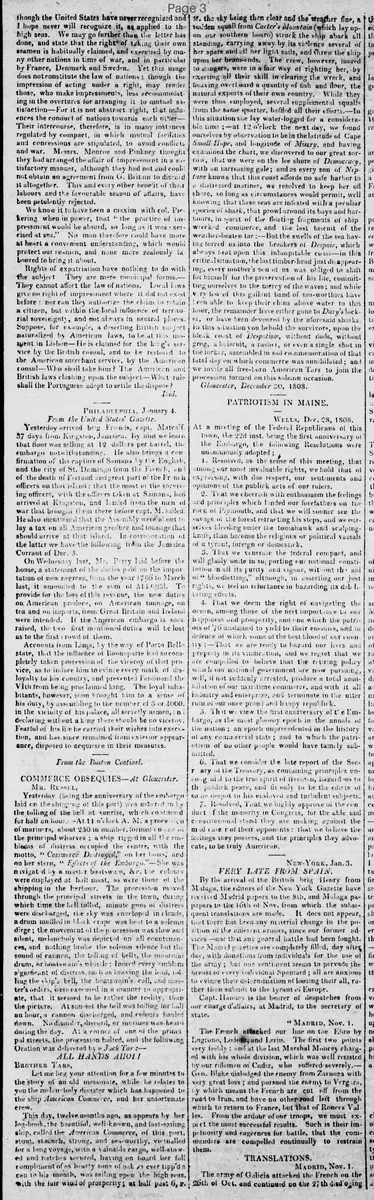
Yesterday (being the anniversary of the embargo laid on the shipping of this port) was ushered in by the tolling of the bell at sunrise, which continued for half an hour. At 11 o'clock A. M. a procession of mariners, about 250 in number, formed on one of the principal wharves; a ship rigged in all the emblems of distress occupied the centre, with the motto, "Commerce Destroyed," on her bows; and on her stern, "Effects of the Embargo."—She was navigated by a master, boatswain, &c. the colours were displayed at half mast, as were those of the shipping in the harbour. The procession moved through the principal streets in the town, during which time the bell tolled, minute guns of distress were discharged, the sky was enveloped in clouds, a drum muffled in black crape was beat to a solemn dirge; the movement of the procession was slow and silent, melancholy was depicted on all countenances, and nothing broke the solemn silence but the sound of cannon, the tolling of bells, the mournful drum, or boatswain's whistle: Indeed every emblem significant of distress, such as heaving the lead, tolling the ship's bell, the boatswain's call, and master's orders, were executed in a manner so appropriate, that it seemed to be rather the reality, than the picture. At sun-set the bell was tolling for half an hour, a cannon discharged, and colours hauled down. No disorder, discord, or murmur was heard during the day. At a corner of one of the principal streets, the procession halted, and the following Oration was delivered by a Jack Tar:-
ALL HANDS AHOY!
BROTHER TARS,
Let me beg your attention for a few minutes to the story of an old messmate, while he relates to you the melancholy disaster which has happened to the ship American Commerce, and her unfortunate crew.
This day, twelve months ago, as appears by her log-book, the beautiful, well-known, and fast-sailing ship, called the American Commerce, of this port, stout, staunch, strong, and sea-worthy, victualled for a long voyage, with a valuable cargo, well-stowed and hatches secured, having on board her full complement of as hearty sons of oak as ever upped a can to his mouth, was sailing on the high seas, with the fair wind of prosperity; at half past 6, P. M. the sky being then clear and the weather fine, a sudden squall from Carter's mountain (which lay upon our southern board) struck the ship aback all standing, carrying away by its violence several of her spars and all her light sails, and threw the ship upon her beam-ends. The crew, however, inured to dangers, were in a fair way of righting her,—by exerting all their skill in clearing the wreck, and heaving overboard a quantity of fish and flour, the natural exports of their own country. While they were thus employed, several supplemental squalls from the same quarter, baffled all their efforts.—In this situation she lay water-logged for a considerable time;—at 12 o'clock the next day, we found ourselves by observation to be in the latitude of Cape Small-Hope, and longitude of Misery, and having examined the chart, we discovered to our great sorrow, that we were on the lee shore of Democracy, with an increasing gale; and as every son of Neptune knows that this coast affords no safe harbor to "distressed mariner, we resolved to keep her off shore, so long as circumstances would permit, well knowing that these seas are infested with a peculiar species of shark, that prowl around its bays and harbors, in quest of the floating fragments of ship-wreck'd commerce, and the last biscuit of the weather-beaten tar :—But the swells of the sea having forced us into the breakers of Despair, which always beat upon this inhospitable coast—in this critical situation, the last timber-head just disappearing, every mother's son of us was obliged to shift for himself for the preservation of his life, committing ourselves to the mercy of the waves; and while very few of this gallant band of sea-worthies have been able to keep their chins above water to this hour, the remainder have either gone to Davy’s locker, or have been devoured by the aforesaid sharks. In this situation you behold the survivors, upon the bleak coast of Despotism, without duds, without grog, a biscuit, a fathom, or even a single shot in the locker, assembled in sad commemoration of that fatal day on which commerce was annihilated; and we invite all free-born American Tars to join the procession formed on this solemn occasion.
Gloucester, December 30, 1808.
COMMERCE OBEQUIES—At Gloucester.
MR. RUSSEL,
Yesterday (being the anniversary of the embargo laid on the shipping of this port) was ushered in by the tolling of the bell at sunrise, which continued for half an hour. At 11 o'clock A. M. a procession of mariners, about 250 in number, formed on one of the principal wharves; a ship rigged in all the emblems of distress occupied the centre, with the motto, "Commerce Destroyed," on her bows; and on her stern, "Effects of the Embargo."—She was navigated by a master, boatswain, &c. the colours were displayed at half mast, as were those of the shipping in the harbour. The procession moved through the principal streets in the town, during which time the bell tolled, minute guns of distress were discharged, the sky was enveloped in clouds, a drum muffled in black crape was beat to a solemn dirge; the movement of the procession was slow and silent, melancholy was depicted on all countenances, and nothing broke the solemn silence but the sound of cannon, the tolling of bells, the mournful drum, or boatswain's whistle: Indeed every emblem significant of distress, such as heaving the lead, tolling the ship's bell, the boatswain's call, and master's orders, were executed in a manner so appropriate, that it seemed to be rather the reality, than the picture. At sun-set the bell was tolling for half an hour, a cannon discharged, and colours hauled down. No disorder, discord, or murmur was heard during the day. At a corner of one of the principal streets, the procession halted, and the following Oration was delivered by a Jack Tar:-
ALL HANDS AHOY!
BROTHER TARS,
Let me beg your attention for a few minutes to the story of an old messmate, while he relates to you the melancholy disaster which has happened to the ship American Commerce, and her unfortunate crew.
This day, twelve months ago, as appears by her log-book, the beautiful, well-known, and fast-sailing ship, called the American Commerce, of this port, stout, staunch, strong, and sea-worthy, victualled for a long voyage, with a valuable cargo, well-stowed and hatches secured, having on board her full complement of as hearty sons of oak as ever upped a can to his mouth, was sailing on the high seas, with the fair wind of prosperity; at half past 6, P. M. the sky being then clear and the weather fine, a sudden squall from Carter's mountain (which lay upon our southern board) struck the ship aback all standing, carrying away by its violence several of her spars and all her light sails, and threw the ship upon her beam-ends. The crew, however, inured to dangers, were in a fair way of righting her,—by exerting all their skill in clearing the wreck, and heaving overboard a quantity of fish and flour, the natural exports of their own country. While they were thus employed, several supplemental squalls from the same quarter, baffled all their efforts.—In this situation she lay water-logged for a considerable time;—at 12 o'clock the next day, we found ourselves by observation to be in the latitude of Cape Small-Hope, and longitude of Misery, and having examined the chart, we discovered to our great sorrow, that we were on the lee shore of Democracy, with an increasing gale; and as every son of Neptune knows that this coast affords no safe harbor to "distressed mariner, we resolved to keep her off shore, so long as circumstances would permit, well knowing that these seas are infested with a peculiar species of shark, that prowl around its bays and harbors, in quest of the floating fragments of ship-wreck'd commerce, and the last biscuit of the weather-beaten tar :—But the swells of the sea having forced us into the breakers of Despair, which always beat upon this inhospitable coast—in this critical situation, the last timber-head just disappearing, every mother's son of us was obliged to shift for himself for the preservation of his life, committing ourselves to the mercy of the waves; and while very few of this gallant band of sea-worthies have been able to keep their chins above water to this hour, the remainder have either gone to Davy’s locker, or have been devoured by the aforesaid sharks. In this situation you behold the survivors, upon the bleak coast of Despotism, without duds, without grog, a biscuit, a fathom, or even a single shot in the locker, assembled in sad commemoration of that fatal day on which commerce was annihilated; and we invite all free-born American Tars to join the procession formed on this solemn occasion.
Gloucester, December 30, 1808.
What sub-type of article is it?
Historical Event
Curiosity
What themes does it cover?
Misfortune
Justice
What keywords are associated?
Embargo Protest
Commerce Obsequies
Gloucester Procession
Shipwreck Metaphor
American Tars
Economic Distress
Where did it happen?
Gloucester
Story Details
Location
Gloucester
Event Date
December 1808
Story Details
Mariners in Gloucester held a funeral procession for American commerce on the embargo's anniversary, featuring a symbolic distressed ship and an oration depicting the embargo as a shipwreck stranding sailors on the 'coast of Despotism.'