Thank you for visiting SNEWPapers!
Sign up free
Atlanta Daily World
Atlanta, Fulton County, Georgia
What is this article about?
In the US, 26 states end daylight saving time this weekend by setting clocks back one hour at 2 a.m. Sunday, re-synchronizing with the rest of the nation. Eastern states observe it for worker benefits, while Southern and Southwestern farmers prefer standard time year-round. Some states had split observance.
Clipping
OCR Quality
Full Text
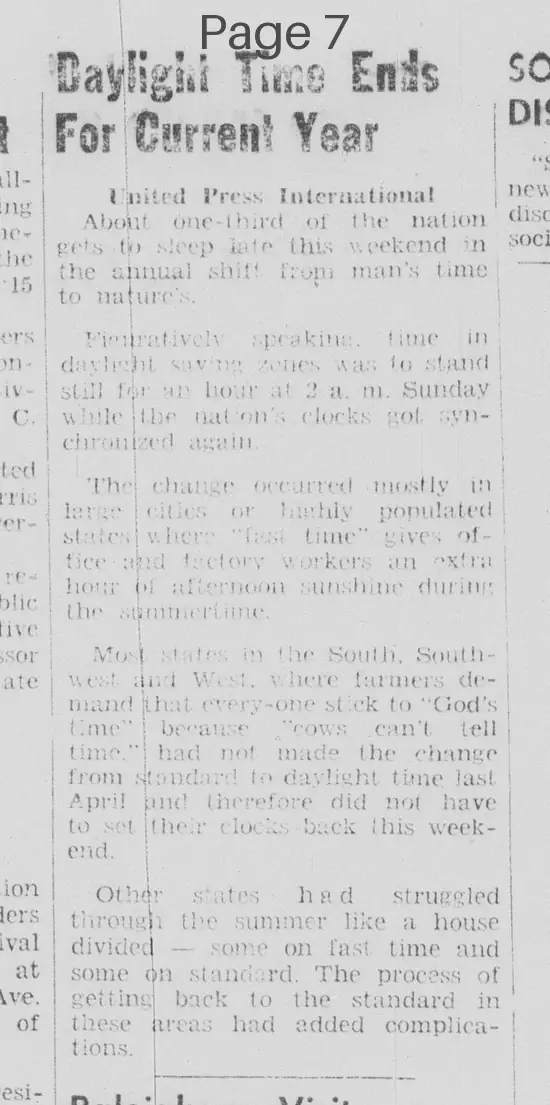
United Press International
About one third of the nation gets to sleep late this weekend in the annual shift from man's time to nature's.
Twenty-six states still observe daylight saving time and so stand still while the rest of the nation's clocks go back one hour to 2 a.m. Sunday, while the rest of the nation clocks go synchronized again.
The change occurred mostly in large Eastern, sparsely populated states where time-saving gives office and factory workers an extra hour of daylight in the summer time.
Most of the South, Southwest where farmers demand to stick to God's time because "cows can't tell time" that had not made the change from standard to daylight time last April and therefore did not have to set their clocks back this weekend.
Other states had struggled through the summer like a house divided - some on fast time and some on standard. The process of getting back to the standard in these areas had added complications.
What sub-type of article is it?
What keywords are associated?
Where did it happen?
Domestic News Details
Primary Location
United States
Event Date
This Weekend, 2 A.M. Sunday
Event Details
Twenty-six states observe daylight saving time and set clocks back one hour to standard time at 2 a.m. Sunday, while the rest of the nation that did not observe it remains synchronized. The change primarily affects large Eastern, sparsely populated states where it provides workers extra daylight in summer. Most of the South and Southwest did not switch to daylight time last April due to farmers preferring standard time, as cows cannot tell time. Some states had divided observance during summer, complicating the return to standard time.