Thank you for visiting SNEWPapers!
Sign up free
Carroll Free Press
Carrollton, Carroll County, Ohio
What is this article about?
On March 25, 1845, Ohio Auditor of State John Woods issued instructions to county auditors and assessors for implementing new tax laws on money at interest, capital in trade, and money brokers, aiming to ensure fair taxation and prevent evasions.
Clipping
OCR Quality
Full Text
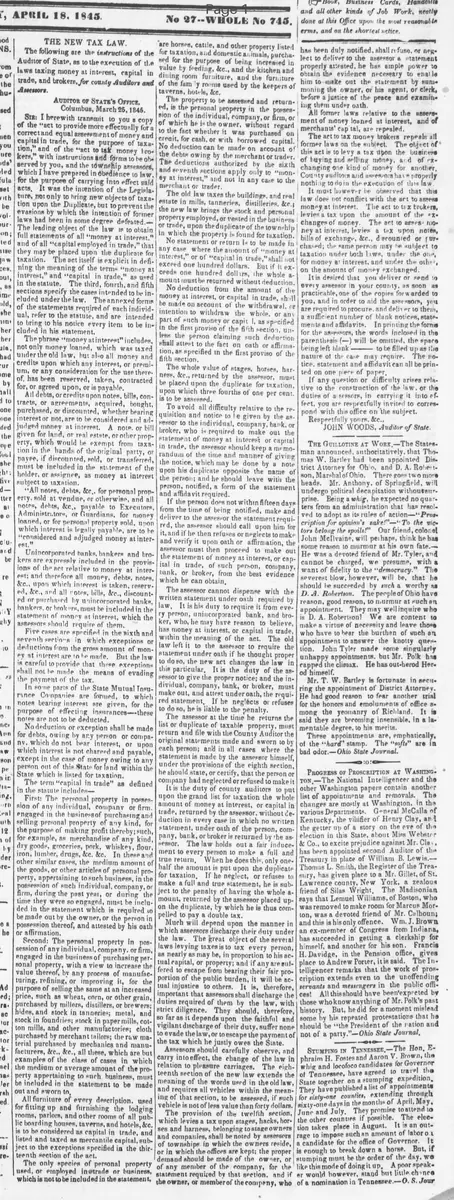
The following are the instructions of the Auditor of State, as to the execution of the laws taxing money at interest, capital in trade, and brokers, for county Auditors and Assessors.
Auditor of State's Office,
Columbus, March 25, 1845.
SIR: I herewith transmit to you a copy of the "act to provide more effectually for a correct and equal assessment of money and capital in trade, for the purpose of taxation," and of the "act to tax money brokers," with instructions and forms to be observed by you, and the township assessors, which I have prepared in obedience to law, for the purpose of carrying into effect said acts. It was the intention of the Legislature, not only to bring new objects of taxation upon the Duplicate, but to prevent the evasions by which the intention of former laws had been in some degree defeated.—The leading object of the law is to obtain full statements of all "money at interest," and of all "capital employed in trade," that they may be placed upon the duplicate for taxation. The act itself is explicit in defining the meaning of the terms "money at interest," and "capital in trade," as used in the statute. The third, fourth, and fifth sections specify the cases intended to be included under the law. The annexed forms of the statements required of each individual, refer to the statute, and are intended to bring to his notice every item to be included in his statement.
The phrase "money at interest" includes, not only money loaned, which was taxed under the old law, but also all money and credits upon which any interest, or premium, or any consideration for the use thereof, has been reserved, taken, contracted for, or agreed upon, or is payable.
All debts, or credits upon notes, bills, contracts, or agreements, acquired, bought, purchased, or discounted, whether bearing interest or not, are to be considered and adjudged money at interest. A note, or bill given for land, or real estate, or other property, which would be exempt from taxation in the hands of the original party, or payee, if discounted, sold, or transferred, must be included in the statement of the holder, or assignee, as money at interest subject to taxation.
"All notes, debts, &c., for personal property, sold at vendue, or otherwise, and all notes, debts, &c., payable to Executors, Administrators, or Guardians, for money loaned, or for personal property sold, upon which interest is legally payable, are to be considered and adjudged money at interest."
Unincorporated banks, bankers and brokers are expressly included in the provisions of the act relative to money at interest; and therefore all money, debts, notes, &c., upon which interest is taken, reserved, &c., and all notes, bills, &c., discounted or purchased by unincorporated banks, bankers, or brokers, must be included in the statement of money at interest, which the assessors should require of them.
Five cases are specified in the sixth and seventh sections in which exceptions or deductions from the gross amount of money at interest are to be made. But the law is careful to provide that these exceptions shall not be made the means of evading the payment of the tax.
In some parts of the State Mutual Insurance Companies are formed, to which notes bearing interest are given, for the purpose of effecting insurances--these notes are not to be deducted.
No deduction or exception shall be made for debts, owing by any person or company, which do not bear interest, or upon which interest is not charged and payable, except in the case of money owing to any person out of this State for land within the State which is listed for taxation.
The term "capital in trade" as defined in the statute includes--
First: The personal property in possession of any individual, company or firm, engaged in the business of purchasing and selling personal property of any kind, for the purpose of making profit thereby; such, for example, as merchandise of any kind, dry goods, groceries, pork, whiskey, flour, iron, lumber, drugs, &c. &c. In these and other similar cases, the medium amount of the goods, or other articles of personal property, appertaining to such business, in the possession of such individual, company, or firm, during the past year, or during the time they were so engaged, must be included in the statement which is required to be made out by the owner, or the person in possession thereof, and attested by his oath or affirmation.
Second: The personal property in possession of any individual, company, or firm, engaged in the business of purchasing personal property, with a view to increase the value thereof, by any process of manufacturing, refining, or improving it, for the purpose of selling the same at an increased price, such as wheat, corn, or other grain, purchased by millers, distillers, or brewers; hides, and stock in tanneries; metal, and stock in foundries; stock in paper mills, cotton mills, and other manufactories; cloth purchased by merchant tailors; the raw material purchased by mechanics and manufacturers, &c., &c., all these, which are but examples of the class of cases in which the medium or average amount of the property appertaining to such business, must be included in the statement to be made out and sworn to.
All furniture of every description, used for fitting up and furnishing the lodging rooms, parlors, and other rooms of all public boarding houses, taverns, and hotels, &c., is to be considered as capital in trade, and listed and taxed as mercantile capital, subject to the exceptions specified in the thirteenth section of the act.
The only species of personal property used, or employed in trade or business, which is not to be included in the statement, are horses, cattle, and other property listed for taxation, and domestic animals, purchased for the purpose of being increased in value by feeding, &c., and the kitchen and dining room furniture, and the furniture of the family rooms used by the keepers of taverns, hotels, &c.
The property to be assessed and returned, is the personal property in the possession of the individual, company, or firm, or of which he is the owner, without regard to the fact whether it was purchased on credit, for cash, or with borrowed capital.
No deduction can be made on account of the debts owing by the merchant or trader. The deductions authorized by the sixth and seventh sections apply only to "money at interest," and not in any case to the merchant or trader.
The old law taxes the buildings, and real estate in mills, tanneries, distilleries, &c. the new law brings the stock and personal property employed, or vested in the business or trade, upon the duplicate of the township in which the property is found for taxation.
No statement or return is to be made in any case where the amount of "money at interest," or of "capital in trade," shall not exceed one hundred dollars. But if it exceeds one hundred dollars, the whole amount must be returned without deduction.
No deduction from the amount of the money at interest, or capital in trade, shall be made on account of the withdrawal, or intention to withdraw the whole, or any part of such money or capital, as specified in the first proviso of the fifth section, unless the person claiming such deduction shall attest to the fact on oath or affirmation, as specified in the first proviso of the fifth section.
The whole value of stages, horses, harness, &c., returned by the assessor, must be placed upon the duplicate for taxation, upon which three fourths of one per cent. is to be assessed.
To avoid all difficulty relative to the requisition and notice to be given by the assessor to the individual, company, bank, or broker, who is required to make out the statement of money at interest or capital in trade, the assessor should keep a memorandum of the time and manner of giving the notice, which may be done by a note upon his duplicate opposite the name of the person; and he should leave with the person, notified, a form of the statement and affidavit required.
If the person does not within fifteen days from the time of being notified, make and deliver to the assessor the statement required, the assessor should call upon him for it, and if he then refuses or neglects to make and verify it upon oath or affirmation, the assessor must then proceed to make out the statement of money at interest, or capital in trade, of such person, company, bank, or broker, from the best evidence which he can obtain.
The assessor cannot dispense with the written statement under oath required by law. It is his duty to require it from every person, unincorporated bank, and broker, who, he may have reason to believe, has money at interest, or capital in trade, within the meaning of the act. The old law left it to the assessor to require the statement under oath if he thought proper to do so, the new act changes the law in this particular. It is the duty of the assessor to give the proper notice; and the individual, company, bank, or broker, must make out, and attest under oath, the required statement. If he neglects or refuses to do so, he is liable to the penalty.
The assessor at the time he returns the list or duplicate of taxable property, must return and file with the County Auditor the original statements made and sworn to by each person; and in all cases where the statement is made by the assessor himself, under the provisions of the eighth section, he should state, or certify, that the person or company had neglected or refused to make it.
It is the duty of county auditors to put upon the grand list for taxation the whole amount of money at interest, or capital in trade, returned by the assessor, without deduction in every case in which no written statement, under oath of the person, company, bank, or broker is returned by the assessor.
The law holds out a fair inducement to every person to make a full and true return. When he does this, only one-half the amount is put upon the duplicate for taxation. If he neglect, or refuses to make a full and true statement, he is subject to the penalty of having the whole amount, returned by the assessor placed upon the duplicate, by which he is thus compelled to pay a double tax.
Much will depend upon the manner in which assessors discharge their duty under the law. The great object of the several laws levying taxes is to tax every person, as nearly as may be, in proportion to his actual capital, or property; and if any are suffered to escape from bearing their fair proportion of the public burden, it will be actual injustice to others. It is, therefore, important that assessors shall discharge the duties required of them by the law, with strict diligence. They should, therefore, so far as it depends upon the faithful and vigilant discharge of their duty, suffer none to evade the law, or to escape the payment of the tax which he justly owes the State.
Assessors should carefully observe, and carry into effect, the change of the law in relation to pleasure carriages. The eighteenth section of the new law extends the meaning of the words used in the old law, and requires all vehicles within the meaning of that section, to be assessed, if such vehicle is not of less value than forty dollars.
The provision of the twelfth section, which levies a tax upon stages, hacks, horses and harness, belonging to stage owners and companies, shall be noted by assessors of townships in which the owners reside, or in which the offices are kept; the proper demand should be made of the owner, or of any member of the company, for the statement required by that section, and if the owner, or member of the company, who has been duly notified, shall refuse, or neglect to deliver to the assessor a statement properly attested, he has ample power to obtain the evidence necessary to enable him to make out the statement by summoning the owner, or his agent, or clerk, before a justice of the peace and examining them under oath.
All former laws relative to the assessment of money loaned at interest, and of merchants' capital, are repealed.
The act to tax money brokers repeals all former laws on the subject. The object of this act is to levy a tax upon the business of buying and selling money, and of exchanging one kind of money for another.
County auditors and assessors have properly nothing to do in the execution of this law. It must however be observed that this law does not conflict with the act to assess money at interest. The act to tax brokers, levies a tax upon the amount of the exchanges of money. The act to assess money at interest, levies a tax upon notes, bills of exchange, &c., discounted or purchased; the same person may be subject to taxation under both laws, under the one for money at interest, and under the other on the amount of money exchanged.
It is desired that you deliver or send to every assessor in your county, as soon as practicable, one of the copies forwarded to you, and in order to aid the assessors, you are required to procure, and deliver to them, a sufficient number of blank notices, statements and affidavits. In printing the forms for the assessors, the words inclosed in the parenthesis (-) will be omitted, the space being left blank--to be filled up as the nature of the case may require. The notice, statement and affidavit can all be printed on one piece of paper.
If any question or difficulty arises relative to the construction of the law, or the duties of assessors, in carrying it into effect, you are respectfully invited to correspond with this office on the subject.
Respectfully yours, &c.
JOHN WOODS, Auditor of State.
What sub-type of article is it?
What keywords are associated?
What entities or persons were involved?
Where did it happen?
Domestic News Details
Primary Location
Columbus
Event Date
March 25, 1845
Key Persons
Outcome
instructions provided to enforce taxation on money at interest, capital in trade, and brokers; penalties for non-compliance including double tax; repeal of former laws.
Event Details
The Auditor of State transmits acts and prepares forms for assessing money at interest (including loans, credits, notes, bills) and capital in trade (personal property for profit, manufacturing stock, hotel furnishings). Specifies inclusions, exceptions, deductions, assessor duties, penalties, and changes to carriage and stage taxation.