Thank you for visiting SNEWPapers!
Sign up free
Editorial
March 22, 1828
Virginia Advocate
Charlottesville, Virginia
What is this article about?
This editorial from Charlottesville advocates for a constitutional convention in Virginia to reform the inefficient and unequal state legislature, highlighting defects in representation, failure to promote public improvements, and risks of future corruption without structural changes.
Clipping
OCR Quality
92%
Excellent
Full Text
CHARLOTTESVILLE.
SATURDAY, MARCH 22.
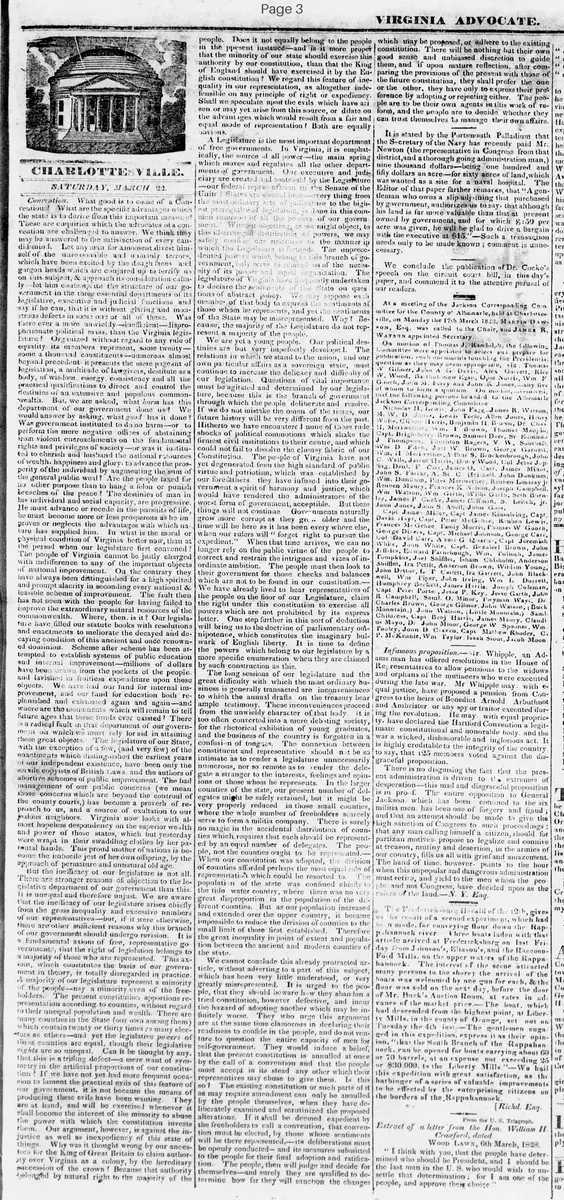
Convention. What good is to come of a Convention? What are the specific advantages which the state is to derive from this important measure? These are enquiries which the advocates of a convention are challenged to answer. We think they may be answered to the satisfaction of every candid mind. Let any man for a moment divest himself of the unreasonable and unmanly terrors, which have been excited by the dough faces and gorgon heads which are conjured up to terrify us on this subject, & approach its consideration calmly--let him contemplate the structure of our government in the three essential departments of its legislative, executive and judicial functions and say if he can, that it is without glaring and monstrous defects in some one or all of these. Was there ever a more unwieldy--inefficient--disproportionate political mess, than the Virginia legislature? Organized without regard to any rule of equality its members represent, some twenty, some a thousand constituents--numerous almost beyond precedent. it presents the mere pageant of legislation, a multitude of lawgivers, destitute as a body, of wisdom, energy, consistency and all the practical qualifications to direct and control the destinies of an extensive and populous commonwealth. But, we are asked, what harm has this department of our government done us? We would answer by asking. what good has it done? Was government instituted to do no harm-or to perform the mere negative offices of abstaining from violent encroachments on the fundamental rights and privileges of society--or was it instituted to cherish and husband the national resources of wealth, happiness and glory. to advance the prosperity of the individual by augmenting the sum of the general public weal? Are the people taxed for no other purpose than to hang a felon or punish breaches of the peace? The destinies of man in his individual and social capacity, are progressive. He must advance or recede in the pursuits of life. he must become more or less prosperous as he improves or neglects the advantages with which nature has supplied him. In what is the moral or physical condition of Virginia better now, than at the period when our legislature first convened? The people of Virginia cannot be justly charged with indifference to any of the important objects of national improvement. On the contrary they have always been distinguished for a high spirited and prompt alacrity in seconding every national & feasible scheme of improvement. The fault then has not been with the people for having failed to improve the extraordinary natural resources of the commonwealth. Where, then. is it? Our legislature have filled our statute books with resolutions and enactments to meliorate the decayed and decaying condition of this ancient and once renowned dominion. Scheme after scheme has been attempted to establish systems of public education and internal improvement--millions of dollars have been drawn from the pockets of the people. and lavished in fruitless expenditure upon these objects. We have had our fund for internal improvement, and our fund for education both replenished and exhausted again and again--and where are the monuments which will remain to tell future ages that these funds ever existed? There is a radical fault in that department of our government on which we must rely for aid in attaining these great objects. The legislature of our State, with the exception of a few, (and very few) of the enactments which distinguished the earliest years of our independent existence, have been only the servile copyists of British Laws, and the authors of abortive schemes of public improvement. The bad management of our public concerns (we mean those concerns which are beyond the controul of the county courts,) has become a proverb of reproach to us, and a source of exultation to our jealous neighbors. Virginia now looks with almost hopeless despondency on the superior wealth and power of those states, which but yesterday were wrapt in their swaddling clothes by her parental hands. This proud mother of nations is become the imbecile jest of her own offspring, by the approach of premature and unnatural old age. But the inefficacy of our legislature is not all. There are stronger reasons of objection to the legislative department of our government than this. It is unequal and therefore unjust. We are aware that the inefficacy of our legislature arises chiefly from the gross inequality and excessive numbers of our representatives--but, if it were otherwise. there are other sufficient reasons why this branch of our government should undergo revision. It is a fundamental axiom of free, representative governments, that the right of legislation belongs to a majority of those who are represented. This axiom, which constitutes the basis of our government in theory. is totally disregarded in practice. A majority of our legislature represent a minority of the people--nay a minority even of the freeholders. The present constitution apportions representation according to counties, without regard to their unequal population and wealth. There are many counties in the State (our own among them) which contain twenty or thirty times as many electors as others-and yet the legislative powers of those counties are equal, though their legislative rights are so unequal. Can it be thought by any. that this is a trifling defect--a mere want of symmetry in the artificial proportions of our constitution! If we have not yet had more frequent occasion to lament the practical evils of this feature of our government, it is not because the means of producing these evils have been wanting. They are at hand, and will be exercised whenever it shall become the interest of the minority to abuse the power with which the constitution invests them. Our argument, however, is against the injustice as well as inexpediency of this state of things. Why was it thought wrong by our ancestors for the King of Great Britain to claim authority over Virginia as a colony, by the hereditary succession of the crown? Because that authority belonged by natural right to the majority of the people. Does it not equally belong to the people in the present juncture--and is it more proper that the minority of our state should exercise this authority by our constitution, than that the King of England should have exercised it by the English constitution? We regard this feature of inequality in our representation, as altogether indefensible on any principle of right or expediency. Shall we speculate upon the evils which have arisen or may yet arise from this source, or dilate on the advantages which would result from a fair and equal mode of representation? Both are equally obvious.
A Legislature is the most important department of free governments. In Virginia, it is emphatically, the source of all power--the main spring which moves and regulates all the other departments of government. Our executive and judiciary are created and controuled by the Legislature--our federal representation in the Senate of the United States are elected by it--every thing from the most ordinary acts of legislation to the highest prerogative of legislation, is done in this common reservoir of all the powers of our government. Without objecting, as we might object, to this ill-arranged distribution of powers, we may safely conclude our strictures to the manner in which the legislature is formed. The unprecedented powers which belong to this branch of government, only serve to remind us of the necessity of its proper and equal organization. The legislature of Virginia have frequently undertaken to declare the sentiments of the State on questions of abstract policy. We may suppose each member of that body to express the sentiments of those whom he represents, and yet the sentiments of the State may be misrepresented. Why? Because, the majority of the Legislature do not represent a majority of the people.
We are yet a young people. Our political destinies are but very imperfectly developed. The relations in which we stand to the union, and our own particular affairs as a sovereign state, must continue to increase the delicacy and difficulty of our legislation. Questions of vital importance must be agitated and determined by our legislature, because this is the branch of government through which the people deliberate and resolve. If we do not mistake the omen of the times, our future history will be very different from the past. Hitherto we have encountered none of those rude shocks of political commotions which shake the firmest civil institutions to their centre, and which could not fail to dissolve the clumsy fabric of our Constitution. The people of Virginia have not yet degenerated from the high standard of public virtue and patriotism, which was established by our forefathers they have infused into their government a spirit of harmony and justice, which would have rendered the administrators of the worst form of government, acceptable. But these things will not continue. Governments naturally grow more corrupt as they grow older and the time will come here as it has been everywhere else, when our rulers will forget right to pursue the expedient. When that time arrives, we can no longer rely on the public virtue of the people to correct and restrain the intrigues and vices of inordinate ambition. The people must then look to their government for those checks and balances which are not to be found in our constitution.
We have already lived to hear representatives of the people on the floor of our Legislature, claim the right under this constitution to exercise all powers which are not prohibited by its express letter. One step further in this sort of deduction will bring us to the doctrine of parliamentary omnipotence, which constitutes the imaginary bulwark of English liberty. It is time to define the powers which belong to our legislature by a more specific enumeration when they are claimed by such construction as this.
The long sessions of our legislature and the great difficulty with which the most ordinary business is generally transacted are inconveniences to which the annual drafts on the treasury bear ample testimony. These inconveniences proceed from the unwieldy character of that body. it is too often converted into a mere debating society, for the rhetorical exhibition of young graduates, and the business of the country is forgotten in a confusion of tongues. The connexion between constituent and representative should not be so intimate as to render a legislature unnecessarily numerous. nor so remote as to render the delegate a stranger to the interests, feelings and opinions of those whom he represents. In the larger counties of the state, our present number of delegates might be safely retained, but it might be very properly reduced in those small counties, where the whole number of freeholders scarcely serve to form a militia company. There is surely no magic in the accidental distribution of counties which requires that each should be represented by an equal number of delegates. The people, not the counties ought to be represented.
When our constitution was adopted, the division of counties afforded perhaps the most equal rule of representation which could be resorted to. The population of the state was confined chiefly to the tide water country, where there was no very great disproportion in the population of the different counties. But as our population increased and extended over the upper country, it became impossible to reduce the division of counties to the small limit of those first established. Therefore the great inequality in point of extent and population between the ancient and modern counties of the state.
We cannot conclude this already protracted article, without adverting to a part of this subject. which has been very little understood, or very greatly misrepresented. It is urged to the people, that they should beware how they abandon a tried constitution, however defective, and incur the hazard of adopting another which may be infinitely worse. They who urge this argument are at the same time clamorous in declaring their readiness to confide in the people, and do not venture to question the entire capacity of men for self-government. They would induce a belief, that the present constitution is annulled at once by the call of a convention and that the people must accept in its stead any other which their representatives may chuse to give them. Is this so? The existing constitution or such parts of it as may require amendment can only be annulled by the people themselves, when they have deliberately examined and scrutinized the proposed alterations. If it shall be deemed expedient by the freeholders to call a convention, that convention must be elected, by those whose sentiments will be there represented,-its deliberations must be openly conducted- and its measures submitted to the people for their final adoption and ratification. The people, then will judge and decide for themselves and surely they are qualified to determine how far they will sanction the changes which may be proposed, or adhere to the existing constitution. There will be nothing but their own good sense and unbiassed discretion to guide them, and if upon mature reflection, after comparing the provisions of the present with those of the future constitution, they shall prefer the one or the other. they have only to express their preference by adopting or rejecting either. The people are to be their own agents in this work of reform, and the people are to decide whether they can trust themselves to manage their own affairs.
SATURDAY, MARCH 22.
Convention. What good is to come of a Convention? What are the specific advantages which the state is to derive from this important measure? These are enquiries which the advocates of a convention are challenged to answer. We think they may be answered to the satisfaction of every candid mind. Let any man for a moment divest himself of the unreasonable and unmanly terrors, which have been excited by the dough faces and gorgon heads which are conjured up to terrify us on this subject, & approach its consideration calmly--let him contemplate the structure of our government in the three essential departments of its legislative, executive and judicial functions and say if he can, that it is without glaring and monstrous defects in some one or all of these. Was there ever a more unwieldy--inefficient--disproportionate political mess, than the Virginia legislature? Organized without regard to any rule of equality its members represent, some twenty, some a thousand constituents--numerous almost beyond precedent. it presents the mere pageant of legislation, a multitude of lawgivers, destitute as a body, of wisdom, energy, consistency and all the practical qualifications to direct and control the destinies of an extensive and populous commonwealth. But, we are asked, what harm has this department of our government done us? We would answer by asking. what good has it done? Was government instituted to do no harm-or to perform the mere negative offices of abstaining from violent encroachments on the fundamental rights and privileges of society--or was it instituted to cherish and husband the national resources of wealth, happiness and glory. to advance the prosperity of the individual by augmenting the sum of the general public weal? Are the people taxed for no other purpose than to hang a felon or punish breaches of the peace? The destinies of man in his individual and social capacity, are progressive. He must advance or recede in the pursuits of life. he must become more or less prosperous as he improves or neglects the advantages with which nature has supplied him. In what is the moral or physical condition of Virginia better now, than at the period when our legislature first convened? The people of Virginia cannot be justly charged with indifference to any of the important objects of national improvement. On the contrary they have always been distinguished for a high spirited and prompt alacrity in seconding every national & feasible scheme of improvement. The fault then has not been with the people for having failed to improve the extraordinary natural resources of the commonwealth. Where, then. is it? Our legislature have filled our statute books with resolutions and enactments to meliorate the decayed and decaying condition of this ancient and once renowned dominion. Scheme after scheme has been attempted to establish systems of public education and internal improvement--millions of dollars have been drawn from the pockets of the people. and lavished in fruitless expenditure upon these objects. We have had our fund for internal improvement, and our fund for education both replenished and exhausted again and again--and where are the monuments which will remain to tell future ages that these funds ever existed? There is a radical fault in that department of our government on which we must rely for aid in attaining these great objects. The legislature of our State, with the exception of a few, (and very few) of the enactments which distinguished the earliest years of our independent existence, have been only the servile copyists of British Laws, and the authors of abortive schemes of public improvement. The bad management of our public concerns (we mean those concerns which are beyond the controul of the county courts,) has become a proverb of reproach to us, and a source of exultation to our jealous neighbors. Virginia now looks with almost hopeless despondency on the superior wealth and power of those states, which but yesterday were wrapt in their swaddling clothes by her parental hands. This proud mother of nations is become the imbecile jest of her own offspring, by the approach of premature and unnatural old age. But the inefficacy of our legislature is not all. There are stronger reasons of objection to the legislative department of our government than this. It is unequal and therefore unjust. We are aware that the inefficacy of our legislature arises chiefly from the gross inequality and excessive numbers of our representatives--but, if it were otherwise. there are other sufficient reasons why this branch of our government should undergo revision. It is a fundamental axiom of free, representative governments, that the right of legislation belongs to a majority of those who are represented. This axiom, which constitutes the basis of our government in theory. is totally disregarded in practice. A majority of our legislature represent a minority of the people--nay a minority even of the freeholders. The present constitution apportions representation according to counties, without regard to their unequal population and wealth. There are many counties in the State (our own among them) which contain twenty or thirty times as many electors as others-and yet the legislative powers of those counties are equal, though their legislative rights are so unequal. Can it be thought by any. that this is a trifling defect--a mere want of symmetry in the artificial proportions of our constitution! If we have not yet had more frequent occasion to lament the practical evils of this feature of our government, it is not because the means of producing these evils have been wanting. They are at hand, and will be exercised whenever it shall become the interest of the minority to abuse the power with which the constitution invests them. Our argument, however, is against the injustice as well as inexpediency of this state of things. Why was it thought wrong by our ancestors for the King of Great Britain to claim authority over Virginia as a colony, by the hereditary succession of the crown? Because that authority belonged by natural right to the majority of the people. Does it not equally belong to the people in the present juncture--and is it more proper that the minority of our state should exercise this authority by our constitution, than that the King of England should have exercised it by the English constitution? We regard this feature of inequality in our representation, as altogether indefensible on any principle of right or expediency. Shall we speculate upon the evils which have arisen or may yet arise from this source, or dilate on the advantages which would result from a fair and equal mode of representation? Both are equally obvious.
A Legislature is the most important department of free governments. In Virginia, it is emphatically, the source of all power--the main spring which moves and regulates all the other departments of government. Our executive and judiciary are created and controuled by the Legislature--our federal representation in the Senate of the United States are elected by it--every thing from the most ordinary acts of legislation to the highest prerogative of legislation, is done in this common reservoir of all the powers of our government. Without objecting, as we might object, to this ill-arranged distribution of powers, we may safely conclude our strictures to the manner in which the legislature is formed. The unprecedented powers which belong to this branch of government, only serve to remind us of the necessity of its proper and equal organization. The legislature of Virginia have frequently undertaken to declare the sentiments of the State on questions of abstract policy. We may suppose each member of that body to express the sentiments of those whom he represents, and yet the sentiments of the State may be misrepresented. Why? Because, the majority of the Legislature do not represent a majority of the people.
We are yet a young people. Our political destinies are but very imperfectly developed. The relations in which we stand to the union, and our own particular affairs as a sovereign state, must continue to increase the delicacy and difficulty of our legislation. Questions of vital importance must be agitated and determined by our legislature, because this is the branch of government through which the people deliberate and resolve. If we do not mistake the omen of the times, our future history will be very different from the past. Hitherto we have encountered none of those rude shocks of political commotions which shake the firmest civil institutions to their centre, and which could not fail to dissolve the clumsy fabric of our Constitution. The people of Virginia have not yet degenerated from the high standard of public virtue and patriotism, which was established by our forefathers they have infused into their government a spirit of harmony and justice, which would have rendered the administrators of the worst form of government, acceptable. But these things will not continue. Governments naturally grow more corrupt as they grow older and the time will come here as it has been everywhere else, when our rulers will forget right to pursue the expedient. When that time arrives, we can no longer rely on the public virtue of the people to correct and restrain the intrigues and vices of inordinate ambition. The people must then look to their government for those checks and balances which are not to be found in our constitution.
We have already lived to hear representatives of the people on the floor of our Legislature, claim the right under this constitution to exercise all powers which are not prohibited by its express letter. One step further in this sort of deduction will bring us to the doctrine of parliamentary omnipotence, which constitutes the imaginary bulwark of English liberty. It is time to define the powers which belong to our legislature by a more specific enumeration when they are claimed by such construction as this.
The long sessions of our legislature and the great difficulty with which the most ordinary business is generally transacted are inconveniences to which the annual drafts on the treasury bear ample testimony. These inconveniences proceed from the unwieldy character of that body. it is too often converted into a mere debating society, for the rhetorical exhibition of young graduates, and the business of the country is forgotten in a confusion of tongues. The connexion between constituent and representative should not be so intimate as to render a legislature unnecessarily numerous. nor so remote as to render the delegate a stranger to the interests, feelings and opinions of those whom he represents. In the larger counties of the state, our present number of delegates might be safely retained, but it might be very properly reduced in those small counties, where the whole number of freeholders scarcely serve to form a militia company. There is surely no magic in the accidental distribution of counties which requires that each should be represented by an equal number of delegates. The people, not the counties ought to be represented.
When our constitution was adopted, the division of counties afforded perhaps the most equal rule of representation which could be resorted to. The population of the state was confined chiefly to the tide water country, where there was no very great disproportion in the population of the different counties. But as our population increased and extended over the upper country, it became impossible to reduce the division of counties to the small limit of those first established. Therefore the great inequality in point of extent and population between the ancient and modern counties of the state.
We cannot conclude this already protracted article, without adverting to a part of this subject. which has been very little understood, or very greatly misrepresented. It is urged to the people, that they should beware how they abandon a tried constitution, however defective, and incur the hazard of adopting another which may be infinitely worse. They who urge this argument are at the same time clamorous in declaring their readiness to confide in the people, and do not venture to question the entire capacity of men for self-government. They would induce a belief, that the present constitution is annulled at once by the call of a convention and that the people must accept in its stead any other which their representatives may chuse to give them. Is this so? The existing constitution or such parts of it as may require amendment can only be annulled by the people themselves, when they have deliberately examined and scrutinized the proposed alterations. If it shall be deemed expedient by the freeholders to call a convention, that convention must be elected, by those whose sentiments will be there represented,-its deliberations must be openly conducted- and its measures submitted to the people for their final adoption and ratification. The people, then will judge and decide for themselves and surely they are qualified to determine how far they will sanction the changes which may be proposed, or adhere to the existing constitution. There will be nothing but their own good sense and unbiassed discretion to guide them, and if upon mature reflection, after comparing the provisions of the present with those of the future constitution, they shall prefer the one or the other. they have only to express their preference by adopting or rejecting either. The people are to be their own agents in this work of reform, and the people are to decide whether they can trust themselves to manage their own affairs.
What sub-type of article is it?
Constitutional
What keywords are associated?
Constitutional Convention
Virginia Legislature
Unequal Representation
Government Reform
Public Improvement
What entities or persons were involved?
Virginia Legislature
People Of Virginia
Counties
Editorial Details
Primary Topic
Advocacy For Constitutional Convention To Reform Virginia Legislature
Stance / Tone
Strongly Pro Convention, Critical Of Current Government Structure
Key Figures
Virginia Legislature
People Of Virginia
Counties
Key Arguments
Virginia Legislature Is Unwieldy, Inefficient, And Disproportionate
Unequal Representation Based On Counties Ignores Population Differences
Legislature Has Failed To Promote Public Education And Internal Improvements Despite Funding
Majority Of Legislature Represents Minority Of People, Violating Principles Of Representation
Future Corruption Requires Constitutional Checks And Balances
Convention Allows People To Review And Ratify Changes Safely