Thank you for visiting SNEWPapers!
Sign up free
The Magnolia Gazette
Magnolia, Pike County, Mississippi
What is this article about?
U.S. Senate passes bill 34-10 enabling states to prohibit liquor importation, subjecting imported liquors to state laws upon arrival; commentary distinguishes interstate trade from state property rights, referencing Original Package case.
Clipping
OCR Quality
Full Text
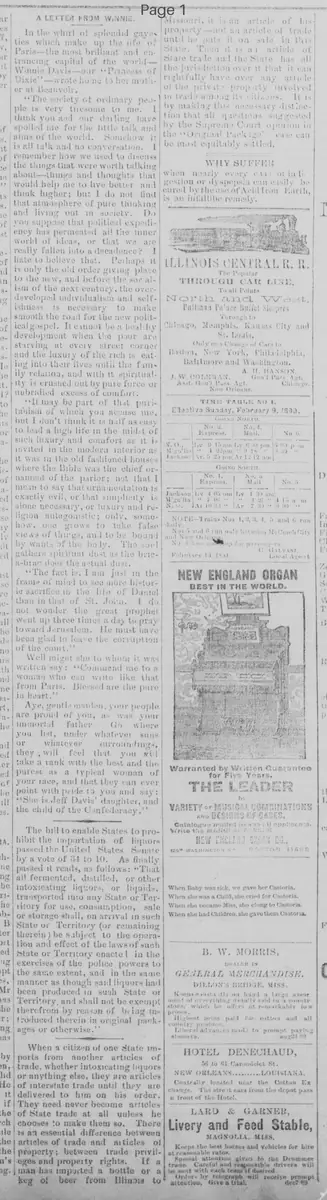
When a citizen of one state imports from another articles of trade, whether intoxicating liquors or anything else, they are articles of interstate trade until they are delivered to him on his order. They need never become articles of State trade at all unless he chooses to make them so. There is an essential difference between articles of trade and articles of property; between trade privileges and property rights. If a man has imported a bottle or a keg of beer from Illinois to Missouri, it is an article of his property—not an article of trade until he puts it on sale in this State. Then it is an article of State trade and the State has all the jurisdiction over it that it can rightfully have over any article of the private property involved in trade among its citizens. It is by making this necessary distinction that all questions suggested by the Supreme Court opinion in the Original Package case can be most equitably settled.
What sub-type of article is it?
What keywords are associated?
Where did it happen?
Domestic News Details
Primary Location
United States
Outcome
passed the united states senate by a vote of 34 to 10
Event Details
The bill to enable States to prohibit the importation of liquors passed the United States Senate by a vote of 34 to 10. As finally passed it reads: "That all fermented, distilled, or other intoxicating liquors, or liquids, transported into any State or Territory for use, consumption, sale or storage shall, on arrival in such State or Territory (or remaining therein) be subject to the operation and effect of the laws of such State or Territory enacted in the exercise of the police powers to the same extent, and in the same manner as though said liquors had been produced in such State or Territory, and shall not be exempt therefrom by reason of being introduced therein in original packages or otherwise." When a citizen of one state imports from another articles of trade, whether intoxicating liquors or anything else, they are articles of interstate trade until they are delivered to him on his order. They need never become articles of State trade at all unless he chooses to make them so. There is an essential difference between articles of trade and articles of property; between trade privileges and property rights. If a man has imported a bottle or a keg of beer from Illinois to Missouri, it is an article of his property—not an article of trade until he puts it on sale in this State. Then it is an article of State trade and the State has all the jurisdiction over it that it can rightfully have over any article of the private property involved in trade among its citizens. It is by making this necessary distinction that all questions suggested by the Supreme Court opinion in the Original Package case can be most equitably settled.