Thank you for visiting SNEWPapers!
Sign up free
Independent Journal, Or, The General Advertiser
New York, New York County, New York
What is this article about?
The Emperor of Germany claims a share of the Dutch East India trade for the Austrian Netherlands, based on 1648 Treaty of Munster and 1785 Treaty of Fontainebleau. M. de Rancourt's memoir criticizes Dutch restrictions on this commerce.
Clipping
OCR Quality
Full Text
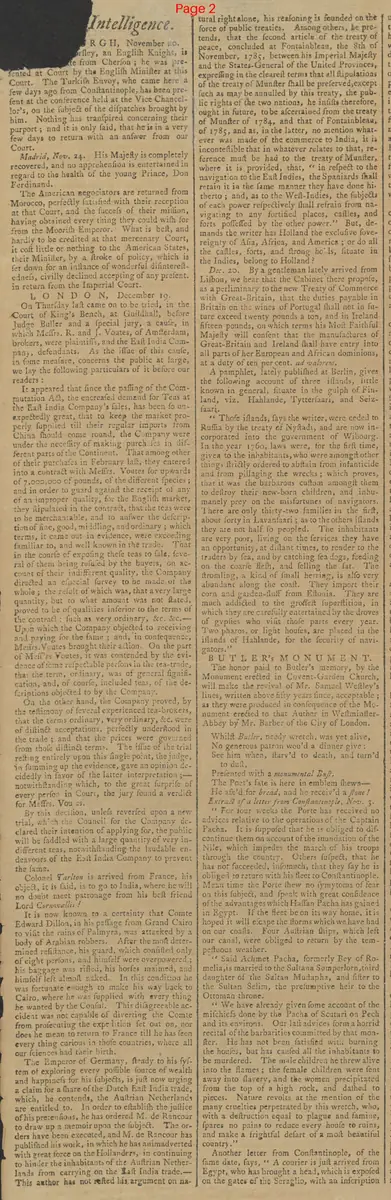
This author has not rested his argument on natural right alone, his reasoning is founded on the force of public treaties. Among others, he pretends, that the second article of the treaty of peace, concluded at Fontainebleau, the 8th of November, 1785, between his Imperial Majesty and the States-General of the United Provinces, expressing in the clearest terms that all stipulations of the treaty of Munster shall be preserved, except such as may be annulled by this treaty, the public rights of the two nations, he insists therefore, ought in future, to be ascertained from the treaty of Munster of 1648, and that of Fontainebleau of 1785, and as, in the latter, no mention whatever was made of the commerce to India, it is incontestable that in whatever relates to that, reference must be had to the treaty of Munster, where it is provided, that, "in respect to the navigation to the East Indies, the Spaniards shall retain it in the same manner they have done hitherto; and, as to the West-Indies, the subjects of each power respectively shall refrain from navigating to any fortified places, castles, and forts possessed by the other power." But, demands the writer, has Holland the exclusive sovereignty of Asia, Africa, and America; or do all the castles, forts, and strong holds, situate in the Indies, belong to Holland?
What sub-type of article is it?
What keywords are associated?
What entities or persons were involved?
Where did it happen?
Foreign News Details
Primary Location
Austrian Netherlands
Event Date
8th Of November, 1785
Key Persons
Outcome
memoir published arguing for trade rights based on treaties; ongoing claim against dutch restrictions.
Event Details
The Emperor of Germany urges a claim for the Austrian Netherlands' share in the Dutch East India trade, contending it is entitled under public treaties. He ordered M. de Rancourt to prepare a memoir, which has been published, strongly criticizing the Dutch for hindering this trade. The argument relies on the Treaty of Munster (1648) and Treaty of Fontainebleau (November 8, 1785), asserting that the latter preserves the former's stipulations on navigation to the Indies, questioning Dutch exclusive rights.