Thank you for visiting SNEWPapers!
Sign up free
Kentucky Gazette
Lexington, Fayette County, Kentucky
What is this article about?
Historical description of Upper Canada's separation from Quebec in 1791, early British settlements along the St. Lawrence and Lake Ontario, establishment of Niagara as initial government seat in 1792, and founding of York (Toronto) as new capital in 1793-1794 by Lt. Gov. John Graves Simcoe, including details on settlements, roads, and geography.
Clipping
OCR Quality
Full Text
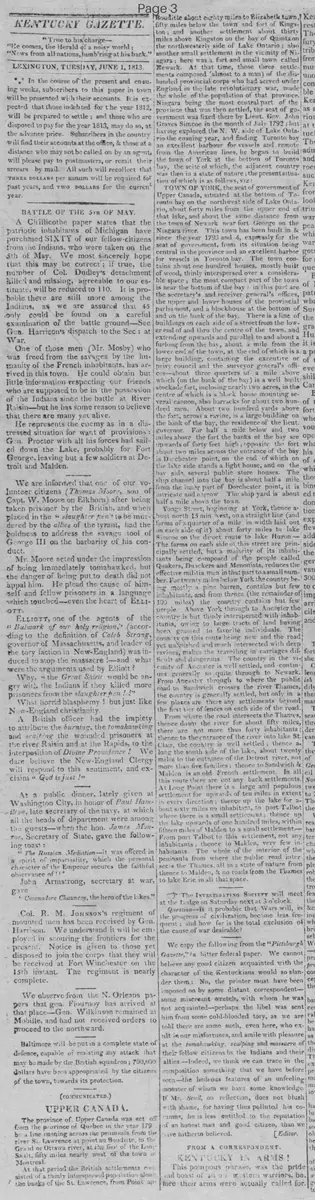
UPPER CANADA.
The province of Upper Canada was set off from the province of Quebec in the year 1791 by a line running across the peninsula from the river St. Lawrence at point au Boudette to the Grand or Ottawa river, at the foot of the Long Sault, fifty miles nearly west of the town of Montreal.
At that period the British settlements consisted of a thinly interspersed population along the banks of the St. Lawrence, from Point au Boudette about eighty miles to Elizabethtown, fifty miles below the town and fort of Kingston; and another settlement about thirty miles above Kingston on the bay of Quinte on the northwesterly side of Lake Ontario; also another small settlement in the vicinity of Niagara; here was a fort and small town called Newark. At that time, those three settlements (composed almost to a man) of the disbanded provincial corps who had served under England in the late revolutionary war, made the whole of the population of that province.
Niagara being the most central part of the province that was then settled, the seat of government was fixed there by Lieut. Gov. John Graves Simcoe in the month of July 1792: but having explored the N. W. side of Lake Ontario the ensuing year, and finding Toronto bay an excellent harbour for vessels and remote from the American lines, he began to build the town of York at the bottom of Toronto bay, the site of which, the adjacent country was then in a state of nature; the present situation of which is as follows, viz:
TOWN OF YORK, the seat of government of Upper Canada, situated at the bottom of Toronto bay on the northwest side of Lake Ontario, about forty miles from the upper end of that lake, and about the same distance from the town of Newark near fort George on the Niagara river. This town has been built in & since the year 1793 and 4, expressly for the seat of government, from its situation being central in the province and an excellent harbor for vessels in Toronto bay. The town contains about one hundred houses, mostly built of wood, thinly interspersed over a considerable space; the most compact part of the town is near the bottom of the bay: in this part are the secretary's and receiver general's offices, the upper and lower houses of the provincial parliament, and a blockhouse at the bottom of and on the bank of the bay. There is a line of buildings on each side of a street from the lower end of and thro the centre of the town, and extending upwards and parallel to and about a furlong from the bay, about a mile from the lower end of the town, at the end of which is a large building, containing the executive or privy council and the surveyor general's offices—about three quarters of a mile above which (on the bank of the bay) is a well built stockade fort, inclosing nearly two acres, in the centre of which is a block house mounting several cannon, also barracks for about two hundred men. About two hundred yards above the fort, across a ravine, is a large building on the bank of the bay, the residence of the lieut. governor. For half a mile below and two miles above the fort the banks of the bay are upwards of forty feet high; opposite the fort about two miles across the entrance of the bay is Dorchester point, on the end of which on the lake side stands a light house, and on the bay side several public store houses. The ship channel into the bay is about half a mile from the inner part of Dorchester point, it is intricate and narrow. The ship yard is about half a mile above the town.
Yonge Street, beginning at York, thence about north 15 min. west, on a straight line (and farms of a quarter of a mile in width laid out on each side of it) about forty miles to Lake Simcoe on the direct route to lake Huron.—The farms on each side of this street are principally settled, but a majority of its inhabitants being composed of the people called Quakers, Dunkers and Menonists, reduces the effective militia men in that part to a small number. For twenty miles below York the country being mostly a pine barren, contains but few inhabitants, and from thence (the remainder of 100 miles) the country contains but few people. Above York through to Ancaster the country is but thinly interspersed with inhabitants, owing to large tracts of land having been granted to favorite individuals. The country on this route being new and the road yet unfinished and much intersected with deep ravines, makes the travelling in carriages difficult and dangerous. The country in the vicinity of Ancaster is well settled, and continues generally so quite through to Newark.
From Ancaster through to where the public road to Sandwich crosses the river Thames, the country is generally settled, but only in a few places are there any settlements beyond the first tier of fences on each side of the road. From where the road intersects the Thames, thence down the river for about fifty miles, there are not more than forty inhabitants; thence to the entrance of the river into lake St. Clair, the country is well settled; thence along the south side of the lake, about twenty miles to the entrance of the Detroit river, not more than five families; thence to Sandwich & Malden is an old French settlement. In all this route there are not any back settlements.
At Long Point there is a large and populous settlement for upwards of ten miles in extent in every direction; thence up the lake for about sixty miles no inhabitant, to port Talbot where there is a small settlement; thence up the lake upwards of one hundred miles, within fifteen miles of Malden to a small settlement.—From port Talbot to this settlement, not any inhabitants; thence to Malden, very few inhabitants. The whole of the interior of the peninsula from where the public road intersects the Thames, all in a state of nature from thence to Malden, & no roads from the Thames to lake Erie in all that space.
What sub-type of article is it?
What keywords are associated?
What entities or persons were involved?
Where did it happen?
Domestic News Details
Primary Location
Upper Canada
Event Date
1791 1794
Key Persons
Event Details
Description of Upper Canada's division from Quebec in 1791, early settlements by disbanded provincial corps, establishment of government seat at Niagara in 1792, and building of York at Toronto Bay in 1793-1794 as central capital with harbor; details on town's structures, Yonge Street route, and sparse settlements across the province to Niagara, Thames River, Lake St. Clair, and Malden.