Thank you for visiting SNEWPapers!
Sign up free
Story
July 18, 1873
The New Northwest
Portland, Multnomah County, Oregon
What is this article about?
Overworked farmwife Jane endures her husband John's complaints and heavy domestic burdens until his typhoid fever recovery prompts him to recognize her sacrifices, hire a servant, renovate their home, and transform their family into a happier one.
Clipping
OCR Quality
95%
Excellent
Full Text
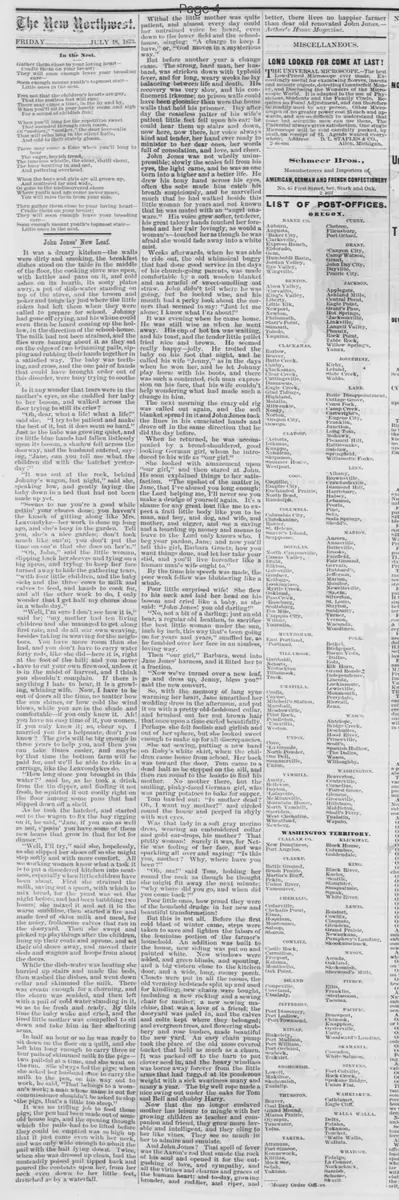
John Jones' New Leaf
It was a dreary kitchen—the walls were dirty and smoking, the breakfast dishes stood on the table in the middle of the floor, the cooking stove was open, with kettles and pans on it, and cold ashes on its hearth, its sooty plates awry, a pot of dish-water standing on top of the stove, and the broom and poker and tongs lay just where the little riders had left them when they were called to prepare for school. Johnny had gone off crying, and his whine could even then be heard coming up the hollow, in the direction of the school-house.
The milk had not been strained, and the flies were buzzing about it as they sat on the edges of two brimming pails, sipping and rubbing their hands together in a satisfied way. The baby was teething, and cross, and the one pair of hands that could have brought order out of this disorder, were busy trying to soothe it.
Is it any wonder that tears were in the mother's eyes, as she cuddled her baby to her bosom, and walked across the floor trying to still its cries?
"Oh, dear, what a life! what a life!" said she. "I try to be patient and make the best of it, but it does seem so hard."
Just as the babe was growing quiet, and its little blue hands had fallen listlessly upon its bosom, a shadow fell across the doorway, and the husband entered, saying, "Jane, can you tell me what the children did with the hatchet yesterday?"
"It was out at the rock, behind Johnny's wagon, last night," said she, speaking low, and gently laying the baby down in a bed that had not been made up yet.
"Seems to me you're a good while getting your chores done; you haven't the knack of getting along like Mrs. Leavondyke—her work is done up long ago, and she's busy in the garden. Tell you, she's a nice garden; don't look much like our'n; you don't put the time on our'n that she does on her'n."
"Oh, John," said the little woman, slipping back her sleeves and tying on a big apron, and trying to keep her face turned away to hide the gathering tears. "with four little children, and the baby sick and the three cows to milk and calves to feed, and hands to cook for, and all the other work to do, I only wonder that I get half my chores done in a whole day."
"Well, I'm sure I don't see how it is," said he; "my mother had ten living children and she managed to get along first rate, and do all our own weaving, besides taking in weaving for the neighbors. You have more room than she had, and you don't have to carry water forty rods, like she did—here it is, right at the foot of the hill; and you never have to cut your own firewood, unless it is in the midst of harvest, and I think you shouldn't complain. If there is anything I hate to hear, it is a growling, whining wife. Now, I have to be out of doors all the time, no matter how the sun shines, or how cold the wind blows, while you are in the shade and comfortable—if you only knew it. Ah! you have an easy time of it, you women, if you only knew it; so, cheer up. I married you for a helpmate, don't you know? The girls will be big enough in three years to help you, and then you can take times easier, and maybe by that time the bottom farm will be paid for, and we'll be able to ride in a carriage, like the Leavondykes do."
"How long since you brought in this water?" said he, as he took a drink from the tin dipper, and finding it not fresh, he squirted it out coolly right on the floor among some pans that had slipped down off a shelf.
As he took the hatchet, and started out to the wagon to fix the hay rigging on it, he said, "Jane, if you can as well as not, s'posin' you have some of them new beans that grow in that fur lot for dinner."
"Well, I'll try," said she, hopelessly, as she slipped her shoes off so she might step softly and with more comfort. All we working women know what a task it is to put a disordered kitchen into neatness, especially when little children have been about. First she strained the milk, saving out a quart, with which to mix bread, for the yeast was set the night before, and had been bubbling two hours; she mixed it and set it in the warm sunshine, then started a fire and made feed of skim milk and meal, for the noisy, frolicsome calves that ran in the dooryard. Then she swept and picked up playthings after the children, hung up their coats and aprons, and set their old shoes away, and moved their sleds and wagons and hoops from about the doors.
While the dish-water was heating she hurried up stairs and made the beds, then washed the dishes, and went down cellar and skimmed the milk. There was cream enough for a churning, and the churn was scalded, and then left with a pail of cold water standing in it, so as to be fresh and ready. By this time the baby woke and cried, and the tired little mother was compelled to sit down and take him in her sheltering arms.
In half an hour or so he was ready to sit down on the floor on a quilt, and she left him long enough to carry three or four pails of skimmed milk to the pigs—two pailsful at a time, and she went on the run. She always fed the pigs; when she asked her husband once to carry the milk to the pen, on his way out to work, he said, "That belongs to a woman's work; a man whose name is out for commissioner shouldn't be asked to slop the pigs, that's a little too steep."
It was no trifling job to feed those pigs; the pen had been made out of some old house logs, and the opening through which the pails had to be lifted before they could be emptied was so low that it just came even with her neck, and was only wide enough to admit the pail with the bail lying down. Twice, when she was dressed up clean, had the unsteadily poised pail tipped back and poured the contents upon her, from her neck even down to her little feet, drenched as by a waterfall.
While the little mother was quite busy with her untrained voice be heard, even patient, and almost every day could down to the lower field and the school-house, singing: "A charge to keep I have," or, "God moves in a mysterious way."
But before another year a change came. The strong, hard man, her husband, was stricken down with typhoid fever, and for long, weary weeks he lay balancing between life and death. His recovery was very slow, and his confinement irksome; no prison walls could have been gloomier than were the home walls that held his prisoner. Day after day the ceaseless patter of his wife's patient little feet fell upon his ear: he could hear them up stairs and down, now here, now there, her voice always kind and tender, her hand ever ready to minister to her dear ones, her words full of consolation, and love, and cheer.
John Jones was not wholly unimpressible; slowly the scales fell from his eyes, the light came, and he was as one born into a higher and a better life. He drew his bony hand across his eyes, often the sobs made him catch his breath suspiciously, and he marvelled much that he had walked beside this little woman for years and not known that he was mated with an "angel unaware." His voice grew softer, tenderer, his great talony hands touched her forehead and her hair lovingly, as would a woman's—touched her as though he was afraid she would fade away into a white mist.
Weeks afterwards, when he was able to ride out, the old whimsical buggy that had done good service in the days of his church-going parents, was made comfortable by a soft woolen blanket and an armful of sweet-smelling oat straw. John didn't tell where he was going, but he looked wise, and his mouth had a perky look about the corners that seemed to say: "Just let me alone; I know what I'm about!"
It was evening when he came home. He was still wise as when he went away. His cup of hot tea was waiting, and his toast, and the tender little pullet fried nice and brown. He seemed really happy—jolly. He trotted the baby on his foot that night, and he called his wife "Jenny," as in the days when he won her, and he let Johnny play horse with his boots, and there was such a contented, rich man expression on his face, that his wife couldn't help wondering what had made such a change in him.
The next morning the crazy old rig was called out again, and the soft blanket spread in it and John Jones took the lines in his emaciated hands and drove off in the same direction that he did the day before.
When he returned, he was accompanied by a broad-shouldered, good looking German girl, whom he introduced to his wife as "our girl."
She looked with amazement upon "our girl," and then stared at John. He soon explained things to her satisfaction. "The upshot of the matter is, Jane, that I've abused you long enough; the Lord helping me, I'll never see you make a drudge of yourself again. It's a shame for any great lout like me to expect a frail little body like you to be man, and boy, and dog, and wife, and mother, and nigger, and me a saving and a hoarding up money and means to leave to the Lord only knows who. I beg your pardon, Jane; and now you'll tell this girl, Barbara Groetz, how you want things done, and let her take your stead, and you'll live hereafter like a human man's wife ought to."
By the time his speech was made, the poor weak fellow was blubbering like a whale.
Poor little surprised wife! She flew to his neck and laid her head on his bosom and cried like a baby, as she said: "John Jones! you old darling!"
"No, not a bit of a darling; just an old bear, a regular old heathen, to sacrifice the best little woman under the sun, inch by inch, this way that's been going on for years and years," snuffled he, as he fumbled over her face in an aimless, loving way.
Then "our girl," Barbara, went into Jane Jones' harness, and it fitted her to a fraction,
"Now we've turned over a new leaf, go and dress up, Jenny, bless you!" said the new convert.
So, with the memory of lang syne warming her heart, Jane unearthed her wedding dress in the afternoon, and put it on with a pretty old-fashioned collar, and brushed out her nut brown hair that once upon a time curled beautifully. Perhaps she felt foolish and girlish and out of her sphere, but she looked sweet enough to make up for all discrepancies.
She sat sewing, putting a new band on Ruby's white skirt, when the children came home from school. Her back was toward the door. Tom came to a dead halt as he stepped on the sill, and then ran round to the leanto to find his mother. No mother there, but the smiling, pinky-faced German girl, who was paring potatoes to bake for supper. Tom bawled out: "Is mother dead? Oh, I want my mother!" and circled round the house and peeped in shyly with wet eyes.
Was that lady in a soft gray merino dress, wearing an embroidered collar and gold ear-drops, his mother? That pretty woman! Surely it was, for Nettie was feeling of her face, and was sparkling all over and saying: "Is this you, mother? Why, where have you been?"
"Oh, ma!" said Tom, holding her round the neck as though he thought she might flit away the next minute: "why where did you go, and when did you come back"
Poor little ones, how proud they were of the household drudge in her new and beautiful transformation!
But this is not all. Before the first cold blast of winter came, steps were taken to save and lighten the labors of the feminine portion of the farmer's household. An addition was built to the house, new siding was put on and painted white. New windows were added, and green blinds, and spouting, and a big cistern close to the kitchen door, and a wide, long, roomy porch. Closets were put in all the rooms, the old verminy bedsteads split up and used for kindling; new chairs were bought, including a new rocking and a sewing chair for mother; a new sewing machine, that was a love of a friend; the dooryard was paled in, and the calves and colts kept where they belonged; and evergreen trees, and flowering shrubbery and rose bushes, made beautiful the new yard. An easy chain pump took the place of the old moss covered bucket that held as much as a churn. It was packed off to the barn to put clover seed in, and the heavy windlass was borne away forever from the little arms that had tugged at its ponderous weight with a sick weariness many and many a year. The big well rope made a nice swing out under the oaks for Tom and Bell and chubby Harry.
Now that the no longer enslaved mother has leisure to mingle with her growing children as teacher and companion and friend, they grow more lovable and intelligent, and they cling to her like vines. They see so much in her to admire and emulate.
And John Jones? That spell of fever was the Aaron's rod that smote the rock of his soul and opened it for the outgushing of love, and sympathy, and all the virtues and charms and graces of the human heart; and to-day, growing broader, and ruddier, and riper, and better, there lives no happier farmer than dear old renovated John Jones.
Arthur's Home Magazine.
It was a dreary kitchen—the walls were dirty and smoking, the breakfast dishes stood on the table in the middle of the floor, the cooking stove was open, with kettles and pans on it, and cold ashes on its hearth, its sooty plates awry, a pot of dish-water standing on top of the stove, and the broom and poker and tongs lay just where the little riders had left them when they were called to prepare for school. Johnny had gone off crying, and his whine could even then be heard coming up the hollow, in the direction of the school-house.
The milk had not been strained, and the flies were buzzing about it as they sat on the edges of two brimming pails, sipping and rubbing their hands together in a satisfied way. The baby was teething, and cross, and the one pair of hands that could have brought order out of this disorder, were busy trying to soothe it.
Is it any wonder that tears were in the mother's eyes, as she cuddled her baby to her bosom, and walked across the floor trying to still its cries?
"Oh, dear, what a life! what a life!" said she. "I try to be patient and make the best of it, but it does seem so hard."
Just as the babe was growing quiet, and its little blue hands had fallen listlessly upon its bosom, a shadow fell across the doorway, and the husband entered, saying, "Jane, can you tell me what the children did with the hatchet yesterday?"
"It was out at the rock, behind Johnny's wagon, last night," said she, speaking low, and gently laying the baby down in a bed that had not been made up yet.
"Seems to me you're a good while getting your chores done; you haven't the knack of getting along like Mrs. Leavondyke—her work is done up long ago, and she's busy in the garden. Tell you, she's a nice garden; don't look much like our'n; you don't put the time on our'n that she does on her'n."
"Oh, John," said the little woman, slipping back her sleeves and tying on a big apron, and trying to keep her face turned away to hide the gathering tears. "with four little children, and the baby sick and the three cows to milk and calves to feed, and hands to cook for, and all the other work to do, I only wonder that I get half my chores done in a whole day."
"Well, I'm sure I don't see how it is," said he; "my mother had ten living children and she managed to get along first rate, and do all our own weaving, besides taking in weaving for the neighbors. You have more room than she had, and you don't have to carry water forty rods, like she did—here it is, right at the foot of the hill; and you never have to cut your own firewood, unless it is in the midst of harvest, and I think you shouldn't complain. If there is anything I hate to hear, it is a growling, whining wife. Now, I have to be out of doors all the time, no matter how the sun shines, or how cold the wind blows, while you are in the shade and comfortable—if you only knew it. Ah! you have an easy time of it, you women, if you only knew it; so, cheer up. I married you for a helpmate, don't you know? The girls will be big enough in three years to help you, and then you can take times easier, and maybe by that time the bottom farm will be paid for, and we'll be able to ride in a carriage, like the Leavondykes do."
"How long since you brought in this water?" said he, as he took a drink from the tin dipper, and finding it not fresh, he squirted it out coolly right on the floor among some pans that had slipped down off a shelf.
As he took the hatchet, and started out to the wagon to fix the hay rigging on it, he said, "Jane, if you can as well as not, s'posin' you have some of them new beans that grow in that fur lot for dinner."
"Well, I'll try," said she, hopelessly, as she slipped her shoes off so she might step softly and with more comfort. All we working women know what a task it is to put a disordered kitchen into neatness, especially when little children have been about. First she strained the milk, saving out a quart, with which to mix bread, for the yeast was set the night before, and had been bubbling two hours; she mixed it and set it in the warm sunshine, then started a fire and made feed of skim milk and meal, for the noisy, frolicsome calves that ran in the dooryard. Then she swept and picked up playthings after the children, hung up their coats and aprons, and set their old shoes away, and moved their sleds and wagons and hoops from about the doors.
While the dish-water was heating she hurried up stairs and made the beds, then washed the dishes, and went down cellar and skimmed the milk. There was cream enough for a churning, and the churn was scalded, and then left with a pail of cold water standing in it, so as to be fresh and ready. By this time the baby woke and cried, and the tired little mother was compelled to sit down and take him in her sheltering arms.
In half an hour or so he was ready to sit down on the floor on a quilt, and she left him long enough to carry three or four pails of skimmed milk to the pigs—two pailsful at a time, and she went on the run. She always fed the pigs; when she asked her husband once to carry the milk to the pen, on his way out to work, he said, "That belongs to a woman's work; a man whose name is out for commissioner shouldn't be asked to slop the pigs, that's a little too steep."
It was no trifling job to feed those pigs; the pen had been made out of some old house logs, and the opening through which the pails had to be lifted before they could be emptied was so low that it just came even with her neck, and was only wide enough to admit the pail with the bail lying down. Twice, when she was dressed up clean, had the unsteadily poised pail tipped back and poured the contents upon her, from her neck even down to her little feet, drenched as by a waterfall.
While the little mother was quite busy with her untrained voice be heard, even patient, and almost every day could down to the lower field and the school-house, singing: "A charge to keep I have," or, "God moves in a mysterious way."
But before another year a change came. The strong, hard man, her husband, was stricken down with typhoid fever, and for long, weary weeks he lay balancing between life and death. His recovery was very slow, and his confinement irksome; no prison walls could have been gloomier than were the home walls that held his prisoner. Day after day the ceaseless patter of his wife's patient little feet fell upon his ear: he could hear them up stairs and down, now here, now there, her voice always kind and tender, her hand ever ready to minister to her dear ones, her words full of consolation, and love, and cheer.
John Jones was not wholly unimpressible; slowly the scales fell from his eyes, the light came, and he was as one born into a higher and a better life. He drew his bony hand across his eyes, often the sobs made him catch his breath suspiciously, and he marvelled much that he had walked beside this little woman for years and not known that he was mated with an "angel unaware." His voice grew softer, tenderer, his great talony hands touched her forehead and her hair lovingly, as would a woman's—touched her as though he was afraid she would fade away into a white mist.
Weeks afterwards, when he was able to ride out, the old whimsical buggy that had done good service in the days of his church-going parents, was made comfortable by a soft woolen blanket and an armful of sweet-smelling oat straw. John didn't tell where he was going, but he looked wise, and his mouth had a perky look about the corners that seemed to say: "Just let me alone; I know what I'm about!"
It was evening when he came home. He was still wise as when he went away. His cup of hot tea was waiting, and his toast, and the tender little pullet fried nice and brown. He seemed really happy—jolly. He trotted the baby on his foot that night, and he called his wife "Jenny," as in the days when he won her, and he let Johnny play horse with his boots, and there was such a contented, rich man expression on his face, that his wife couldn't help wondering what had made such a change in him.
The next morning the crazy old rig was called out again, and the soft blanket spread in it and John Jones took the lines in his emaciated hands and drove off in the same direction that he did the day before.
When he returned, he was accompanied by a broad-shouldered, good looking German girl, whom he introduced to his wife as "our girl."
She looked with amazement upon "our girl," and then stared at John. He soon explained things to her satisfaction. "The upshot of the matter is, Jane, that I've abused you long enough; the Lord helping me, I'll never see you make a drudge of yourself again. It's a shame for any great lout like me to expect a frail little body like you to be man, and boy, and dog, and wife, and mother, and nigger, and me a saving and a hoarding up money and means to leave to the Lord only knows who. I beg your pardon, Jane; and now you'll tell this girl, Barbara Groetz, how you want things done, and let her take your stead, and you'll live hereafter like a human man's wife ought to."
By the time his speech was made, the poor weak fellow was blubbering like a whale.
Poor little surprised wife! She flew to his neck and laid her head on his bosom and cried like a baby, as she said: "John Jones! you old darling!"
"No, not a bit of a darling; just an old bear, a regular old heathen, to sacrifice the best little woman under the sun, inch by inch, this way that's been going on for years and years," snuffled he, as he fumbled over her face in an aimless, loving way.
Then "our girl," Barbara, went into Jane Jones' harness, and it fitted her to a fraction,
"Now we've turned over a new leaf, go and dress up, Jenny, bless you!" said the new convert.
So, with the memory of lang syne warming her heart, Jane unearthed her wedding dress in the afternoon, and put it on with a pretty old-fashioned collar, and brushed out her nut brown hair that once upon a time curled beautifully. Perhaps she felt foolish and girlish and out of her sphere, but she looked sweet enough to make up for all discrepancies.
She sat sewing, putting a new band on Ruby's white skirt, when the children came home from school. Her back was toward the door. Tom came to a dead halt as he stepped on the sill, and then ran round to the leanto to find his mother. No mother there, but the smiling, pinky-faced German girl, who was paring potatoes to bake for supper. Tom bawled out: "Is mother dead? Oh, I want my mother!" and circled round the house and peeped in shyly with wet eyes.
Was that lady in a soft gray merino dress, wearing an embroidered collar and gold ear-drops, his mother? That pretty woman! Surely it was, for Nettie was feeling of her face, and was sparkling all over and saying: "Is this you, mother? Why, where have you been?"
"Oh, ma!" said Tom, holding her round the neck as though he thought she might flit away the next minute: "why where did you go, and when did you come back"
Poor little ones, how proud they were of the household drudge in her new and beautiful transformation!
But this is not all. Before the first cold blast of winter came, steps were taken to save and lighten the labors of the feminine portion of the farmer's household. An addition was built to the house, new siding was put on and painted white. New windows were added, and green blinds, and spouting, and a big cistern close to the kitchen door, and a wide, long, roomy porch. Closets were put in all the rooms, the old verminy bedsteads split up and used for kindling; new chairs were bought, including a new rocking and a sewing chair for mother; a new sewing machine, that was a love of a friend; the dooryard was paled in, and the calves and colts kept where they belonged; and evergreen trees, and flowering shrubbery and rose bushes, made beautiful the new yard. An easy chain pump took the place of the old moss covered bucket that held as much as a churn. It was packed off to the barn to put clover seed in, and the heavy windlass was borne away forever from the little arms that had tugged at its ponderous weight with a sick weariness many and many a year. The big well rope made a nice swing out under the oaks for Tom and Bell and chubby Harry.
Now that the no longer enslaved mother has leisure to mingle with her growing children as teacher and companion and friend, they grow more lovable and intelligent, and they cling to her like vines. They see so much in her to admire and emulate.
And John Jones? That spell of fever was the Aaron's rod that smote the rock of his soul and opened it for the outgushing of love, and sympathy, and all the virtues and charms and graces of the human heart; and to-day, growing broader, and ruddier, and riper, and better, there lives no happier farmer than dear old renovated John Jones.
Arthur's Home Magazine.
What sub-type of article is it?
Family Drama
Personal Triumph
What themes does it cover?
Family
Moral Virtue
Triumph
What keywords are associated?
Family Transformation
Domestic Burdens
Husband Realization
Rural Hardship
Mother's Sacrifices
What entities or persons were involved?
John Jones
Jane Jones
Barbara Groetz
Johnny
Tom
Nettie
Ruby
Bell
Harry
Where did it happen?
Rural Farm
Story Details
Key Persons
John Jones
Jane Jones
Barbara Groetz
Johnny
Tom
Nettie
Ruby
Bell
Harry
Location
Rural Farm
Story Details
Overburdened farmwife Jane struggles with endless chores and her unsympathetic husband John's criticisms until his typhoid fever illness reveals her devotion, prompting him to hire servant Barbara, renovate their home, and embrace a loving family life.