Thank you for visiting SNEWPapers!
Sign up free
Phenix Gazette
Alexandria, Virginia
What is this article about?
John H. Pleasants, editor of the Richmond Whig, defends against a contempt charge from the Alexandria Circuit Court for ignoring a summons to testify before a grand jury investigating a conspiracy related to R.B. Randolph's assault on President Andrew Jackson. The case questions the court's jurisdiction over Virginia residents.
Clipping
OCR Quality
Full Text
[From the Richmond Whig]
Attachment for contempt, against the Senior Editor of this paper.
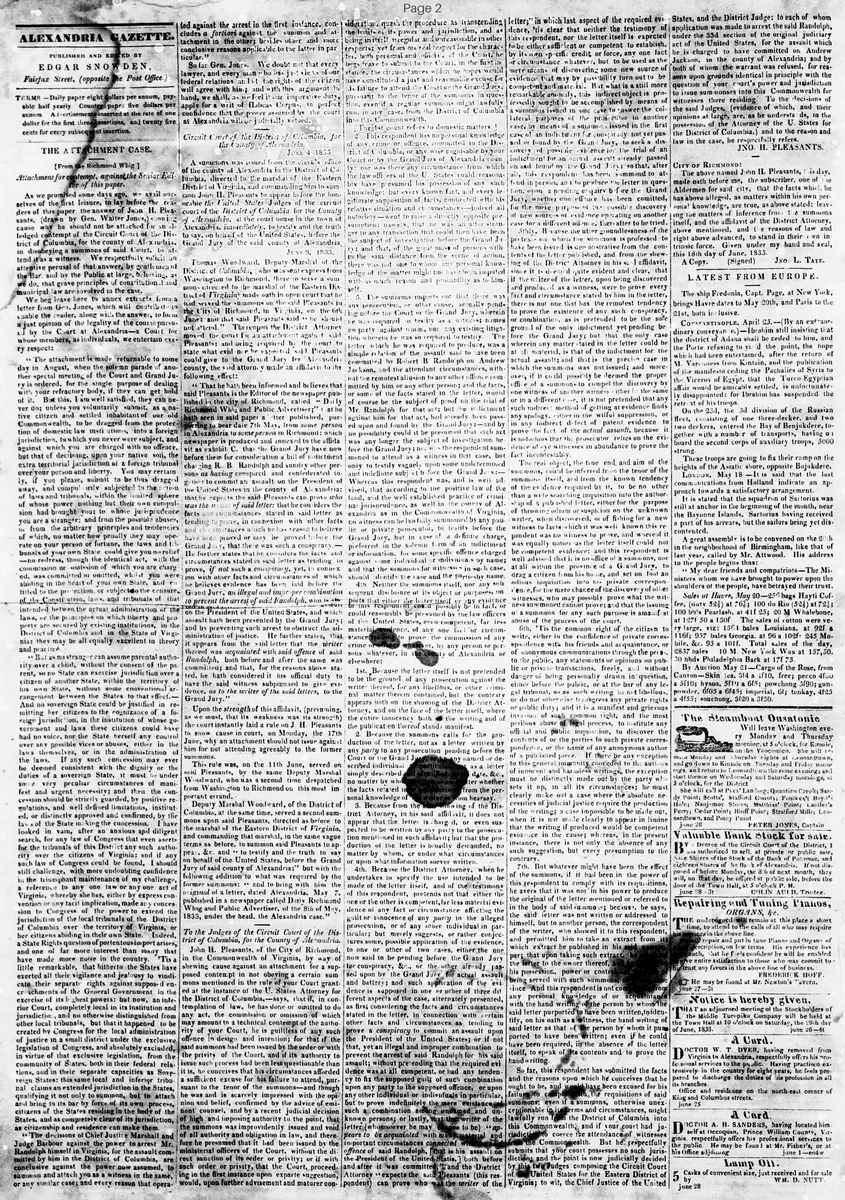
As we promised some days ago, we avail ourselves of the first leisure, to lay before the readers of this paper the answer of John H. Pleasants, (drawn by Geo. W. Jones,) showing cause why he should not be attached for an alleged contempt of the Circuit Court of the District of Columbia, for the county of Alexandria, in disobeying a summons of said Court, to attend it as a witness. We respectfully solicit an attentive perusal of that answer, by gentlemen of the Bar, and by the Public at large, believing, as we do, that grave principles of constitutional and municipal law are involved in the case.
We beg leave here to annex extracts from a letter from Gen. Jones, which will contribute to enable the reader, along with the answer, to form a just opinion of the legality of the course pursued by the Court at Alexandria—a Court for whose members, as individuals, we entertain every respect:
"The attachment is made returnable to some day in August, when the solemn parade of another special meeting of the Court and Grand Jury is ordered, for the single purpose of dealing with your refractory body, if they can get hold of it. But this, I am well satisfied, they can never do; unless you voluntarily submit, as a native citizen and settled inhabitant of our old Commonwealth, to be dragged from the protection of domestic law institutions, into a foreign jurisdiction, to which you never were subject, and against which you are charged with no offence, but that of declining, upon your native soil, the extra territorial jurisdiction of a foreign tribunal over your person and liberty. You may certainly, if you please, submit to be thus dragged away, and compulsorily subjected to the action of laws and tribunals, within the limited sphere of whose power nothing but their own compulsion had brought you; to whose jurisprudence you are a stranger; and from the possible abuses, or from the arbitrary principles and tendencies of which, no matter how penal they may operate on your person or fortune, the laws and tribunals of your own State could give you no relief—no redress, though the identical act, with the commission or omission of which you are charged, was committed or omitted, whilst you were abiding in the heart of your own State, and entitled to the protection, or subject to the censure, of the Constitution, laws, and tribunals of that Commonwealth.
There is no question intended between the actual administration of the laws, or the principles on which liberty and property are secured by existing institutions, in the District of Columbia and in the State of Virginia: they may be all equally excellent in theory and practice. But as no stranger can assume parental authority over a child, without the consent of the parent, so no State can exercise jurisdiction over a citizen of another State, within the territory of his own State, without some conventional arrangement between the States to that effect.—And no sovereign State could be justified in remitting her citizens to the cognizance of a foreign jurisdiction, in the institution of whose government and laws these citizens could have had no voice, nor the State herself any control over any possible vices or abuses, either in the laws themselves, or in the administration of the laws. If any such concession may ever be deemed consistent with the dignity or the duties of a sovereign State, it must be under some very peculiar circumstances of manifest and urgent necessity; and then the concession should be strictly guarded, by positive regulations, and well defined limitations, instituted, or distinctly approved and confirmed, by the laws of the State making the concession. I have looked in vain, after an anxious and diligent search, for any law of Congress that even asserts for the tribunals of this District any such authority over the citizens of Virginia; and if any such law of Congress could be found, I should still challenge, with more undoubting confidence in the triumphant maintenance of my challenge, a reference to any one law or any one act of Virginia, whereby she has, either by express convention or any tacit implication, made any concession to Congress of the power to extend the jurisdiction of the local tribunals of the District of Columbia over the territory of Virginia, or her citizens abiding in their own State. Indeed, a State Rights question of portentous import arises, and one of far more interest than many that have made more noise in the country. 'Tis a little remarkable, that hitherto the States have exerted all their vigilance and jealousy to vindicate their separate rights against supposed encroachments of the General Government in the exercise of its highest powers: but now, an inferior Court, completely local in its institution and jurisdiction, and no otherwise distinguished from other local tribunals, but that it happened to be created by Congress for the local administration of justice in a small district under the exclusive legislation of Congress, and absolutely excluded, in virtue of that exclusive legislation, from the community of States, both in their federal relations, and in their separate capacities as Sovereign States: this same local and inferior tribunal claims an extended jurisdiction in the States, qualifying it not only to summon, but to attach and bring to its bar by force of its own process, citizens of the States residing in the body of the States, and as completely clear of its jurisdiction, as citizenship and residence can make them.
“The decisions of Chief Justice Marshall and Judge Barbour against the power to arrest Mr. Randolph himself in Virginia, for the assault committed by him in the District of Columbia, are conclusive against the power now assumed, to summon and attach you as a witness in the same, or any similar case; and every reason that operated against the arrest in the first instance, concludes a fortiori against the summon and attachment in the other; besides other and more conclusive reasons applicable to the latter in particular."
So far Gen. Jones. We doubt not that every lawyer, and every man who has just views of our federal relations and of the rights of the citizen will agree with him; and with this argument in hand, we shall, as we feel it our imperative duty, apply for a writ of Habeas Corpus, in perfect confidence that the power assumed by the court at Alexandria will be judicially vetoed.
Circuit Court of the District of Columbia, for the County of Alexandria.
June 4 1833
A summons was issued from the clerk's office of the county of Alexandria in the District of Columbia, directed to the marshal of the Eastern District of Virginia, and commanding him to summon John H. Pleasants to appear before the honorable the United States Judges of the circuit court of the District of Columbia for the County of Alexandria, at the court house in the town of Alexandria, immediately, to testify and the truth to say, on behalf of the United States, before the Grand Jury of the said county of Alexandria
JUNE 8. 1833.
Thomas Woodward, Deputy-Marshal of the District of Columbia, (who was sent express from Washington to Richmond, there to serve a summons directed to the marshal of the Eastern District of Virginia) made oath in open court that he had served the summons on the said Pleasants in the City of Richmond, in Virginia, on the 6th June; and that said Pleasants said he should not attend." Thereupon the District Attorney moved the court for an attachment against said Pleasants: and being required by the court to state what evidence he expected said Pleasants could give to the Grand Jury for Alexandria county, the said attorney made an affidavit to the following effect:
" That he hath been informed and believes that said Pleasants is the Editor of the newspaper published in the city of Richmond, called "Daily Richmond Whig and Public Advertiser;" that he hath seen in said paper a letter published, purporting to bear date 7th May, from some person in Alexandria to some person in Richmond: which newspaper is produced and annexed to the affidavit as exhibit C. that the Grand Jury have now before them for consideration a bill of indictment charging R. B. Randolph and sundry other persons as having conspired and confederated together to commit an assault on the President of the United States in the county of Alexandria: that he expects the said Pleasants can prove who was the writer of said letter: that he considers the facts and circumstances stated in said letter as tending to prove, in connexion with other facts and circumstances which he has reason to believe have been proved or may be proved before the Grand Jury, that there was such a conspiracy.—
He further states that he considers the facts and circumstances stated in said letter as tending to prove, if not such a conspiracy, yet, in connexion with other facts and circumstances of which he believes evidence has been laid before the Grand Jury: an illegal and improper combination to prevent the arrest of said Randolph, who is summoned on the President of the United States, and which assault hath been presented by the Grand Jury and by preventing such arrest to obstruct the administration of justice. He further states, that it appears from the said letter that the writer thereof was acquainted with said offence of said Randolph, both before and after the same was committed; and that, for the reasons above stated, he hath considered it his official duty to have the said witness subpoenaed to give evidence, as to the writer of the said letter, to the Grand Jury.
Upon the strength of this affidavit, (presuming, as we must, that its weakness was its strength) the court instantly laid a rule on J. H. Pleasants to show cause in court, on Monday, the 17th June, why an attachment should not issue against him for not attending agreeably to the former summons.
This rule was, on the 11th June, served on said Pleasants, by the same Deputy Marshal Woodward, who was a second time despatched from Washington to Richmond on this most important errand.
Deputy Marshal Woodward, of the District of Columbia, at the same time, served a second summons upon said Pleasants, directed as before to the marshal of the Eastern District of Virginia, and commanding that marshal, in the same vague terms as before, to summon said Pleasants to appear, &c. and " to testify and the truth to say on behalf of the United States, before the Grand Jury of said county of Alexandria;" but with the following addition to what was required by the former summons: " and to bring with him the original of a letter, dated Alexandria, May 7, published in a newspaper called Daily Richmond Whig and Public Advertiser, of the 8th of May, 1833, under the head, the Alexandria case."
To the Judges of the Circuit Court of the District of Columbia, for the County of Alexandria.
John H. Pleasants, of the City of Richmond, in the Commonwealth of Virginia, by way of shewing cause against an attachment for a supposed contempt in not obeying a certain summons mentioned in the rule of your Court granted at the instance of the U. States Attorney for the District of Columbia,—says, that if, in contemplation of law, he has done or omitted to do any act, the commission or omission of which may amount to a technical contempt of the authority of your Court, he is guiltless of any such offence in design and intention; for that if the said summons had been issued by the order or with the privity of the Court, and if its authority to issue such process had been less questionable than it is, he conceives that his circumstances afforded a sufficient excuse for his failure to attend, pursuant to the tenor of the summons—and though he was and is scarcely impressed with the opinion and belief, confirmed by the advice of eminent counsel, and by a recent judicial decision of high and imposing authority to the point, that the summons was improvidently issued and void of all authority and obligation in law, and therefore he presumed that it had been issued by the ministerial officers of the Court, without the direct sanction of its order or privity; or if with such order or privity, that the Court, proceeding in the first instance upon ex parte suggestion, would, upon further advisement and maturer consideration, quash the procedure as transcending the line of its power and jurisdiction, and as being in itself irregular and unreasonable in other respects: yet from his real respect for the character, both personal and official, of the Court, he begs leave to submit to the Court, in the first instance, the circumstances which he hopes would have constituted a just and reasonable excuse for his failure to attend the Court or the Grand Jury, pursuant to the tenor of the summons in question, even if a regular summons might lawfully run, in any case, from the District of Columbia into this Commonwealth.
[The 1st count refers to domestic matters.]
1. This respondent has no personal knowledge of any crime or offence, committed in the District of Columbia, or any wise cognizable by your Court or by the Grand Jury of Alexandria county: nor was there any circumstance from which the law officers of the U. States could reasonably have presumed his possession of any such knowledge: but every known fact, and every legitimate supposition of facts, connected with his relative situation and circumstances—indeed all notoriety—went to raise a directly opposite presumption: namely, that he was an utter stranger to any transaction that could then have been the subject of investigation before the Grand Jury: and that, of the great mass of persons within the same distance from the scene of action, there was not one to whom any personal knowledge of the matter might not have been imputed with as much reason and probability as to himself.
2. The summons imports not that there was any prosecution, or other cause, actually pending before the Court or the Grand Jury, wherein he was required to testify as a witness: names no party against whom, nor any existing litigation wherein he was so required to testify. The letter which he was required to produce, was a simple relation of the assault said to have been committed by Robert B. Randolph on Andrew Jackson, and the attendant circumstances, without the remotest allusion to any other offence committed by him or any other person; and the facts, or some of the facts stated in the letter, would of course be the subject of proof on the trial of Mr. Randolph for that act; but the indictment against him for that act, had already been passed upon and found by the Grand Jury;—and by no possibility could it be presumed that such act was any longer the subject of investigation before the Grand Jury;—nor was the respondent summoned to attend as a witness in that case, but only to testify vaguely, upon some undetermined and indefinite subject before the Grand Jury:—
Whereas this respondent was, and is well advised, that according to the positive law of the land, and the well established practice of criminal jurisprudence, as well in the county of Alexandria as in the Commonwealth of Virginia, no witness can be lawfully summoned by any public or private prosecutor, to testify before the Grand Jury, but in case of a definite charge, preferred in the solemn form of an indictment or information, for some specific offence charged against some individual or individuals by name; and that the summons for witnesses in such case, should identify the case and the parties by name.
3d. Neither the summons itself, nor any subsequent disclosure of its object or purposes, imports that either the letter itself or any evidence or testimony of the respondent could possibly be in fact, or could reasonably be presumed by the law officers of the United States, even competent, far less material evidence or reference, of any one fact or circumstance to prove the commission of any crime or offence whatever, by any person or persons whatever, in the county of Alexandria or elsewhere:
1st. Because the letter itself is not pretended to be the ground of any prosecution against the writer thereof, for any libellous, or other criminal matter therein contained, but the contrary appears both on the showing of the District Attorney, and on the face of the letter itself, where the entire innocency both of the writing and of the publication thereof stands manifest.
2. Because the summons calls for the production of the letter, not as a letter written by any party to any prosecution pending before the Court or the Grand Jury, or otherwise described individually as a letter written by any particular person, but simply described as a letter dated, &c., no matter by whom written, or whether the facts related therein were from personal knowledge or hearsay.
3. Because from the showing of the District Attorney, in his said affidavit, it does not appear that the letter is charged, or even suspected to be written by any party to the prosecution mentioned in such affidavit; but that the production of the letter is broadly demanded, no matter by whom, or under what circumstances or upon what information soever written.
4th. Because the District Attorney, when he undertakes to specify the use intended to be made of the letter itself, and of the testimony of this respondent, pretends not that either the one or the other is competent, far less material evidence of any fact or circumstance affecting the guilt or innocence of any party to the alleged prosecution, or of any other individual in particular; but merely suggests, or rather conjectures some possible application of the evidence, to one or other of two cases, either the one now said to be pending before the Grand Jury for conspiracy, &c., or the other already passed upon by the Grand Jury for actual assault and battery; and such application of the evidence is supposed in one or other of three different aspects of the case, alternately presented, as first considering the facts and circumstances stated in the letter, in connection with certain other facts and circumstances as tending to prove a conspiracy to commit an assault upon the President of the United States; or if not that, yet an illegal and improper combination to prevent the arrest of said Randolph for his said assault; without pretending that the required evidence was at all competent, or had any tendency to fix the supposed guilt of such combination upon any party to the supposed offence, or upon any other individual or individuals in particular, but to prove indefinitely the mere existence of such a combination among unnamed and unknown persons; or lastly, that the writer of the letter (whomsoever he may be) "appears to be acquainted with many and important circumstances connected with the offence of said Randolph, in his assault on the President of the United States, both before and after it was committed." " and the District Attorney expects the said Pleasants (this respondent) can prove who was the writer of the letter;" in which last aspect of the required evidence, it is clear that neither the testimony of this respondent, nor the letter itself is expected to be either sufficient or competent to establish, by its own specific credit or force, any one fact or circumstance whatever, but to be used as the mere means of discovering some new source of evidence that may by possibility turn out to be competent and material. But what is a still more remarkable anomaly, this indirect object is professedly sought to be accomplished by means of a summons issued in one case to answer the collateral purposes of the prosecutor in another case, by means of a summons issued in the first case of an indictment for conspiracy not yet passed or found by the Grand Jury, to seek a discovery of possible evidence for the trial of an indictment for an actual assault already passed on and found by the Grand Jury; so that, after all, this respondent has been summoned to attend in person, and to produce the letter in question, upon a pending enquiry before the Grand Jury, whether one offence has been committed, for the mere purpose of the possible discovery of new sources of evidence operating on another case for a different offence, thereafter to be tried.
5th. Because the utter groundlessness of the pretext on which the summons is professed to have been issued is demonstrative from the contents of the letter published, and from the showing of the District Attorney in his said affidavit, since it is deemed quite evident and clear, that if the writer of the letter, upon being discovered and produced as a witness, were to prove every fact and circumstance stated by him in the letter, there is not one that has the remotest tendency to prove the existence of any such conspiracy, or combination, as is pretended to be the sole ground of the only indictment yet pending before the Grand Jury; but that the only case wherein any matter stated in the letter could be at all material, is that of the indictment for the actual assault; and that is the precise case in which the summons was not issued; and moreover, if it could possibly be deemed the proper office of a summons to compel the discovery by one witness of another witness either in the same or in a different case, it is not pretended that any such indirect method of getting at evidence finds any apology, either in the wilful suppression, or in any indirect defect of patent evidence to prove the fact of the actual assault, because it is notorious that the prosecutor relies on the evidence of eye witnesses in abundance to prove the fact incontestably.
The real object, the true end and aim of the summons, could be inferred from the tenor of the summons itself, and from the known tendency of the evidence required by it, to be no other than a wide searching inquisition into the authorship of a published letter, either for the purpose of throwing odium or suspicion on the unknown writer, when discovered, or of fishing for a new witness to facts which it was well known this respondent was no witness to prove, and whereof it was equally notorious the letter itself could not be competent evidence: and this respondent is well advised that it is no office of a summons, nor at all within the province of a Grand Jury, to drag a citizen from his home, and set on foot an odious inquisition into his private correspondence, for the mere chance of the discovery of other witnesses, who may possibly prove what the witness summoned cannot prove: and that the issuing of a summons for any such purpose is a manifest abuse of the process of the court.
6th. 'Tis the common right of the citizen to write, either in the confidence of private correspondence with his friends and acquaintance, or of anonymous communications through the press, to the public, any statements or opinions on public or private transactions, freely, and without danger of being personally drawn in question, either before the public, or at the bar of any legal tribunal, so as such writing be not libellous, or do not otherwise transgress any private rights or public duty; and it is a manifest and grievous invasion of such common right, and the most perilous abuse of legal process, to institute any official and public inquisition, to discover the contents of or the parties to such private correspondence, or the name of any anonymous author of a published piece. If there be any exception to this general immunity conceded to the authors of innocent and harmless writings, the exception must be distinctly made out by the party who sets it up, in all its circumstances; he must clearly make out a case where the absolute necessities of judicial justice require the production of the writing; a case impossible to be made out, when it is not made clearly to appear in limine that the writing if produced would be competent evidence in the cause; whereas, in the present instance, there is not only the absence of any such suggestion, but every presumption to the contrary.
7th. But whatever might have been the effect of the summons, if it had been in the power of this respondent to comply with its requisitions, he avers that it was not in his power to produce the original of the letter mentioned or referred to in the body of said summons; because, he says, the said letter was not written or addressed to himself, but to another person, the correspondent of the writer, who showed it to this respondent, and permitted him to take an extract from it which extract he published in his said paper; that upon taking such extract he returned the letter to the owner thereof, from whose possession, power or control it has ever since been, at the time of his being served with such summons; and this respondent is not conscious of any personal knowledge of or acquaintance with the hand writing of the person by whom the said letter purported to have been written, to identify, on his oath as a witness, the handwriting of said letter as that of the person by whom it purported to have been written; even if he could have been required, in the absence of the letter itself, to speak of its contents and to prove the handwriting.
So far, this respondent has submitted the facts and the reasons upon which he conceives that he ought to be, and would have been excused for his failure to comply with the requisitions of said summons; even if a summons, otherwise unexceptionable in its terms and circumstances, might lawfully run from the District of Columbia into this Commonwealth; and if your court had jurisdiction to coerce the attendance of witnesses from the Commonwealth. But he respectfully submits that your court possesses no such jurisdiction; and the point is now judicially decided by the two Judges composing the Circuit Court of United States for the Eastern District of Virginia; to wit, the Chief Justice of the United States, and the District Judge: to each of whom application was made to arrest the said Randolph, under the 33d section of the original judiciary act of the United States, for the assault which he is charged to have committed on Andrew Jackson, in the county of Alexandria; and by both of whom the warrant was refused, for reasons upon grounds identical in principle with the question of your court's power and jurisdiction to issue summonses into this Commonwealth for witnesses there residing.' To the decisions of the said Judges, (evidence of which, and their opinions at large, are, as he understands, in the possession of the Attorney of the U. States for the District of Columbia.) and to the reason and law in the case, he respectfully refers.
JNO. H. PLEASANTS.
City of Richmond:
The above named John H. Pleasants, this day, made oath before me, the subscriber, one of the Aldermen for said city, that the facts which he has above alleged, as matters within his own personal knowledge, are true, as above stated: leaving the matters of inference from the summons itself, and the affidavit of the District Attorney, above mentioned, and the reasons of law and right above advanced, to stand in their own intrinsic force. Given under my hand and seal this 18th day of June, 1833.
A Copy.
(Signed) Jno. L. TATE.
What sub-type of article is it?
What themes does it cover?
What keywords are associated?
What entities or persons were involved?
Where did it happen?
Story Details
Key Persons
Location
Richmond, Virginia; Alexandria, District Of Columbia
Event Date
June 1833
Story Details
John H. Pleasants refuses a summons from the Alexandria court to testify before a grand jury about a letter published in his newspaper regarding R.B. Randolph's assault on President Andrew Jackson, arguing the court lacks jurisdiction over him as a Virginia resident and that the summons is improper and abusive.