Thank you for visiting SNEWPapers!
Sign up free
Story
July 6, 1943
The Daily Monitor Leader
Mount Clemens, Macomb County, Michigan
What is this article about?
Lawrence A. Appley, War Manpower Commission executive, proposes industry educate war workers on their vital role in industrial revolution for postwar impact, to boost morale and avoid 1930s backlash, based on his business experience.
Clipping
OCR Quality
100%
Excellent
Full Text
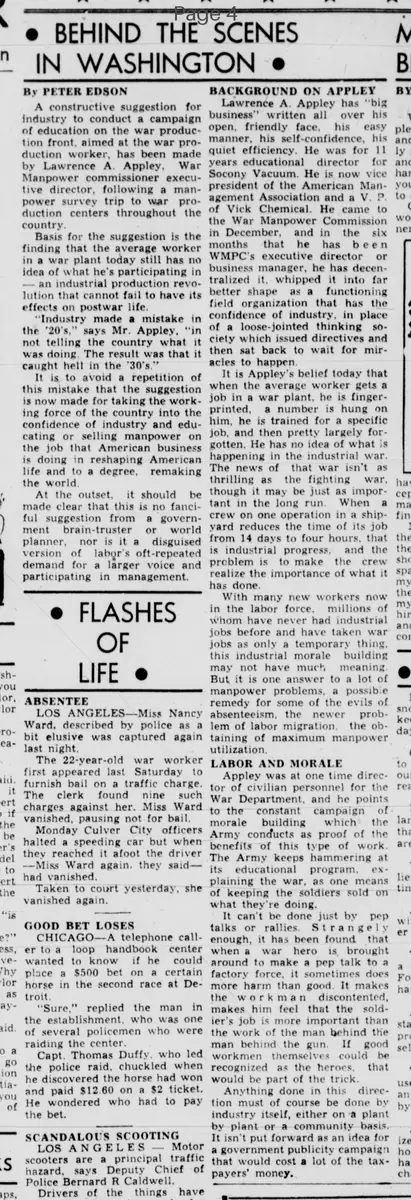
A constructive suggestion for industry to conduct a campaign of education on the war production front, aimed at the war production worker, has been made by Lawrence A. Appley, War Manpower Commission executive director, following a manpower survey trip to war production centers throughout the country.
Basis for the suggestion is the finding that the average worker in a war plant today still has no idea of what he's participating in -an industrial production revolution that cannot fail to have its effects on postwar life.
"Industry made a mistake in the '20's," says Mr. Appley, "in not telling the country what it was doing. The result was that it caught hell in the '30's."
It is to avoid a repetition of this mistake that the suggestion is now made for taking the working force of the country into the confidence of industry and educating or selling manpower on the job that American business is doing in reshaping American life and to a degree, remaking the world.
At the outset, it should be made clear that this is no fanciful suggestion from a government brain-truster or world planner, nor is it a disguised version of labor's oft-repeated demand for a larger voice and participating in management.
BACKGROUND ON APPLEY
Lawrence A. Appley has "big business" written all over his open, friendly face, his easy manner, his self-confidence, his quiet efficiency. He was for 11 years educational director for Socony Vacuum. He is now vice president of the American Management Association and a V. P. of Vick Chemical. He came to the War Manpower Commission in December, and in the six months that he has been WMPC's executive director or business manager, he has decentralized it, whipped it into far better shape as a functioning field organization that has the confidence of industry, in place of a loose-jointed thinking society which issued directives and then sat back to wait for miracles to happen.
It is Appley's belief today that when the average worker gets a job in a war plant, he is finger-printed, a number is hung on him, he is trained for a specific job, and then pretty largely forgotten. He has no idea of what is happening in the industrial war. The news of that war isn't as thrilling as the fighting war, though it may be just as important in the long run. When a crew on one operation in a shipyard reduces the time of its job from 14 days to four hours, that is industrial progress, and the problem is to make the crew realize the importance of what it has done.
With many new workers now in the labor force, millions of whom have never had industrial jobs before and have taken war jobs as only a temporary thing, this industrial morale building may not have much meaning.
But it is one answer to a lot of manpower problems, a possible remedy for some of the evils of absenteeism, the newer problem of labor migration, the obtaining of maximum manpower utilization.
LABOR AND MORALE
Appley was at one time director of civilian personnel for the War Department, and he points to the constant campaign of morale building which the Army conducts as proof of the benefits of this type of work.
The Army keeps hammering at its educational program, explaining the war, as one means of keeping the soldiers sold on what they're doing.
It can't be done just by pep talks or rallies. Strangely enough, it has been found that when a war hero is brought around to make a pep talk to a factory force, it sometimes does more harm than good. It makes the workman discontented, makes him feel that the soldier's job is more important than the work of the man behind the man behind the gun. If good workmen themselves could be recognized as the heroes, that would be part of the trick.
Anything done in this direction must of course be done by industry itself, either on a plant by plant or a community basis.
It isn't put forward as an idea for a government publicity campaign that would cost a lot of the taxpayers' money.
Basis for the suggestion is the finding that the average worker in a war plant today still has no idea of what he's participating in -an industrial production revolution that cannot fail to have its effects on postwar life.
"Industry made a mistake in the '20's," says Mr. Appley, "in not telling the country what it was doing. The result was that it caught hell in the '30's."
It is to avoid a repetition of this mistake that the suggestion is now made for taking the working force of the country into the confidence of industry and educating or selling manpower on the job that American business is doing in reshaping American life and to a degree, remaking the world.
At the outset, it should be made clear that this is no fanciful suggestion from a government brain-truster or world planner, nor is it a disguised version of labor's oft-repeated demand for a larger voice and participating in management.
BACKGROUND ON APPLEY
Lawrence A. Appley has "big business" written all over his open, friendly face, his easy manner, his self-confidence, his quiet efficiency. He was for 11 years educational director for Socony Vacuum. He is now vice president of the American Management Association and a V. P. of Vick Chemical. He came to the War Manpower Commission in December, and in the six months that he has been WMPC's executive director or business manager, he has decentralized it, whipped it into far better shape as a functioning field organization that has the confidence of industry, in place of a loose-jointed thinking society which issued directives and then sat back to wait for miracles to happen.
It is Appley's belief today that when the average worker gets a job in a war plant, he is finger-printed, a number is hung on him, he is trained for a specific job, and then pretty largely forgotten. He has no idea of what is happening in the industrial war. The news of that war isn't as thrilling as the fighting war, though it may be just as important in the long run. When a crew on one operation in a shipyard reduces the time of its job from 14 days to four hours, that is industrial progress, and the problem is to make the crew realize the importance of what it has done.
With many new workers now in the labor force, millions of whom have never had industrial jobs before and have taken war jobs as only a temporary thing, this industrial morale building may not have much meaning.
But it is one answer to a lot of manpower problems, a possible remedy for some of the evils of absenteeism, the newer problem of labor migration, the obtaining of maximum manpower utilization.
LABOR AND MORALE
Appley was at one time director of civilian personnel for the War Department, and he points to the constant campaign of morale building which the Army conducts as proof of the benefits of this type of work.
The Army keeps hammering at its educational program, explaining the war, as one means of keeping the soldiers sold on what they're doing.
It can't be done just by pep talks or rallies. Strangely enough, it has been found that when a war hero is brought around to make a pep talk to a factory force, it sometimes does more harm than good. It makes the workman discontented, makes him feel that the soldier's job is more important than the work of the man behind the man behind the gun. If good workmen themselves could be recognized as the heroes, that would be part of the trick.
Anything done in this direction must of course be done by industry itself, either on a plant by plant or a community basis.
It isn't put forward as an idea for a government publicity campaign that would cost a lot of the taxpayers' money.
What sub-type of article is it?
Historical Event
Biography
What themes does it cover?
Moral Virtue
Social Manners
What keywords are associated?
War Production
Manpower Education
Industrial Morale
Worker Confidence
Postwar Effects
What entities or persons were involved?
Lawrence A. Appley
Where did it happen?
War Production Centers Throughout The Country
Story Details
Key Persons
Lawrence A. Appley
Location
War Production Centers Throughout The Country
Story Details
Lawrence A. Appley suggests industry educate war production workers on their role in an industrial revolution affecting postwar life, to avoid past mistakes and build morale, drawing from his background in business and War Manpower Commission.