Thank you for visiting SNEWPapers!
Sign up free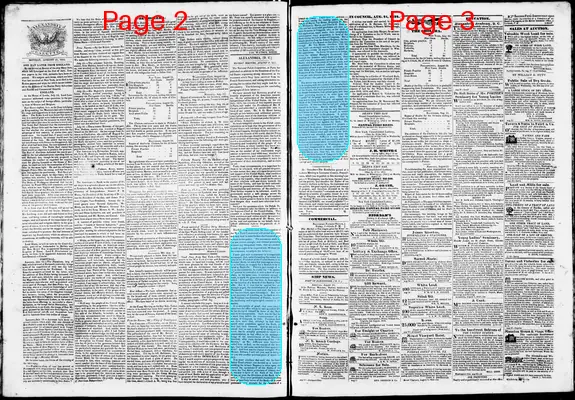
Editorial
August 27, 1832
Phenix Gazette
Alexandria, Virginia
What is this article about?
Letter reveals President Jackson's shift from supporting the National Bank to opposing it, influenced by Van Buren and Albany Regency's scheme to control state banks via Safety Fund, exposing hypocrisy among politicians who previously favored the Bank.
Merged-components note: Text content shows clear continuation across pages of the editorial on Jackson and the Bank of the United States; sequential reading order.
Clippings
1 of 2
OCR Quality
95%
Excellent
Full Text
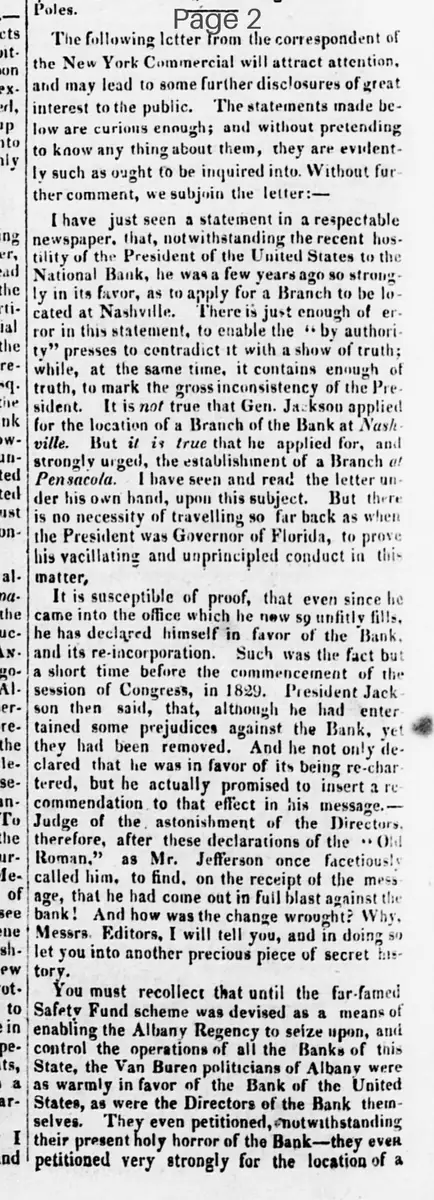
The following letter from the correspondent of the New York Commercial will attract attention, and may lead to some further disclosures of great interest to the public. The statements made below are curious enough; and without pretending to know any thing about them, they are evidently such as ought to be inquired into. Without further comment, we subjoin the letter:-
I have just seen a statement in a respectable newspaper, that, notwithstanding the recent hostility of the President of the United States to the National Bank, he was a few years ago so strongly in its favor, as to apply for a Branch to be located at Nashville. There is just enough of error in this statement, to enable the "by authority" presses to contradict it with a show of truth; while, at the same time, it contains enough of truth, to mark the gross inconsistency of the President. It is not true that Gen. Jackson applied for the location of a Branch of the Bank at Nashville. But it is true that he applied for, and strongly urged, the establishment of a Branch at Pensacola. I have seen and read the letter under his own hand, upon this subject. But there is no necessity of travelling so far back as when the President was Governor of Florida, to prove his vacillating and unprincipled conduct in this matter,
It is susceptible of proof, that even since he came into the office which he now so unfitly fills, he has declared himself in favor of the Bank, and its re-incorporation. Such was the fact but a short time before the commencement of the session of Congress, in 1829. President Jackson then said, that, although he had entertained some prejudices against the Bank, yet they had been removed. "And he not only declared that he was in favor of its being re-chartered, but he actually promised to insert a recommendation to that effect in his message." Judge of the astonishment of the Directors, therefore, after these declarations of the "Old Roman," as Mr. Jefferson once facetiously called him, to find, on the receipt of the message, that he had come out in full blast against the bank! And how was the change wrought? Why, Messrs. Editors, I will tell you, and in doing so let you into another precious piece of secret history.
You must recollect that until the far-famed Safety Fund scheme was devised as a means of enabling the Albany Regency to seize upon, and control the operations of all the Banks of this State, the Van Buren politicians of Albany were as warmly in favor of the Bank of the United States, as were the Directors of the Bank themselves. They even petitioned, notwithstanding their present holy horror of the Bank—they even petitioned very strongly for the location of a Branch at Albany.
I have seen the petition.-
It contains among the leading applicants, the names of Martin Van Buren, Benjamin F. Butler, William L. Marcy, and Charles E. Dudley.
The two last mentioned gentlemen are now uncontrollable Senators in Congress, who, in the teeth of this application, made under their own hands, voted against every proposition in favor of the Bank during the late session of Congress. But a simple petition from the Albany Regency, for the establishment of a Branch at that place, was not enough. Mr. Van Buren, therefore, with his own hand--so strongly was he then in favor of the application. Such was the posture of things, when the Albany Managers discovered, that through the delusive safety-fund scheme, they could seize the substantial control of all the old Banks, and grasp the stock of the new ones, in addition to the political influence which the possession of such a power would give them, enable them also, in the event of getting rid of the Branches of the United States Bank, to exact seven per cent, interest upon their discounts, instead of six.--the rate of discount of the Branches.
Since audaciously proclaimed in the Senate-house lying in keeping with the conduct of those who have The device was worthy of its authors-exactly of the Union, that their political principles have no deeper foundation than private gain, and that their governing maxim is to seize upon the 'spoils' of the people for a prey. The next step was to bring the President out against the Bank. It was true that he had just pledged himself in its favor. But no matter: Mr. Van Buren was his Premier; and the wily Secretary well knew what apron string to pull to mould the 'nose of wax' to his purpose. A private meeting of the Master-Spirits was then held in Albany,--at which it was agreed that the President should be brought out against the Bank. The Argus may deny this statement if it pleases. - But it will do no good. I know who the persons were attending that meeting; and I can prove in a Court of Justice when and where it was held, by whom it was attended, and what were the steps agreed upon. Suffice it to say, that the measure was matured, as I have stated, and such further arrangements taken as would secure the success of the conspiracy at Washington. Nor were they disappointed in their calculations.- Knowing their men, their measures were considerably taken; and, thus far, the voice of the people, and both houses of Congress to the contrary notwithstanding, they have marched steadily forward towards the accomplishment of their corrupt and sinister purpose.
I have just seen a statement in a respectable newspaper, that, notwithstanding the recent hostility of the President of the United States to the National Bank, he was a few years ago so strongly in its favor, as to apply for a Branch to be located at Nashville. There is just enough of error in this statement, to enable the "by authority" presses to contradict it with a show of truth; while, at the same time, it contains enough of truth, to mark the gross inconsistency of the President. It is not true that Gen. Jackson applied for the location of a Branch of the Bank at Nashville. But it is true that he applied for, and strongly urged, the establishment of a Branch at Pensacola. I have seen and read the letter under his own hand, upon this subject. But there is no necessity of travelling so far back as when the President was Governor of Florida, to prove his vacillating and unprincipled conduct in this matter,
It is susceptible of proof, that even since he came into the office which he now so unfitly fills, he has declared himself in favor of the Bank, and its re-incorporation. Such was the fact but a short time before the commencement of the session of Congress, in 1829. President Jackson then said, that, although he had entertained some prejudices against the Bank, yet they had been removed. "And he not only declared that he was in favor of its being re-chartered, but he actually promised to insert a recommendation to that effect in his message." Judge of the astonishment of the Directors, therefore, after these declarations of the "Old Roman," as Mr. Jefferson once facetiously called him, to find, on the receipt of the message, that he had come out in full blast against the bank! And how was the change wrought? Why, Messrs. Editors, I will tell you, and in doing so let you into another precious piece of secret history.
You must recollect that until the far-famed Safety Fund scheme was devised as a means of enabling the Albany Regency to seize upon, and control the operations of all the Banks of this State, the Van Buren politicians of Albany were as warmly in favor of the Bank of the United States, as were the Directors of the Bank themselves. They even petitioned, notwithstanding their present holy horror of the Bank—they even petitioned very strongly for the location of a Branch at Albany.
I have seen the petition.-
It contains among the leading applicants, the names of Martin Van Buren, Benjamin F. Butler, William L. Marcy, and Charles E. Dudley.
The two last mentioned gentlemen are now uncontrollable Senators in Congress, who, in the teeth of this application, made under their own hands, voted against every proposition in favor of the Bank during the late session of Congress. But a simple petition from the Albany Regency, for the establishment of a Branch at that place, was not enough. Mr. Van Buren, therefore, with his own hand--so strongly was he then in favor of the application. Such was the posture of things, when the Albany Managers discovered, that through the delusive safety-fund scheme, they could seize the substantial control of all the old Banks, and grasp the stock of the new ones, in addition to the political influence which the possession of such a power would give them, enable them also, in the event of getting rid of the Branches of the United States Bank, to exact seven per cent, interest upon their discounts, instead of six.--the rate of discount of the Branches.
Since audaciously proclaimed in the Senate-house lying in keeping with the conduct of those who have The device was worthy of its authors-exactly of the Union, that their political principles have no deeper foundation than private gain, and that their governing maxim is to seize upon the 'spoils' of the people for a prey. The next step was to bring the President out against the Bank. It was true that he had just pledged himself in its favor. But no matter: Mr. Van Buren was his Premier; and the wily Secretary well knew what apron string to pull to mould the 'nose of wax' to his purpose. A private meeting of the Master-Spirits was then held in Albany,--at which it was agreed that the President should be brought out against the Bank. The Argus may deny this statement if it pleases. - But it will do no good. I know who the persons were attending that meeting; and I can prove in a Court of Justice when and where it was held, by whom it was attended, and what were the steps agreed upon. Suffice it to say, that the measure was matured, as I have stated, and such further arrangements taken as would secure the success of the conspiracy at Washington. Nor were they disappointed in their calculations.- Knowing their men, their measures were considerably taken; and, thus far, the voice of the people, and both houses of Congress to the contrary notwithstanding, they have marched steadily forward towards the accomplishment of their corrupt and sinister purpose.
What sub-type of article is it?
Partisan Politics
Economic Policy
What keywords are associated?
National Bank
Jackson Inconsistency
Van Buren
Albany Regency
Safety Fund
Political Conspiracy
What entities or persons were involved?
President Jackson
Martin Van Buren
Benjamin F. Butler
William L. Marcy
Charles E. Dudley
Albany Regency
Editorial Details
Primary Topic
President Jackson's Inconsistency On The National Bank And Van Buren Influence
Stance / Tone
Strongly Critical Of Jackson And Van Buren Hypocrisy
Key Figures
President Jackson
Martin Van Buren
Benjamin F. Butler
William L. Marcy
Charles E. Dudley
Albany Regency
Key Arguments
Jackson Applied For A Bank Branch At Pensacola As Governor Of Florida
Jackson Declared Favor For Bank Re Charter In 1829 But Opposed It In His Message
Van Buren And Albany Politicians Petitioned For Bank Branch At Albany Then Opposed It
Safety Fund Scheme Allowed Albany Control Over State Banks
Secret Meeting In Albany Decided To Turn Jackson Against The Bank
Van Buren Influenced Jackson To Change Stance Despite Prior Pledge