Thank you for visiting SNEWPapers!
Sign up free
Alexandria Daily Advertiser
Alexandria, Virginia
What is this article about?
Reports from London in late November detail ongoing French invasion threats against Britain, including Bonaparte at Boulogne, unconfirmed gunboat attacks near Alderney, delays in French preparations due to British vigilance, and speculations that French aims may target the Levant as a feint, with discussions on strategic value of Cyprus, Rhodes, and Candia for commerce and conquest.
Merged-components note: These sequential components form a single article compiling late foreign intelligence from New York, London, and Cork papers, including speculation on French invasion plans towards the Levant.
Clippings
1 of 2
OCR Quality
Full Text
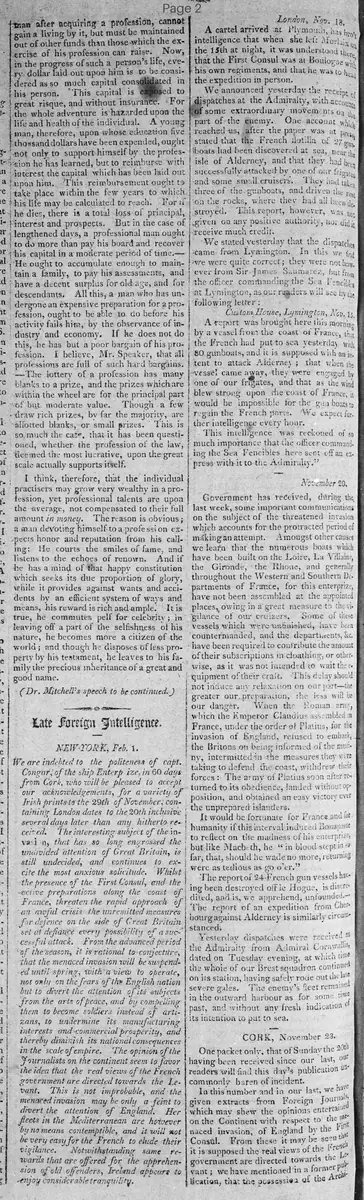
NEW YORK, Feb. 1.
We are indebted to the politeness of capt.
Congar, of the ship Enterprise, in 60 days
from Cork, who will be pleased to accept
our acknowledgements, for a variety of
Irish prints to the 29th of November; con-
taining London dates to the 20th inclusive,
several days later than any hitherto re-
ceived. The interesting subject of the in-
vasion, that has so long engrossed the
undivided attention of Great Britain, is
still undecided, and continues to ex-
cite the most anxious solicitude. Whilst
the presence of the First Consul, and the
active preparations along the coast of
France, threaten the rapid approach of
an awful crisis the unremitted measures
for defence on the side of Great Britain
set at defiance every possibility of a suc-
cessful attack. From the advanced period
of the season, it is rational to conjecture,
that the menaced invasion will be suspend-
ed until spring, with a view to operate,
not only on the fears of the English nation
but to divert the attention of its subjects
from the arts of peace, and by compelling
them to become soldiers instead of arti-
zans, to undermine its manufacturing
interests and commercial prosperity, and
thereby diminish its national consequence
in the scale of empire. The opinion of the
Journalists on the continent seem to favor
the idea that the real views of the French
government are directed towards the Le-
vant. This is not improbable, and the
menaced invasion may be only a feint to
divert the attention of England. Her
fleets in the Mediterranean are however
by no means contemptible, and it will not
be very easy for the French to elude their
vigilance. Notwithstanding some rewards that are offered for the apprehen-
sion of old offenders, Ireland appears to
enjoy considerable tranquility.
London, Nov. 18.
A cartel arrived at Plymouth, has bro't
intelligence that when she left Morlaix on
the 15th at night, it was understood there.
that the First Consul was at Boulogne with
his own regiments, and that he was to head
the expedition in person.
We announced yesterday the receipt of
dispatches at the Admiralty, with accounts
of some extraordinary movements on the
part of the enemy. One account which
reached us, after the paper was at press,
stated that the French flotilla of 27 gun-
boats had been discovered at sea, near the
Isle of Alderney, and that they had been
successfully attacked by one of our frigates
and some small cruisers. They had taken
three of the gunboats, and driven the rest
on the rocks, where they had all been de-
stroved. This report, however, was not
given on any positive authority, nor did it
receive much credit.
We stated yesterday that the dispatches
came from Lymington. In this we find
we were quite correct; they were not how-
ever from Sir James Saumarez, but from
the officer commanding the Sea Fencibles
at Lymington, as our readers will see by the
following letter:
Custom House, Lymington, Nov. 15.
A report was brought here this morning
by a vessel from the coast of France, that
the French had put to sea yesterday with
80 gunboats, and it is supposed with an in-
tent to attack Alderney; that when the
vessel came away, they were engaged by
one of our frigates, and that as the wind
blew strong upon the coast of France, it
would be impossible for the gun boats to
regain the French ports. We expect fur-
ther intelligence every hour.
This intelligence was reckoned of so
much importance that the officer command-
ing the Sea Fencibles here sent off an ex-
press with it to the Admiralty.
November 20.
Government has received, during the
last week, some important communications
on the subject of the threatened invasion
which accounts for the protracted period of
making an attempt. Amongst other causes
we learn that the numerous boats which
have been built on the Loire, La Villaine,
the Gironde, the Rhone, and generally
throughout the Western and Southern De-
partments of France, for this enterprize
have not been assembled at the appointed
places, owing in a great measure to the vi-
gilance of our cruizers. Some of these
vessels which were unfinished, have been
countermanded, and the departments, &c.
have been required to contribute the amount
of their subscriptions in cloathing, or other-
wise, as it was not intended to wait the e-
quipment of their craft. This delay should
not induce any relaxation on our part—the
greater our preparation, the less will be
our danger. When the Roman army,
which the Emperor Claudius assembled in
France, under the order of Plautius, for the
invasion of England, refused to embark,
the Britons on being informed of the muti-
ny, intermitted in the measures they were
taking to defend the coast, withdrew their
forces: The army of Plautius soon after re-
turned to its obedience, landed without op-
position, and obtained an easy victory over
the unprepared islanders.
It would be fortunate for France and for
humanity if this interval induced Bonaparte
to reflect on the madness of his enterprize,
but like Macbeth, he "in blood stept in so
far, that, should he wade no more, returning
were as tedious as go o'er."
The report of 24 French gun vessels hav-
ing been destroyed off La Hogue, is discred-
ited, and is, we apprehend, unfounded.
The report of an expedition from Cher-
bourg against Alderney is similarly circum-
stanced.
Yesterday dispatches were received at
the Admiralty from Admiral Cornwallis,
dated on Tuesday evening, at which time
the whole of our Brest squadron continued
on its station, having safely rode out the late
severe gales. The enemy's fleet remained
in the outward harbour as for some time
past, and without any fresh indication of
its intention to put to sea.
CORK, November 23.
One packet only, that of Sunday the 20th
having been received since our last, our
readers will find this day's publication un-
commonly barren of incident.
In this number and in our last, we have
given extracts from Foreign Journals,
which may shew the opinions entertained
on the Continent with respect to the me-
naced invasion, of England by the First
Consul
it is supposed the real views of the French
government are directed towards the Le-
vant; we have mentioned in a former pub-
lication, that the possession of the Archi-
Iraq and Egypt, would indemnify the republic for the loss of her possessions in the West-Indies. Thus the Island of Cyprus produces cotton of a fine kind, though not by any means in the same quantity as when it was in the possession of the Venetians; at that period there were extensive plantations of sugar canes in this island, which were destroyed by the Turks. This island and its situation with respect to Egypt, is valuable also on account of its Minerals the conquest of which would have been considerably facilitated by the possession of Cyprus, where the French would find zealous partizans in the Greeks. Numerous harbours which it would be easy to put in a respectable state of defence would present ships cruising in the sea of Syria, would serve the fleet secure from any attack block up all its ports, and at a favourable moment these ships, favoured by the rapid current, would speedily transport over the short distance of seventy leagues from Cyprus to Alexandria, an army accustomed to the heat of the climate, and reinforced by Cypriots. The debarkation being effected the fleet might quit the dangerous shores of Alexandria, and regain the roads of Cyprus. An easy, quick and continual communication which it would be extremely difficult for the English cruizers to intercept, might be kept up between the two colonies; the island would furnish the continent with provisions and with wood, in which Egypt is extremely deficient-the French army might make descents on the coast of Syria, and thus avoid long and destructive marches over the burning sands which separate Asia from Africa. The resources which the island of Cyprus affords for the conquest of Egypt extend also to its preservation; they would considerably facilitate and secure the acquisition of a country, which from its situation is the key and the emporium of the commerce of three great divisions of the world, and of which the Roman Emperors, who were acquainted with its importance, were so jealous, that they strictly forbade the entrance of it to senators and generals who had not obtained their express permission for that purpose, from an apprehension that the prodigious fecundity and the delights of that beautiful and rich country might induce them to attempt usurpation. Placed in the route which vessels from the north of Greece must hold in order to repair to Syria and Egypt. the island of Rhodes would in other hands become an emporium of a very considerable commerce: its ports would afford places of shelter and refreshment, and its proximity to the coasts would render its mistress of the trade of part of Asia, and it would participate in that of Egypt and of the other neighbouring countries: a situation so happy could not have remained useless, but under the government of the Turks; under any other it would become a fertile source of prosperity. While its position, its vicinity to a long extent of coast and numerous islands, and the good quality of the wood which its forests furnish for ship-building, necessarily make the people of Rhodes a people of navigators, several harbours invite thither commerce, and multiply and facilitate its means. Capes, which render the figure of the island irregular, form road-steads, havens and bays. in which vessels can deposit and receive their ladings, supply themselves with excellent water and provisions of every sort sheltered secure from the wind.
The other islands of the Archipelago offer also considerable attraction to an enterprising and ambitious nation like France, which is not restrained by laws, by which the civilized world has been governed hitherto. Of these undoubtedly the most important is Candia, whose position seems to insure the Empire and commerce of the Mediterranean. Contiguity to Europe, Asia and Africa. and its grand and spacious harbours would render it a formidable position in the hands of a power that meditates plans of conquest in every portion of the old world. With the advantages to be derived from the possession of these islands the French government is well acquainted; even during the reign of Louis XVI. scientific men were sent to explore the Archipelago and Egypt; and the plan of subjugating the latter country was conceived under the reign of Louis XIV. and lay for whole generations in the depot of the invalids untouched, but not forgotten. It was at length adopted, and executed in a manner that astonished Europe. Whoever naturally weighs these circumstances will not be disposed to consider the projects of France with respect to the Morea and the Levant, as chimerical. During the administration of Bonaparte, the republic has had her commerce annihilated, and the most valuable possessions in the West-Indies lost to her for ever: those who are acquainted
with the character of the First Consul, will naturally conclude that he will endeavour to remove this stigma, by procuring to France some compensation for her losses, and he cannot seek for it any where with so much probability of success, as in the tottering Empire of the Grand Seignior.
What sub-type of article is it?
What keywords are associated?
What entities or persons were involved?
Where did it happen?
Foreign News Details
Primary Location
England
Event Date
November 18 To 29
Key Persons
Outcome
unconfirmed reports of three french gunboats captured and others destroyed near alderney; delays in french invasion preparations due to british cruisers; no actual invasion attempt by late november.
Event Details
British reports detail French preparations for invasion of England led by First Consul at Boulogne; unconfirmed intelligence of French gunboats attacked by British frigates near Alderney; government notes delays in assembling invasion boats due to British vigilance; speculations suggest French aims may feint towards Levant, targeting Cyprus, Rhodes, Candia for strategic and commercial gains to compensate West Indies losses.