Thank you for visiting SNEWPapers!
Sign up free
The Rhode Island American, And General Advertiser
Providence, Providence County, Rhode Island
What is this article about?
Satirical letter to the Rhode-Island American editor mocks a prior article's flawed anatomy and bizarre drowning revival techniques (e.g., salt burial, bladder inflation), then shares reliable Dublin Humane Society guidelines using bellows and warmth. Dated June 14, 1817, from Bristol.
Merged-components note: The notice provides the 'following article' referenced and appended to the letter to the editor on recovering the drowned, forming a single coherent piece; notice relabeled to letter_to_editor.
Clipping
OCR Quality
Full Text
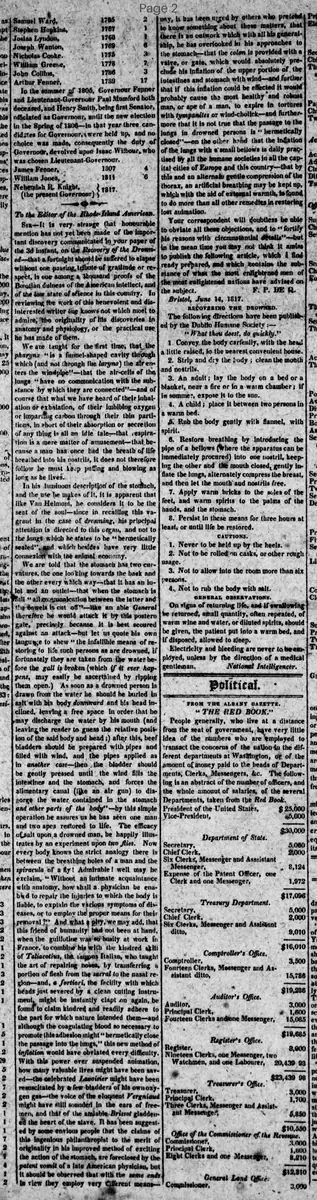
Sir—It is very strange that honourable mention has not yet been made of the important discovery communicated in your paper of the 3d instant, on the Recovery of the Drowned—that a fortnight should be suffered to elapse without one passing tribute of gratitude or respect, is one among a thousand proofs of the Bœotian dulness of the American intellect, and of the low state of science in this country. In reviewing the work of this benevolent and disinterested writer one knows not which most to admire; the originality of his discoveries in anatomy and physiology, or the practical use he has made of them.
We are taught for the first time, that the pharynx 'is a funnel-shaped cavity through which (and not through the larynx) the air enters the windpipe'—that the air-cells of the lungs 'have no communication with the substance by which they are connected'—and of course that what we have heard of their inhalation or exhalation, of their imbibing oxygen or imparting carbon through their thin partitions, in short of their absorption or secretion of any thing is all an idle tale—that respiration is a mere matter of amusement—that because a man has once had the breath of life breathed into his nostrils, it does not therefore follow he must keep puffing and blowing as long as he lives.
In his luminous description of the stomach, and the use he makes of it, it is apparent that like Van Helmont, he considers it to be the seat of the soul—since in recalling this vagrant in the case of drowning, his principal attention is directed to this organ, —and not to the lungs which he states to be 'hermetically sealed', and which besides have very little connexion with, the animal economy.
We are told that the stomach has two curvatures, the one looking towards the back and the other every which way—that it has an inlet and an outlet—that when the stomach is full 'all communication between the latter and the bowels is cut off' like an able General therefore he would attack it by this postern gate, precisely because it is best secured against an attack—but let us quote his own language to shew 'the infallible means of restoring to life such persons as are drowned, if fortunately they are taken from the water before the gall is broken (which if it ever happens, may easily be ascertained by ripping them open.) As soon as a drowned person is drawn from the water he should be buried in salt' with his body downward and his head inclined, leaving a free space in order that he may discharge the water by his mouth (and leaving the reader to guess the relative position of the said body and head ;) after this, beef bladders should be prepared with pipes and filled with wind, and the pipes applied as in another case—then the bladder should be gently pressed until the wind fills the intestines and the stomach, and forces the alimentary canal (like an air gun) to discharge the water contained in the stomach and other parts of the body'—by this simple operation he assures us he has seen one man and two apes restored to life. The efficacy of salt upon a drowned man, he happily illustrates by an experiment upon two flies. Now every body knows the strict analogy there is between the breathing holes of a man and the spiracula of a fly! Admirable! well may he exclaim, 'Without an intimate acquaintance with anatomy, how shall a physician be enabled to repair the injuries to which the body is liable, to explain the various symptoms of diseases, or to employ the proper means for their removal ?' And what a pity, we may add, that this friend of humanity had not been at hand, when the guillotine was so busily at work in France, to combine his with the kindred skill of Taliacotius, the famous Italian, who taught the art of repairing noses, by transferring a portion of flesh from the sacral to the nasal region—and, a fortiori, the facility with which heads just severed by a clean cutting instrument, might be instantly clapt on again, be found to claim kindred and readily adhere to the part for which nature intended them—and although the coagulating blood so necessary to promote this adhesion might 'hermetically close the passage into the lungs,' this new method of inflation would have obviated every difficulty.
With this power over suspended animation, how many valuable lives might have been saved—the celebrated Lavoisier might have been resuscitated by new bladders of his own oxygen gas—the voice of the eloquent Vergniaud might have still sounded in the ear of freemen, and that of the amiable Brissot gladdened the heart of the slave. It has been suggested by some envious people that the claims of this ingenious philanthropist to the merit of originality in his improved method of exciting the action of the stomach, are foreclosed by the patent vomit of a late American physician, but it should be observed that with the same ends in view they employ very different means—
way, it has been urged by others who pretend to know something about these matters, that there is an outwork which with all his generalship, he has overlooked in his approaches to the stomach—that the colon is provided with a valve, or gate, which, would absolutely preclude his inflation of the upper portion of, the intestines and stomach with wind—and further that if this inflation could be effected it would probably cause the most healthy and robust man, or ape of a man, to expire in tortures with tympanites or wind-cholick—and furthermore that it is not true that the passage to the lungs in drowned persons is 'hermetically closed'—on the other hand that the inflation of the lungs with a small bellows is daily practised by all the humane societies in all the capital cities of Europe and this country—that by this and an alternate gentle compression of the thorax, an artificial breathing may be kept up. which with the aid of external warmth, is found to do more than all other remedies in restoring lost animation.
Your correspondent will doubtless be able to obviate all these objections, and to 'fortify his reasons with circumstantial details'. but in the mean time you may not think it amiss to publish the following article, which I find ready prepared, and which contains the substance of what the most enlightened men of the most enlightened nations have advised on the subject.
F.P.DER.
Bristol, June 14, 1817.
RECOVERING THE DROWNED.
The following directions have been published by the Dublin Humane Society :—
'What thou doest, do quickly.'
1. Convey the body carefully, with the head a little raised, to the nearest convenient house.
2. Strip and dry the body; clean the mouth and nostrils.
3. An adult; lay the body on a bed or a blanket, near a fire or in a warm chamber; if in summer, expose it to the sun.
4. A child; place it between two persons in a warm bed.
5. Rub the body gently with flannel, with spirit.
6. Restore breathing by introducing the pipe of a bellows (where the apparatus can be immediately procured) into one nostril, keeping the other and the mouth closed, gently inflate the lungs, alternately compress the breast, and then let the mouth and nostrils free.
7. Apply warm bricks to the soles of the feet, and warm spirits to the palms of the hands, and the stomach.
8. Persist in these means for three hours at least, or until life be restored.
CAUTIONS.
1. Never to be held up by the heels.
2. Not to be rolled on casks, or other rough usage.
3. Not to allow into the room more than six persons.
4. Not to rub the body with salt.
GENERAL OBSERVATIONS.
On signs of returning life, and if swallowing be returned, small quantity, often repeated, of warm wine and water, or diluted spirits, should be given, the patient put into a warm bed, and if disposed, allowed to sleep.
Electricity and bleeding are never to be employed, unless by the direction of a medical gentleman.
What sub-type of article is it?
What themes does it cover?
What keywords are associated?
What entities or persons were involved?
Letter to Editor Details
Author
F.P.Der., Bristol, June 14, 1817
Recipient
To The Editor Of The Rhode Island American
Main Argument
the letter satirically criticizes the absurd anatomical claims and impractical methods in a recent article on recovering drowned persons, contrasting them with established procedures from the dublin humane society.
Notable Details