Thank you for visiting SNEWPapers!
Sign up free
Editorial
June 19, 1840
The Arkansas State Democrat, And Helena Commercial Advertiser
Helena, Phillips County, Arkansas
What is this article about?
An Arkansas editorial criticizes Federal Whig leaders Preston and McPherson for defending Gen. Harrison's approval of the 1807 property qualification law, arguing it was not compelled by congressional ordinance and that Harrison had discretion to veto it. Excerpts an Indiana paper debunking Whig excuses.
Clipping
OCR Quality
95%
Excellent
Full Text
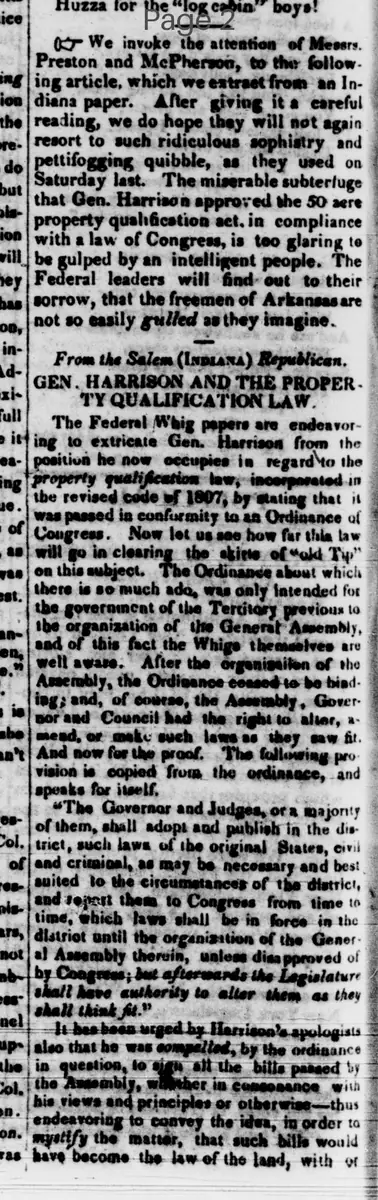
We invoke the attention of Messrs. Preston and McPherson, to the following article, which we extract from an Indiana paper. After giving it a careful reading, we do hope they will not again resort to such ridiculous sophistry and pettifogging quibble, as they used on Saturday last. The miserable subterfuge that Gen. Harrison approved the 50 acre property qualification act, in compliance with a law of Congress, is too glaring to be gulped by an intelligent people. The Federal leaders will find out to their sorrow, that the freemen of Arkansas are not so easily gulled as they imagine.
From the Salem (Indiana) Republican.
GEN. HARRISON AND THE PROPERTY QUALIFICATION LAW.
The Federal Whig papers are endeavoring to extricate Gen. Harrison from the position he now occupies in regard to the property qualification law, incorporated in the revised code of 1807, by stating that it was passed in conformity to an Ordinance of Congress. Now let us see how far this law will go in clearing the skirts of "old Tip" on this subject. The Ordinance about which there is so much ado, was only intended for the government of the Territory previous to the organization of the General Assembly, and of this fact the Whigs themselves are well aware. After the organization of the Assembly, the Ordinance ceased to be binding; and, of course, the Assembly, Governor and Council had the right to alter, amend, or make such laws as they saw fit.
And now for the proof. The following provision is copied from the ordinance, and speaks for itself
"The Governor and Judges, or a majority of them, shall adopt and publish in the district, such laws of the original States, civil and criminal, as may be necessary and best suited to the circumstances of the district, and report them to Congress from time to time, which laws shall be in force in the district until the organization of the General Assembly therein, unless disapproved of by Congress; but afterwards the Legislature shall have authority to alter them as they shall think fit."
It has been urged by Harrison's apologists also that he was compelled by the ordinance in question, to sign all the bills passed by the Assembly, whether in consonance with his views and principles or otherwise—thus endeavoring to convey the idea, in order to mystify the matter, that such bills would have become the law of the land, with or without his signature.
From the Salem (Indiana) Republican.
GEN. HARRISON AND THE PROPERTY QUALIFICATION LAW.
The Federal Whig papers are endeavoring to extricate Gen. Harrison from the position he now occupies in regard to the property qualification law, incorporated in the revised code of 1807, by stating that it was passed in conformity to an Ordinance of Congress. Now let us see how far this law will go in clearing the skirts of "old Tip" on this subject. The Ordinance about which there is so much ado, was only intended for the government of the Territory previous to the organization of the General Assembly, and of this fact the Whigs themselves are well aware. After the organization of the Assembly, the Ordinance ceased to be binding; and, of course, the Assembly, Governor and Council had the right to alter, amend, or make such laws as they saw fit.
And now for the proof. The following provision is copied from the ordinance, and speaks for itself
"The Governor and Judges, or a majority of them, shall adopt and publish in the district, such laws of the original States, civil and criminal, as may be necessary and best suited to the circumstances of the district, and report them to Congress from time to time, which laws shall be in force in the district until the organization of the General Assembly therein, unless disapproved of by Congress; but afterwards the Legislature shall have authority to alter them as they shall think fit."
It has been urged by Harrison's apologists also that he was compelled by the ordinance in question, to sign all the bills passed by the Assembly, whether in consonance with his views and principles or otherwise—thus endeavoring to convey the idea, in order to mystify the matter, that such bills would have become the law of the land, with or without his signature.
What sub-type of article is it?
Partisan Politics
Suffrage
What keywords are associated?
Property Qualification Law
Gen. Harrison
Federal Whigs
Voting Rights
Congressional Ordinance
Arkansas Freemen
What entities or persons were involved?
Gen. Harrison
Messrs. Preston And Mcpherson
Federal Whigs
Freemen Of Arkansas
Salem Republican
Editorial Details
Primary Topic
Critique Of Gen. Harrison's Role In The 1807 Property Qualification Law
Stance / Tone
Strongly Anti Harrison And Anti Whig, Defending Voting Rights Of Freemen
Key Figures
Gen. Harrison
Messrs. Preston And Mcpherson
Federal Whigs
Freemen Of Arkansas
Salem Republican
Key Arguments
Harrison's Approval Of The Property Qualification Act Was Not Compelled By Congressional Ordinance
The Ordinance Only Governed Before The General Assembly's Organization And Ceased To Bind Afterward
The Assembly, Governor, And Council Had Full Authority To Alter Laws Post Organization
Harrison Was Not Required To Sign Bills Against His Principles; Veto Was Possible
Whig Defenses Are Sophistry And Subterfuge To Mislead The Public