Thank you for visiting SNEWPapers!
Sign up free
Domestic News
March 29, 1838
Staunton Spectator, And General Advertiser
Staunton, Virginia
What is this article about?
Advice for farmers on spring harrowing of winter grain to close fissures, pulverize soil, and promote plant tillering, with recommendation to sow 8-10 pounds of clover seed per acre beforehand for soil fertility and livestock feed.
Clipping
OCR Quality
98%
Excellent
Full Text
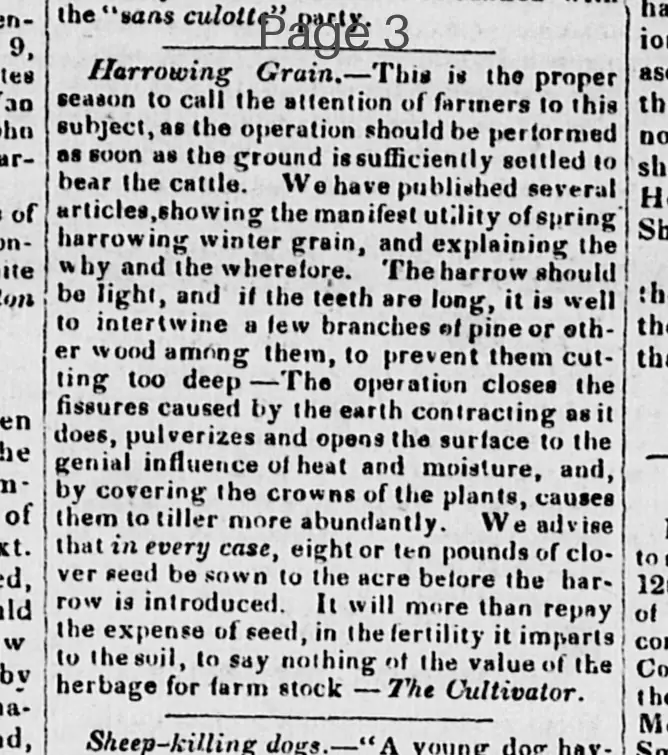
Harrowing Grain.—This is the proper season to call the attention of farmers to this subject, as the operation should be performed as soon as the ground is sufficiently settled to bear the cattle. We have published several articles, showing the manifest utility of spring harrowing winter grain, and explaining the why and the wherefore. The harrow should be light, and if the teeth are long, it is well to intertwine a few branches of pine or other wood among them, to prevent them cutting too deep—The operation closes the fissures caused by the earth contracting as it does, pulverizes and opens the surface to the genial influence of heat and moisture, and, by covering the crowns of the plants, causes them to tiller more abundantly. We advise that in every case, eight or ten pounds of clover seed be sown to the acre before the harrow is introduced. It will more than repay the expense of seed, in the fertility it imparts to the soil, to say nothing of the value of the herbage for farm stock — The Cultivator.
What sub-type of article is it?
Agriculture
What keywords are associated?
Harrowing Grain
Winter Grain
Clover Seed
Spring Farming
Soil Fertility
Domestic News Details
Event Details
Advice on performing spring harrowing of winter grain using a light harrow, possibly with intertwined branches to avoid deep cutting, to close earth fissures, pulverize surface, expose to heat and moisture, and cover plant crowns for better tillering; recommend sowing 8-10 pounds of clover seed per acre beforehand for soil fertility and livestock feed.