Thank you for visiting SNEWPapers!
Sign up free
The New Hampshire Gazette
Portsmouth, Rockingham County, New Hampshire
What is this article about?
Proceedings of the U.S. House of Representatives on Feb. 14 and 17, including committee appointments, debates on suspending commercial intercourse with France, amendments proposed and negatived, petitions, and resolutions on various matters like bonds, drawbacks, and the Nash/Robbins case.
Clipping
OCR Quality
Full Text
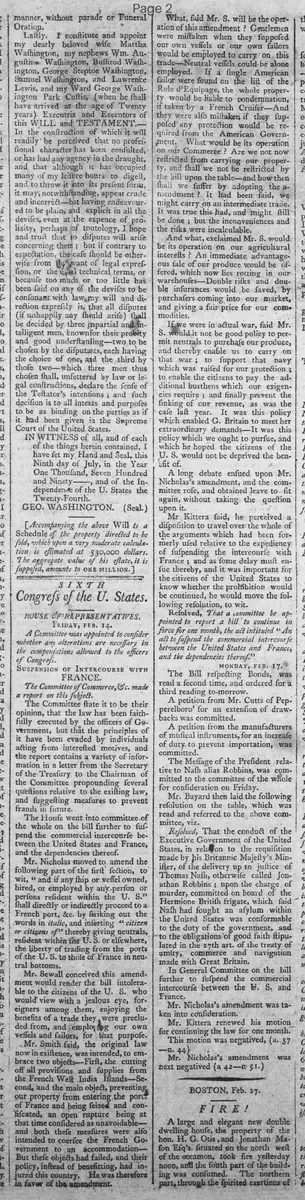
A Committee was appointed to consider whether any alterations are necessary in the compensations allowed to the officers of Congress.
Suspension of Intercourse with FRANCE.
The Committee of Commerce, &c. made a report on this subject. The Committee state it to be their opinion, that the law has been faithfully executed by the officers of Government, but that the principles of it have been evaded by individuals acting from interested motives, and the report contains a variety of information in a letter from the Secretary of the Treasury to the Chairman of the Committee propounding several questions relative to the existing law, and suggesting measures to prevent frauds in future.
The House went into committee of the whole on the bill further to suspend the commercial intercourse between the United States and France, and the dependencies thereof.
Mr. Nicholas moved to amend the following part of the first' section, to wit, " and if any ship or vessel owned, hired, or employed by any person or persons resident within. the U. S." shall directly or indirectly proceed to a French port, &c. by striking out the words in italic, and inserting " citizen or citizens of" thereby giving neutrals, resident within the U. S. or elsewhere, the liberty of trading from the ports of the U. S. to those of France in neutral bottoms.
Mr. Sewall conceived this amendment would render the bill intolerable to the citizens of the U. S. who would view with a jealous eye, foreigners among them, enjoying the benefits of a trade they were precluded from, and employing our own vessels and sailors. for that purpose.
Mr. Smith said, the original law now in existence, was intended, to embrace two objects--First, the cutting off all provisions and supplies from the French West India Islands--Second, and the main object, preventing our property from entering the ports of France and being seized and confiscated, an open rupture being at that time considered as unavoidable-- and both these measures were also intended to coerce the French Government to an accommodation-- But these objects had failed, and their policy, instead of benefitting, had injured this country. He was therefore in favor of the amendment.
What. said Mr. S. will be the operation of this amendment ? Gentlemen were mistaken when they supposed our own vessels or our own sailors would be employed to carry on this trade Neutral vessels could be alone employed. If a single American sailor were found on the list of the Role d'Equipage, the whole property would be liable to condemnation, if taken by a French Cruiser--And they were also mistaken if they supposed any protection would be required from the American Government. What would be its operation on our Commerce ? Are we not now restricted from carrying our property, and shall we not be restricted by the bill upon the table--and how then shall we suffer by adopting the amendment ? It hiad been said, we might carry on an intermediate trade. It was true this had, and might still be done : but the inconveniences and the risks were incalculable. . And what, exclaimed Mr. S. would be its operation on our agricultural interests ? An immediate advantageous sale of our produce would be offered, which now lies rotting in our warehouses--Double risks and double insurances would be saved, by purchasers coming into our market, and giving a fair price for our commodities.
If we were in actual war, said Mr. S. would it not be good policy to permit neutrals to purchase our produce, and thereby enable us to carry on that war.; to support that navy which was raised for our protection ; to enable the citizens to pay the additional burthens which our exigencies require ; and finally prevent the sinking of our revenue, as was the case last year. It was. this policy which enabled G. Britain to meet her extraordinary demands--It was this policy which we ought to pursue, and which he hoped the citizens of the U. S. would not be deprived the benefit of. R
A long debate ensued upon Mr. Nicholas's amendment, and the committee rose, and obtained leave to sit again, without taking the question upon it.
Mr Kittera said, he perceived a disposition to travel over the whole of the arguments which had been formerly used relative to the expediency of suspending the intercourse with France ; and as some delay must ensue thereby, and it was important for the citizens of the United States to know whether the prohibition would be continued, he would move the following resolution, to wit.
Resolved, That a committee be appointed to report a bill'to continue in force for one month, the act intituled " An act to suspend the commercial intercourse between the United States and France, and the dependencies thereof."
MONDAY, FEB. 17.
The Bill respecting Bonds, was read a second time, and ordered for a third reading to-morrow.
A petition from Mr. Cutts of Pepperelboro' for an extension of drawbacks was committed.
A petition from the manufacturers of musical instruments, for an increase of duty to prevent importation, was committed.
The Message of the President relative to Nash alias Robbins, was committed to the committee of the whole for consideration on Friday.
Mr. Bayard then laid the following resolution on the table, which was read and referred to the above committee, viz.
Resolved, That the conduct of the Executive Government of the United States, in relation to the requisition made by his Britannic Majesty's Minister, of the delivery up to justice of Thomas Nash, otherwise called Jonathan Robbins ; upon the charge of murder, committed on board of the Hermione British frigate, which said Nash had sought an asylum within the United States was conformable to the duty of the government, and to the obligations of good faith stipulated in the 27th art. of the treaty of amity, commerce and navigation made with Great Britain.
In General Committee on the bill further to suspend the commercial intercourse between the U. S. and France.
Mr. Nicholas's amendment was taken into consideration.
Mr. Kittera renewed his motion for continuing the law for one month.
This motion was negatived, (a. 37 -n. 44
Mr. Nicholas's amendment was next negatived (a 42-n 51.)
What sub-type of article is it?
What keywords are associated?
What entities or persons were involved?
Where did it happen?
Domestic News Details
Primary Location
United States
Event Date
Friday, Feb. 14. And Monday, Feb. 17.
Key Persons
Outcome
mr. kittera's motion to continue the law for one month negatived (37-44); mr. nicholas's amendment negatived (42-51). various petitions and bills committed; resolutions laid on table.
Event Details
House of Representatives proceedings: Committee appointed on officer compensations; report on suspension of intercourse with France; debate on bill to further suspend commercial intercourse, including Mr. Nicholas's amendment to allow neutrals to trade; long debate; motion to continue existing act for one month; on Feb. 17, bills read, petitions from Mr. Cutts and musical instrument manufacturers committed; President's message on Nash/Robbins committed; Mr. Bayard's resolution on executive conduct regarding Nash/Robbins; continuation of debate with motions negatived.