Thank you for visiting SNEWPapers!
Sign up free
Richmond Enquirer
Richmond, Richmond County, Virginia
What is this article about?
South Carolina Legislature met on November 22, electing O'Neale as House Speaker and Pope as Senate President without opposition. Electoral vote favored Gen. Jackson. Governor Wilson's message warned against federal consolidation and urged wise selection of electors and senator.
Clipping
OCR Quality
Full Text
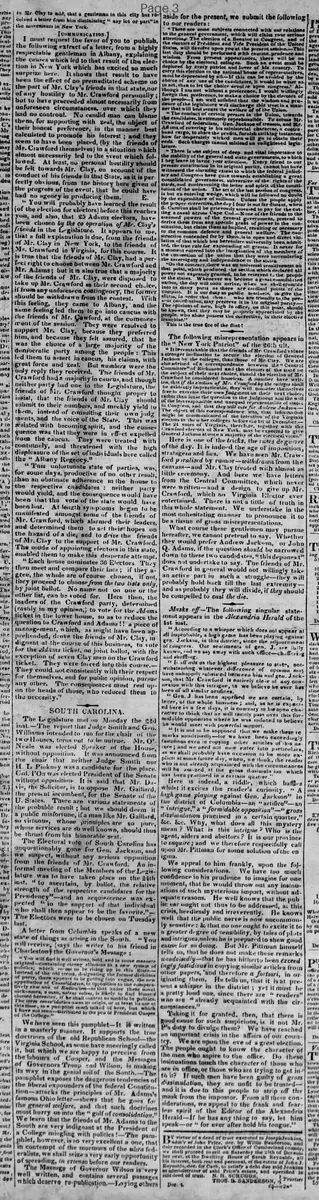
The Legislature met on Monday the 22d inst.—The report that Judge Smith and Gen. Williams intended to run for the chair of the two houses, turns out to be untrue. Mr. O'Neale was elected Speaker of the House, without opposition. It was announced from the chair that neither Judge Smith nor H. L. Pinckney was a candidate for the place. Col. Pope was elected President of the Senate without opposition. It is said that Mr. Davis, the Solicitor, is to oppose Mr. Gaillard, the present incumbent, for the Senate of the U. States. There are various statements of the probable result; but we should deem it a public misfortune, if a man like Mr. Gaillard, so virtuous, whose principles are so pure, whose services are so well known, should thus be thrust from his honorable seat.
The Electoral vote of South Carolina has unquestionably gone for Gen. Jackson, and we suspect, without any serious opposition from the friends of Mr. Crawford. An informal meeting of the Members of the Legislature was to have taken place on the 24th inst. "to ascertain, by ballot, the relative strength of the respective candidates for the Presidency"—and an acquiescence was expected "in the support of that individual who shall then appear to be the favorite."—The Electors were to be chosen on Tuesday last.
A letter from Columbia speaks of a new state of things as arising in the South. "You will receive, (says the writer to his friend in Charleston) the Governor's Message: You will find it well written, bold, and in some measure original—containing strong allusions to a new system of politics; which seems to be rising up in this State.—Instead of the old terms, designating the former divisions of party, there appears to be getting into vogue, the new appellation of Consolidation, in opposition to the comparatively new one of Radicalism—so that under these novel nicknames, a man, nolens volens, is likely to find himself classed hereafter, if he shall consent to meddle in politics. The term consolidation owes its origin, or at least its use at this time, to a pamphlet much talked of here, but which I have not seen—attributed to the pen of President Cooper of the College."
We have seen this pamphlet—It is written in a masterly manner. It supports the true doctrines of the old Republican School—the Virginia School, as some have sneeringly called it, but which we are happy to perceive from the labours of Cooper, and the Messages of Governors Troup and Wilson, is making its way in the genial soil of the South.—The pamphlet exposes the dangerous tendencies of the liberal expounders of the federal Constitution—attacks the principles of Mr. Adams's famous Ohio letter—shews that he goes for the general welfare, and that such doctrines must hurry us into the "gulf of consolidation."
We learn that the friends of Mr. Adams to the South are very indignant at the President of a College mingling with politics!—The pamphlet, however, is so very excellent a one, that in contempt of the murmurs of the ultra federalists, we shall seize a very early opportunity of spreading, in extenso before our readers.
The Message of Governor Wilson is very well written, and contains several passages which deserve re-publication.—Laying others aside for the present, we submit the following to our readers:
"There are some subjects connected with our relations to the general government, which will claim your serious attention. The election of a Senator to Congress, and of the electors of President and Vice President of the United States, will devolve upon you at the present session.—This last duty should be performed with caution, prudence and wisdom. From present appearances, there will be no choice by the electoral colleges. Such an event must be deplored by every patriot and lover of his country. To carry this election to the national house of representatives, must be deprecated by all.—If this can be avoided by the choice of any one of the candidates, it would be wiser so to act, than to let the choice devolve upon congress." Although I am not without a preference, I would willingly forego that preference, to make a choice by the electors of the people—I am well satisfied that the wisdom and prudence of the legislature will discharge this trust in a manner that will best secure the welfare of the Union.
The conduct of certain individuals in the Union, towards the candidates, is extremely reprehensible. To accuse Mr. Crawford of federalism, Gen. Jackson of treason, and Mr. Adams of covering in his ministerial character, a contraband cargo, to share the profits, furnishes striking instances, how far desperately wicked men will go to obtain their ends. But cannot mislead an enlightened legislature.
There is one subject of deep and vital importance to the stability of the general and state governments, to which I beg leave to invite your attention. Every friend to our present constitution in its original purity, cannot but have witnessed the alarming extent to which the federal judiciary and Congress have gone towards establishing a great consolidated government, subversive of the rights of the states, and contravening the letter and spirit of the constitution of the union. The act of the last session of congress, is but an entering wedge, which will be followed no doubt by the expenditure of millions. Unless the people apply the proper corrective, the day I fear is not far distant, when S. Carolina shall be grievously assessed to pay for the cutting a canal across Cape Cod.—None of the friends to the assumed powers of the general government, pretend to derive them from any specific grant of power in the constitution, but claim them as implied, resulting or necessary to the common defence and general welfare. The construction contended for by them, is in open and direct violation of that which has heretofore universally been admitted, the true rule for expounding all grants. It never entered into the imagination of the members of the convention of the union that they were surrendering the sovereignty and independence of the states. It never for "On the contrary, there was an universal sensitiveness on that point, which produced the section which declared all power not expressly granted, to be reserved to the people or the states. Whenever we become a great consolidated nation, the day will soon arrive, when we shall crumble into as many parts as there are cardinal points of the compass. It is our duty as public sentinels, to give the alarm, in order that those who are friendly to the present constitution, may preserve it in its original purity.—The opinions of men, high in office, on this point, should be known, that they may be properly appreciated by the people, who alone possess the corrective, in their elective franchise."
What sub-type of article is it?
What keywords are associated?
What entities or persons were involved?
Where did it happen?
Domestic News Details
Primary Location
South Carolina
Event Date
Monday The 22d Inst.
Key Persons
Outcome
o'neale elected speaker without opposition; pope elected senate president without opposition; electoral vote for gen. jackson; discussion of new political terms 'consolidation' vs. 'radicalism'; governor warns against federal consolidation.
Event Details
The South Carolina Legislature met, electing officers and discussing U.S. Senate and presidential electors. A pamphlet by President Cooper critiques federalism. Governor Wilson's message urges caution in elections and opposes consolidation of power in the federal government.