Thank you for visiting SNEWPapers!
Sign up free
Daily National Intelligencer
Washington, District Of Columbia
What is this article about?
In the British House of Commons on June 1, debate on renewing the East India Company's charter focused on maintaining its exclusive tea trade to China while restricting direct British merchant trade. Mr. Marryatt opposed the monopoly, highlighting its economic harms, historical abuses, and threats to naval supremacy.
Clipping
OCR Quality
Full Text
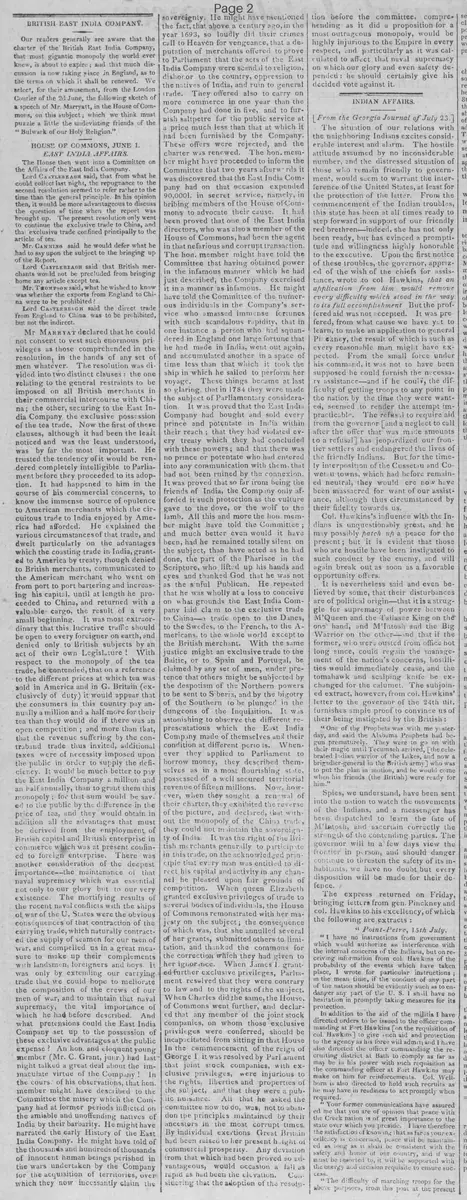
Our readers generally are aware that the charter of the British East India Company, that most gigantic monopoly the world ever knew, is about to expire: and that much discussion is now taking place in England, as to the terms on which it shall be renewed. We select, for their amusement, from the London Courier of the 2d June, the following sketch of a speech of Mr. Marryatt, in the House of Commons, on this subject; which we think must puzzle a little the undeviating friends of the "Bulwark of our Holy Religion."
HOUSE OF COMMONS. JUNE 1.
EAST INDIA AFFAIRS
The House then went into a Committee on the Affairs of the East India Company.
Lord Castlereagh said, that from what he could collect last night, the repugnance to the second resolution seemed to refer rather to the time than the general principle. In his opinion then, it would be more advantageous to discuss the question of time when the report was brought up. The present resolution only went to continue the exclusive trade to China, and that exclusive trade confined principally to the article of tea.
Mr. Canning said he would defer what he had to say upon the subject to the bringing up of the Report.
Lord Castlereagh said that British merchants would not be precluded from bringing home any article except tea.
Mr. Thompson said, what he wished to know was whether the exports from England to China were to be prohibited?
Lord Castlereagh said the direct trade from England to China was to be prohibited, but not the indirect.
Mr. Marryatt declared that he could not consent to vest such enormous privileges as those comprehended in the resolution, in the hands of any set of men whatever. The resolution was divided into two distinct clauses: the one relating to the general restraints to be imposed on all British merchants in their commercial intercourse with China; the other, securing to the East India Company the exclusive possession of the tea trade. Now the first of these clauses, although it had been the least noticed and was the least understood, was by far the most important. He trusted the tendency of it would be rendered completely intelligible to Parliament before they proceeded to its adoption. It had happened to him in the course of his commercial concerns, to know the immense source of opulence to American merchants which the circuitous trade to India enjoyed by America had afforded. He explained the various circumstances of that trade, and dwelt particularly on the advantages which the coasting trade in India, granted to America by treaty, though denied to British merchants, communicated to the American merchant who went on from port to port bartering and increasing his capital, until at length he proceeded to China, and returned with a valuable cargo, the result of a very small beginning. It was most extraordinary that this lucrative traffic should be open to every foreigner on earth, and denied only to British subjects by an act of their own Legislature! With respect to the monopoly of the tea trade, he contended, that on a reference to the different prices at which tea was sold in America and in G. Britain (exclusively of duty) it would appear that the consumers in this country pay annually a million and a half more for their tea than they would do if there was an open competition; and more than that, that the revenue suffering by the contraband trade thus invited, additional taxes were of necessity imposed upon the public in order to supply the deficiency. It would be much better to pay the East India Company a million and a half annually, than to grant them this monopoly; for that sum would be saved to the public by the difference in the price of tea, and they would obtain in addition all the advantages that must be derived from the employment of British capital and British enterprise in commerce which was at present confined to foreign enterprise. There was another consideration of the deepest importance--the maintenance of that naval supremacy which was essential not only to our glory but to our very existence. The mortifying results of the recent naval conflicts with the ships of war of the U. States were the obvious consequences of that contraction of the carrying trade, which naturally contracted the supply of seamen for our men of war, and compelled us in a great measure to make up their complements with landsmen, foreigners and boys. It was only by extending our carrying trade that we could hope to meliorate the composition of the crews of our men of war, and to maintain that naval supremacy, the vital importance of which he had before described. And what pretensions could the East India Company set up to the possession of these exclusive advantages at the public expense? An hon. and eloquent young member (Mr. C. Grant, junr.) had last night talked a great deal about the immaculate virtue of the Company! In the course of his observations, that hon. member might have described to the Committee the misery which the Company had at former periods inflicted on the amiable and unoffending natives of India by their barbarity. He might have narrated the early History of the East India Company. He might have told of the thousands and hundreds of thousands of innocent human beings perished in the wars undertaken by the Company for the acquisition of territories, over which they now incessantly claim the sovereignty. He might have mentioned the fact, that above a century ago, in the year 1693, so loudly did their crimes call to Heaven for vengeance, that a deputation of merchants offered to prove to Parliament that the acts of the East India Company were scandal to religion, dishonor to the country, oppression to the natives of India, and ruin to general trade. They offered also to carry on more commerce in one year than the Company had done in five, and to furnish saltpetre for the public service at a price much less than that at which it had been furnished by the Company. These offers were rejected, and the charter was renewed. The hon. member might have proceeded to inform the Committee that two years afterwards it was discovered that the East India Company had on that occasion expended 90,000l. in secret service, namely, in bribing members of the House of Commons to advocate their cause. It had been proved that one of the East India directors, who was also a member of the House of Commons, had been the agent in that nefarious and corrupt transaction. The hon. member might have told the Committee that having obtained power in the infamous manner which he had just described, the Company exercised it in a manner as infamous. He might have told the Committee of the numerous individuals in the Company's service who amassed immense fortunes with such scandalous rapidity, that in one instance a person who had squandered in England one large fortune that he had made in India, went out again, and accumulated another in a space of time less than that which it took the ship in which he sailed to perform her voyage. These things became at last so glaring, that in 1784 they were made the subject of Parliamentary consideration. It was proved that the East India Company had bought and sold every prince and potentate in India within their reach; that they had violated every treaty which they had concluded with these powers; and that there was no prince or potentate who had entered into any communication with them, that had not been ruined by the connexion. It was proved that so far from being the friends of India, the Company only afforded it such protection as the vulture gave to the dove, or the wolf to the lamb. All this and more the hon. member might have told the Committee; and much better even would it have been, had he remained totally silent on the subject, than have acted as he had done, the part of the Pharisee in the Scripture, who lifted up his hands and eyes and thanked God that he was not as the sinful Publican. He repeated that he was wholly at a loss to conceive on what grounds the East India Company laid claim to the exclusive trade to China--a trade open to the Danes, to the Swedes, to the French, to the Americans, to the whole world except to the British merchant. With the same justice might an exclusive trade to the Baltic, or to Spain and Portugal, be claimed by any set of men, under pretence that others might be subjected by the despotism of the Northern powers to be sent to Siberia, and by the bigotry of the Southern to be plunged in the dungeons of the Inquisition. It was astonishing to observe the different representations which the East India Company made of themselves and their condition at different periods. Whenever they applied to Parliament to borrow money, they described themselves as in a most flourishing state, possessed of a well secured territorial revenue of fifteen millions. Now, however, when they sought a renewal of their charter, they exhibited the reverse of the picture, and declared, that without the monopoly of the China trade, they could not maintain the sovereignty of India. It was the right of the British merchants generally to participate in this trade, on the acknowledged principle that every man was entitled to direct his capital and activity in any channel he pleased upon fair grounds of competition. When queen Elizabeth granted exclusive privileges of trade to several bodies of individuals, the House of Commons remonstrated with her majesty on the subject; the consequence of which was, that she annulled several of her grants, submitted others to limitation, and thanked the commons for the correction which they had given to her ignorance. When James I. granted further exclusive privileges, Parliament resolved that they were contrary to law and to the rights of the subject. When Charles did the same, the House of Commons went further, and declared that any member of the joint stock companies, on whom those exclusive privileges were conferred, should be incapacitated from sitting in that House. In the commencement of the reign of George I it was resolved by Parliament that joint stock companies, with exclusive privileges, were injurious to the rights, liberties and properties of the subject, and that they were a public nuisance. All that he asked the committee now to do, was, not to abandon the principles maintained by their ancestors in the most corrupt times. By individual exertions Great Britain had been raised to her present height of commercial prosperity. Any deviation from that which had been proved so advantageous, would occasion a fall as rapid as had been the elevation. Considering that the adoption of the resolution before the committee, comprehending as it did a proposition for a most outrageous monopoly, would be highly injurious to the Empire in every respect, and particularly as it was calculated to affect that naval supremacy on which our glory and even safety depended: he should certainly give his decided vote against it.
What sub-type of article is it?
What keywords are associated?
What entities or persons were involved?
Where did it happen?
Foreign News Details
Primary Location
London
Event Date
June 1
Key Persons
Outcome
mr. marryatt opposed the resolution to continue the east india company's exclusive tea trade to china, arguing it harms british merchants, consumers, and naval strength; no final outcome reported.
Event Details
The House of Commons Committee debated the East India Company's charter renewal, focusing on exclusive trade to China limited to tea. Lord Castlereagh clarified restrictions on direct British trade but allowed indirect. Mr. Marryatt criticized the monopoly's clauses, detailing benefits to American merchants, higher tea prices in Britain, revenue losses from smuggling, historical Company abuses in India including wars, bribery, and treaty violations, and risks to naval supremacy from reduced carrying trade.