Thank you for visiting SNEWPapers!
Sign up free
Story
August 16, 1823
Edwardsville Spectator
Edwardsville, Madison County, Illinois
What is this article about?
Historical medical account of 'Milk Sick' or 'Sick Stomach' disease in western US states like Ohio, Kentucky, Indiana, Illinois, Missouri. Describes symptoms, conjectured causes (e.g., milk from poisoned cattle), and treatments favoring cathartics and yeast over calomel to avoid fatalities.
Clipping
OCR Quality
95%
Excellent
Full Text
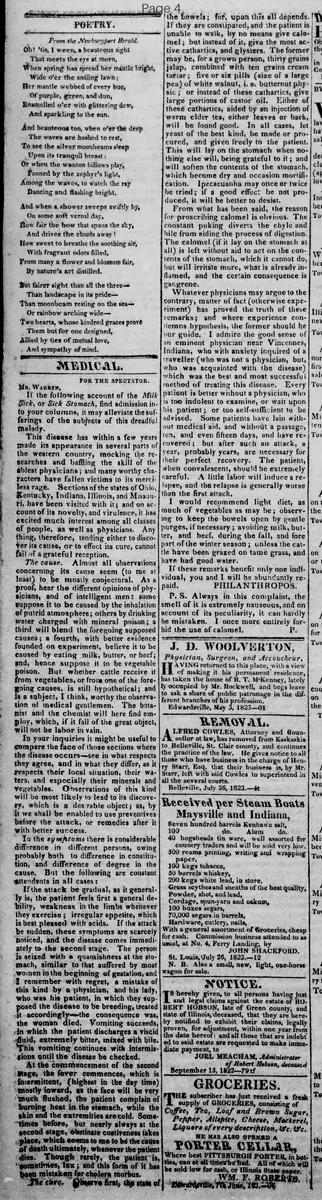
MEDICAL.
FOR THE SPECTATOR.
MR. WARREN,
If the following account of the Milk Sick, or Sick Stomach, find admission into your columns, it may alleviate the sufferings of the subjects of this dreadful malady.
This disease has within a few years made its appearance in several parts of the western country, mocking the researches and baffling the skill of the ablest physicians; and many worthy characters have fallen victims to its merciless rage. Sections of the states of Ohio, Kentucky, Indiana, Illinois, and Missouri, have been visited with it: and on account of its novelty, and virulence, it has excited much interest among all classes of people, as well as physicians. Anything, therefore, tending either to discover its cause, or to effect its cure, cannot fail of a grateful reception.
The cause. Almost all observations concerning its cause seem (to me at least) to be mostly conjectural. As a proof, hear the different opinions of physicians, and of intelligent men: some suppose it to be caused by the inhalation of putrid atmosphere; others by drinking water charged with mineral poison; a third will blend the foregoing supposed causes; a fourth, with better evidence founded on experiment, believe it to be caused by eating milk, butter, or beef: and, hence suppose it to be vegetable poison. But whether cattle receive it from vegetables, or from one of the foregoing causes, is still hypothetical; and is a subject, I think, worthy the observation of medical gentlemen. The Botanist and the chemist will here find employment, which, if it fail of the great object, will not be labor in vain.
In your inquiries it might be useful to compare the face of those sections where the disease occurs--see in what respects they agree, and in what they differ, as it respects their local situation, their waters, and especially their minerals and vegetables. Observations of this kind will be most likely to lead to its discovery, which is a desirable object; as, by it we shall be enabled to use preventives before the attack, or remedies after it with better success.
In the symptoms there is considerable difference in different persons, owing probably both to difference in constitution, and difference of degree in the cause. But the following are constant attendants in all cases:
If the attack be gradual, as it generally is, the patient feels first a general debility, weakness in the limbs whenever they exercise; irregular appetite, which is best pleased with acids. If the attack be sudden, these symptoms are scarcely noticed, and the disease comes immediately to the second stage. The person is seized with a queasiness at the stomach, similar to that suffered by most women in the beginning of gestation, and I remember with regret, a mistake of this kind by a physician, and his lady, who was his patient, in which they supposed the disease to be breeding, treated it accordingly--the consequence was, the woman died. Vomiting succeeds, in which the patient discharges a viscid fluid, extremely bitter, mixed with bile. This vomiting continues with intermissions until the disease be checked.
At the commencement of the second stage; the fever commences, which is intermittent, (highest in the day time) mostly toward evening, as the face will be very much flushed, the patient complain of burning heat in the stomach, while the skin and the extremities are cold. Sometimes before, but nearly always at the second stage, obstinate costiveness takes place, which seems to me to be the cause of death ultimately, whenever the patient dies. Though rarely, the patient is, sometimes, lax; and this form of it has been mistaken for cholera morbus.
The cure. Observe first, the state of the bowels: for upon this all depends. If they are constipated, and the patient is unable to walk, by no means give calomel; but instead of it, give the most active cathartics, and glysters. The former may be, for a grown person, thirty grains jalap, combined with ten grains cream tartar; five or six pills (size of a large pea) of white walnut, i.e. butternut physic; or instead of these cathartics, give large portions of castor oil. Either of these cathartics, aided by an injection of warm elder tea, either leaves or bark, will be found good. In all cases, let yeast of the best kind, be made or procured, and given freely to the patient. This will lay on the stomach when nothing else will, being grateful to it; and will soften the contents of the stomach, which become dry and occasion mortification. Ipecacuanha may once or twice be tried; if a good effect be not produced, it will be better to desist.
From what has been said, the reason for proscribing calomel is obvious. The constant puking diverts the chyle and bile from aiding the process of digestion. The calomel (if it lay on the stomach at all) is left without aid to act on the contents of the stomach, which it cannot do, but will irritate more, what is already inflamed, and the certain consequence is gangrene.
Whatever physicians may argue to the contrary, matter of fact (otherwise experiment) has proved the truth of these remarks; and where experience condemns hypothesis, the former should be our guide. I admire the good sense of an eminent physician near Vincennes, Indiana, who with anxiety inquired of a traveller (who was not a physician, but, who was acquainted with the disease) which was the best and most successful method of treating this disease. Every patient is better without a physician, who is too indolent to examine, or wait upon his patient: or too self-sufficient to be advised. Some patients have lain without medical aid, and without a passage, ten, and even fifteen days, and have recovered; but after such an attack, a year, probably years, are necessary for their perfect recovery. The patient, when convalescent, should be extremely careful. A little labor will induce a relapse, and the relapse is generally worse than the first attack.
I would recommend light diet, as much of vegetables as may be; observing to keep the bowels open by gentle purges, if necessary; avoiding milk, butter, and beef, during the fall, and fore part of the winter season; unless the cattle have been grazed on tame grass, and have had good water.
If these remarks benefit only one individual, you and I will be abundantly repaid.
PHILANTHROPOS.
P. S. Always in this complaint, the smell of it is extremely nauseous, and on account of its peculiarity, it can hardly be mistaken. I once more entirely forbid the use of calomel.
P.
FOR THE SPECTATOR.
MR. WARREN,
If the following account of the Milk Sick, or Sick Stomach, find admission into your columns, it may alleviate the sufferings of the subjects of this dreadful malady.
This disease has within a few years made its appearance in several parts of the western country, mocking the researches and baffling the skill of the ablest physicians; and many worthy characters have fallen victims to its merciless rage. Sections of the states of Ohio, Kentucky, Indiana, Illinois, and Missouri, have been visited with it: and on account of its novelty, and virulence, it has excited much interest among all classes of people, as well as physicians. Anything, therefore, tending either to discover its cause, or to effect its cure, cannot fail of a grateful reception.
The cause. Almost all observations concerning its cause seem (to me at least) to be mostly conjectural. As a proof, hear the different opinions of physicians, and of intelligent men: some suppose it to be caused by the inhalation of putrid atmosphere; others by drinking water charged with mineral poison; a third will blend the foregoing supposed causes; a fourth, with better evidence founded on experiment, believe it to be caused by eating milk, butter, or beef: and, hence suppose it to be vegetable poison. But whether cattle receive it from vegetables, or from one of the foregoing causes, is still hypothetical; and is a subject, I think, worthy the observation of medical gentlemen. The Botanist and the chemist will here find employment, which, if it fail of the great object, will not be labor in vain.
In your inquiries it might be useful to compare the face of those sections where the disease occurs--see in what respects they agree, and in what they differ, as it respects their local situation, their waters, and especially their minerals and vegetables. Observations of this kind will be most likely to lead to its discovery, which is a desirable object; as, by it we shall be enabled to use preventives before the attack, or remedies after it with better success.
In the symptoms there is considerable difference in different persons, owing probably both to difference in constitution, and difference of degree in the cause. But the following are constant attendants in all cases:
If the attack be gradual, as it generally is, the patient feels first a general debility, weakness in the limbs whenever they exercise; irregular appetite, which is best pleased with acids. If the attack be sudden, these symptoms are scarcely noticed, and the disease comes immediately to the second stage. The person is seized with a queasiness at the stomach, similar to that suffered by most women in the beginning of gestation, and I remember with regret, a mistake of this kind by a physician, and his lady, who was his patient, in which they supposed the disease to be breeding, treated it accordingly--the consequence was, the woman died. Vomiting succeeds, in which the patient discharges a viscid fluid, extremely bitter, mixed with bile. This vomiting continues with intermissions until the disease be checked.
At the commencement of the second stage; the fever commences, which is intermittent, (highest in the day time) mostly toward evening, as the face will be very much flushed, the patient complain of burning heat in the stomach, while the skin and the extremities are cold. Sometimes before, but nearly always at the second stage, obstinate costiveness takes place, which seems to me to be the cause of death ultimately, whenever the patient dies. Though rarely, the patient is, sometimes, lax; and this form of it has been mistaken for cholera morbus.
The cure. Observe first, the state of the bowels: for upon this all depends. If they are constipated, and the patient is unable to walk, by no means give calomel; but instead of it, give the most active cathartics, and glysters. The former may be, for a grown person, thirty grains jalap, combined with ten grains cream tartar; five or six pills (size of a large pea) of white walnut, i.e. butternut physic; or instead of these cathartics, give large portions of castor oil. Either of these cathartics, aided by an injection of warm elder tea, either leaves or bark, will be found good. In all cases, let yeast of the best kind, be made or procured, and given freely to the patient. This will lay on the stomach when nothing else will, being grateful to it; and will soften the contents of the stomach, which become dry and occasion mortification. Ipecacuanha may once or twice be tried; if a good effect be not produced, it will be better to desist.
From what has been said, the reason for proscribing calomel is obvious. The constant puking diverts the chyle and bile from aiding the process of digestion. The calomel (if it lay on the stomach at all) is left without aid to act on the contents of the stomach, which it cannot do, but will irritate more, what is already inflamed, and the certain consequence is gangrene.
Whatever physicians may argue to the contrary, matter of fact (otherwise experiment) has proved the truth of these remarks; and where experience condemns hypothesis, the former should be our guide. I admire the good sense of an eminent physician near Vincennes, Indiana, who with anxiety inquired of a traveller (who was not a physician, but, who was acquainted with the disease) which was the best and most successful method of treating this disease. Every patient is better without a physician, who is too indolent to examine, or wait upon his patient: or too self-sufficient to be advised. Some patients have lain without medical aid, and without a passage, ten, and even fifteen days, and have recovered; but after such an attack, a year, probably years, are necessary for their perfect recovery. The patient, when convalescent, should be extremely careful. A little labor will induce a relapse, and the relapse is generally worse than the first attack.
I would recommend light diet, as much of vegetables as may be; observing to keep the bowels open by gentle purges, if necessary; avoiding milk, butter, and beef, during the fall, and fore part of the winter season; unless the cattle have been grazed on tame grass, and have had good water.
If these remarks benefit only one individual, you and I will be abundantly repaid.
PHILANTHROPOS.
P. S. Always in this complaint, the smell of it is extremely nauseous, and on account of its peculiarity, it can hardly be mistaken. I once more entirely forbid the use of calomel.
P.
What sub-type of article is it?
Medical Curiosity
Curiosity
What themes does it cover?
Misfortune
Recovery
What keywords are associated?
Milk Sick
Sick Stomach
Disease
Western Country
Cathartics
Calomel
Vomiting
Fever
Recovery
What entities or persons were involved?
Philanthropos
Where did it happen?
Sections Of The States Of Ohio, Kentucky, Indiana, Illinois, And Missouri
Story Details
Key Persons
Philanthropos
Location
Sections Of The States Of Ohio, Kentucky, Indiana, Illinois, And Missouri
Event Date
Within A Few Years
Story Details
Account of the Milk Sick disease, its conjectured causes linked to milk and cattle, symptoms including debility, vomiting, fever, and costiveness, and recommended cures using cathartics, yeast, and avoiding calomel to prevent death.