Thank you for visiting SNEWPapers!
Sign up free
Norfolk Gazette And Publick Ledger
Norfolk, Virginia
What is this article about?
Report from The Washington Federalist on a heated House debate following Judge Chase's Senate acquittal on March 1. Randolph and Nicholson propose resolutions censuring the Senate and altering the Constitution to subordinate it and the judiciary to the House, sparking criticism of demagoguery and threats to liberty.
Clipping
OCR Quality
Full Text
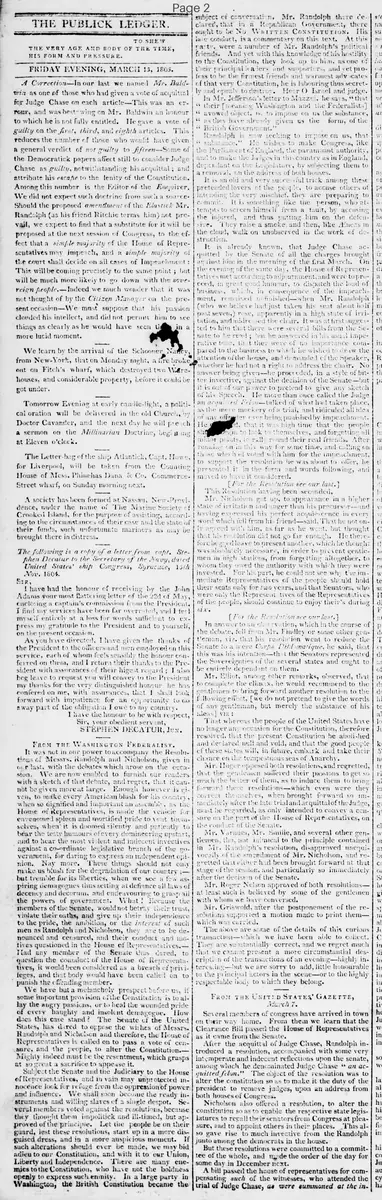
It was not in our power to accompany the Resolutions of Messrs. Randolph and Nicholson, given in our last, with the debates which arose on the occasion. We are now enabled to furnish our readers with a sketch of that debate, and regret, that it cannot be given more at large. Enough however is given, to make every American blush for his country, when so dignified and important an assembly, as the House of Representatives, is made the vehicle for envenomed spleen and mortified pride to vent themselves, when it is doomed silently and patiently to bear the testy humours of every domineering upstart, and to hear the most violent and indecent invectives against a co-ordinate legislative branch of the government, for daring to express an independent opinion. Nay more. These things should not only make us blush for the degradation of our country;—but tremble for its liberties, when we see a few aspiring demagogues thus setting at defiance all laws of decency and decorum, and endeavouring to grasp all the powers of government. What! Because the members of the Senate, would not betray their trust, violate their oaths, and give up their independence to the pride, the ambition, or the interest of such men as Randolph and Nicholson, they are to be denounced and censured, and their conduct and motives questioned in the House of Representatives.—Had any member of the Senate thus dared, to question the conduct of the House of Representatives, it would been considered as a breach of privileges, and that body would have been called on to punish the offending member.
We have but a melancholy prospect before us, if some important provision of the Constitution is to allay the angry passions, or to heal the wounded pride of every haughty and insolent demagogue. How does this case stand? The Senate of the United States, has dared to oppose the wishes of Messrs. Randolph and Nicholson and therefore, the House of Representatives is called on to pass a vote of censure, and the people, to alter the Constitution.—Mighty indeed must be the resentment, which grasps at so great a sacrifice to appease it.
Subject the Senate and the Judiciary to the House of Representatives, and in vain may unprotected innocence look for refuge from the oppression of power and influence. We shall soon become the ready instruments and willing slaves of a single despot. "Several members voted against the resolutions, because they thought them impolitick and ill-timed, but approved of the principle. Let the people be on their guard, lest these resolutions, start up in a more disguised dress, and in a more auspicious moment. If such alterations should ever be made, we may bid adieu to our Constitution, and with it to our Union, Liberty and Independence. There are many enemies to the Constitution, who have not the boldness openly to express such enmity. In a large party in Washington, the British Constitution became the subject of conversation. Mr. Randolph there declared, that in a Republican Government, there ought to be No WRITTEN Constitution. His late conduct, is a commentary on this text. At this party, were a number of Mr. Randolph's political friends. — And yet with this knowledge of his hostility to the Constitution, they look up to him, as one of their principal leaders and supporters, and yet profess to be the firmest friends and warmest advocates of that very Constitution, he is labouring thus secretly and openly to destroy. Hear O Israel and judge.
In Mr. Jefferson's letter to Mazzei, he says, "that their [meaning Washington and the Federalists] avowed object, is, to impose on us the substance, as they have already given us the form, of the British Government." Randolph is now seeking to impose on us, that "substance." He wishes to make Congress, like the Parliament of England, the paramount authority, and to make the Judges in this country as in England, dependent on the Legislature, by subjecting them to a removal, on the address of both houses.
It is an old and very successful trick among these pretended lovers of the people, to accuse others of intending the very mischief, they are preparing to commit. It is something like the person, who attempts to screen himself from a fault, by accusing the injured, and thus putting him on the defensive. They raise a smoke, and then, like Aeneas in the cloud, walk on unobserved in the work of destruction.
It is already known, that Judge Chase acquitted by the Senate of all the charges brought against him in the morning of the first March. On the evening of the same day, the House of Representatives met according to adjournment, and were to proceed, in great good humour, to dispatch the load of business, which, in consequence of the impeachment, remained unfinished—when Mr. Randolph (who we believe had just taken his seat about half past seven,) rose, apparently in a high state of irritation, and addressed the chair. It was at first suggested to him that there were several bills from the Senate to be read; but he answered in his usual imperative tone, that they were of no importance compared to the business to which he wished to draw the attention of the house, and demanded of the Speaker, whether he had not a right to address the chair. No answer being given—he proceeded, in a style of bitter invective, against the decision of the Senate—but it is out of our power to pretend to give any sketch of his Speech." He more than once called the Judge an accused Felon—talked of what had taken place. as the mere mockery of a trial, and ridiculed all idea of any offender ever being punished by impeachment. He said, that it was high time that the people should begin to look to themselves, and forgetting all minor points, to rally round their real friends. After running on in this way for some time, and calling on those who had voted with him for the impeachment. to support the resolution he was about to offer, he presented it in the form and words following, and moved to have it considered.
[For the Resolution see our last.]
This Resolution having been seconded, Mr. Nicholson got up, to appearance in a higher state of irritation and anger than his precursor—and having expressed his perfect acquiescence in every word which fell from his friend—said, That he not only agreed with him, as far as he went, but thought that his resolution did not go far enough. He therefore begged leave to present another, which he thought, was absolutely necessary, in order to prevent gentlemen in high stations, from forgetting altogether, to whom they owed the authority with which they were invested. For his part, he could not see why the immediate Representatives of the people should hold their seats only for two years, and that Senators, who were only the Representatives of the Representatives of the people, should continue to enjoy theirs during six.
[For the Resolution see our last.]
In answer to an observation, which in the course of the debate, fell from Mr. Findley or some other gentleman, viz. that his resolution went to reduce the Senate to a mere Corps Diplomatique, he said, that this was his intention—that the Senators represented the Sovereignties of the several states and ought to be entirely dependent on them.
Mr. Elliot, among other remarks, observed, that to complete the climax, he would recommend to the gentlemen to bring forward another resolution to the following effect, [we do not pretend to give the words of any gentleman, but merely the substance of his ideas] viz:
That whereas the people of the United States have no longer any occasion for the Constitution, therefore resolved, that the present Constitution be abolished and declared null and void, and that the good people of these states will, in future, embark and take their chance on the tempestuous seas of Anarchy.
Mr. Huger opposed both resolutions, and regretted that the gentlemen suffered their passions to get so much the better of them, as to induce them to bring forward these resolutions—which even were they correct themselves, when brought forward so immediately after the late trial and acquittal of the Judge, must be regarded, as only intended to convey a censure on the part of the House of Representatives, on the conduct of the Senate.
Mr. Varnum, Mr. Smilie, and several other gentlemen, tho' not inimical to the principle contained in Mr. Randolph's resolution, disapproved unequivocally of the amendment of Mr. Nicholson, and regretted that either had been brought forward at that stage of the session, and particularly so immediately after the decision of the Senate.
Mr. Roger Nelson approved of both resolutions—at least such is believed by some of the gentlemen with whom we have conversed.
Mr. Griswold, after the postponement of the resolutions supported a motion made to print them—which was carried.
The above are some of the details of this curious transaction—which we have been able to collect. They are substantially correct, and we regret much that we cannot present a more circumstantial description of the transactions of an evening—highly interesting—but we are sorry to add, little honourable to the principal actors in the scene—or to the highly respectable body to which they belong.
What sub-type of article is it?
What themes does it cover?
What keywords are associated?
What entities or persons were involved?
Where did it happen?
Story Details
Key Persons
Location
Washington, House Of Representatives
Event Date
First March
Story Details
Following Judge Chase's acquittal by the Senate on March 1, Randolph and Nicholson introduce resolutions in the House to censure the Senate and amend the Constitution to make the Senate and judiciary dependent on the House, leading to a contentious debate criticizing their actions as demagoguery threatening constitutional balance.