Thank you for visiting SNEWPapers!
Sign up free
Literary
February 13, 1925
Clinch Valley News
Tazewell, Jeffersonville, Tazewell County, Virginia
What is this article about?
Prize essay by Miss Pearl Johnson extolling thrift as key to success, using Benjamin Franklin's life, his father's example, early work in printing, self-boarding to buy books, and quotes from 'Poor Richard's Almanac' on saving and economy.
Clipping
OCR Quality
98%
Excellent
Full Text
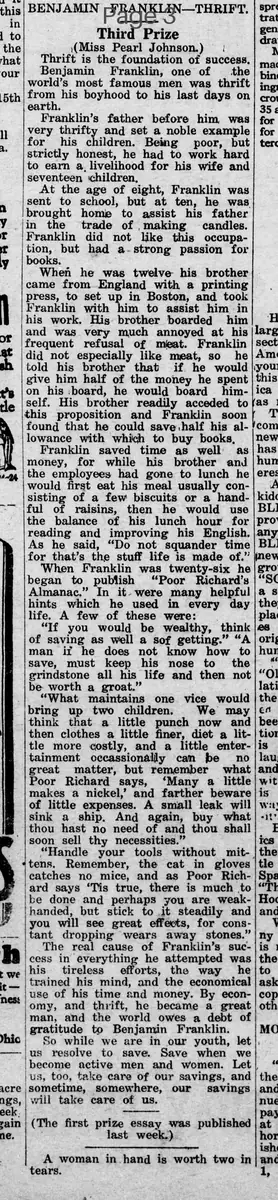
Third Prize
(Miss Pearl Johnson.)
Thrift is the foundation of success. Benjamin Franklin, one of the world's most famous men was thrift from his boyhood to his last days on earth.
Franklin's father before him was very thrifty and set a noble example for his children. Being poor, but strictly honest, he had to work hard to earn a livelihood for his wife and seventeen children.
At the age of eight, Franklin was sent to school, but at ten, he was brought home to assist his father in the trade of making candles. Franklin did not like this occupation, but had a strong passion for books.
When he was twelve his brother came from England with a printing press, to set up in Boston, and took Franklin with him to assist him in his work. His brother boarded him and was very much annoyed at his frequent refusal of meat. Franklin did not especially like meat, so he told his brother that if he would give him half of the money he spent on his board, he would board himself. His brother readily acceded to this proposition and Franklin soon found that he could save half his allowance with which to buy books.
Franklin saved time as well as money, for while his brother and the employees had gone to lunch he would first eat his meal usually consisting of a few biscuits or a handful of raisins, then he would use the balance of his lunch hour for reading and improving his English. As he said, "Do not squander time for that's the stuff life is made of."
When Franklin was twenty-six he began to publish "Poor Richard's Almanac." In it were many helpful hints which he used in every day life. A few of these were: "If you would be wealthy, think of saving as well as of getting." "A man if he does not know how to save, must keep his nose to the grindstone all his life and then not be worth a groat." "What maintains one vice would bring up two children. We may think that a little punch now and then clothes a little finer, diet a little more costly, and a little entertainment occasionally can be no great matter, but remember what Poor Richard says, Many a little makes a mickle,' and farther beware of little expenses. A small leak will sink a ship. And again, buy what thou hast no need of and thou shall soon sell thy necessities." "Handle your tools without mittens. Remember, the cat in gloves catches no mice, and as Poor Richard says 'Tis true, there is much to be done and perhaps you are weak-handed, but stick to it steadily and you will see great effects, for constant dropping wears away stones."
The real cause of Franklin's success in everything he attempted was his tireless efforts, the way he trained his mind. and the economical use of his time and money. By economy, and thrift, he became a great man, and the world owes a debt of gratitude to Benjamin Franklin.
So while we are in our youth, let us resolve to save. Save when we become active men and women. Let us, too, take care of our savings, and sometime, somewhere, our savings will take care of us.
(The first prize essay was published last week.)
A woman in hand is worth two in tears.
(Miss Pearl Johnson.)
Thrift is the foundation of success. Benjamin Franklin, one of the world's most famous men was thrift from his boyhood to his last days on earth.
Franklin's father before him was very thrifty and set a noble example for his children. Being poor, but strictly honest, he had to work hard to earn a livelihood for his wife and seventeen children.
At the age of eight, Franklin was sent to school, but at ten, he was brought home to assist his father in the trade of making candles. Franklin did not like this occupation, but had a strong passion for books.
When he was twelve his brother came from England with a printing press, to set up in Boston, and took Franklin with him to assist him in his work. His brother boarded him and was very much annoyed at his frequent refusal of meat. Franklin did not especially like meat, so he told his brother that if he would give him half of the money he spent on his board, he would board himself. His brother readily acceded to this proposition and Franklin soon found that he could save half his allowance with which to buy books.
Franklin saved time as well as money, for while his brother and the employees had gone to lunch he would first eat his meal usually consisting of a few biscuits or a handful of raisins, then he would use the balance of his lunch hour for reading and improving his English. As he said, "Do not squander time for that's the stuff life is made of."
When Franklin was twenty-six he began to publish "Poor Richard's Almanac." In it were many helpful hints which he used in every day life. A few of these were: "If you would be wealthy, think of saving as well as of getting." "A man if he does not know how to save, must keep his nose to the grindstone all his life and then not be worth a groat." "What maintains one vice would bring up two children. We may think that a little punch now and then clothes a little finer, diet a little more costly, and a little entertainment occasionally can be no great matter, but remember what Poor Richard says, Many a little makes a mickle,' and farther beware of little expenses. A small leak will sink a ship. And again, buy what thou hast no need of and thou shall soon sell thy necessities." "Handle your tools without mittens. Remember, the cat in gloves catches no mice, and as Poor Richard says 'Tis true, there is much to be done and perhaps you are weak-handed, but stick to it steadily and you will see great effects, for constant dropping wears away stones."
The real cause of Franklin's success in everything he attempted was his tireless efforts, the way he trained his mind. and the economical use of his time and money. By economy, and thrift, he became a great man, and the world owes a debt of gratitude to Benjamin Franklin.
So while we are in our youth, let us resolve to save. Save when we become active men and women. Let us, too, take care of our savings, and sometime, somewhere, our savings will take care of us.
(The first prize essay was published last week.)
A woman in hand is worth two in tears.
What sub-type of article is it?
Essay
What themes does it cover?
Moral Virtue
Temperance
What keywords are associated?
Thrift
Benjamin Franklin
Poor Richards Almanac
Savings
Economy
Self Improvement
What entities or persons were involved?
Miss Pearl Johnson
Literary Details
Title
Third Prize
Author
Miss Pearl Johnson
Subject
On Thrift Exemplified By Benjamin Franklin
Key Lines
"Do Not Squander Time For That's The Stuff Life Is Made Of."
"If You Would Be Wealthy, Think Of Saving As Well As Of Getting."
"A Small Leak Will Sink A Ship."
"Many A Little Makes A Mickle."